


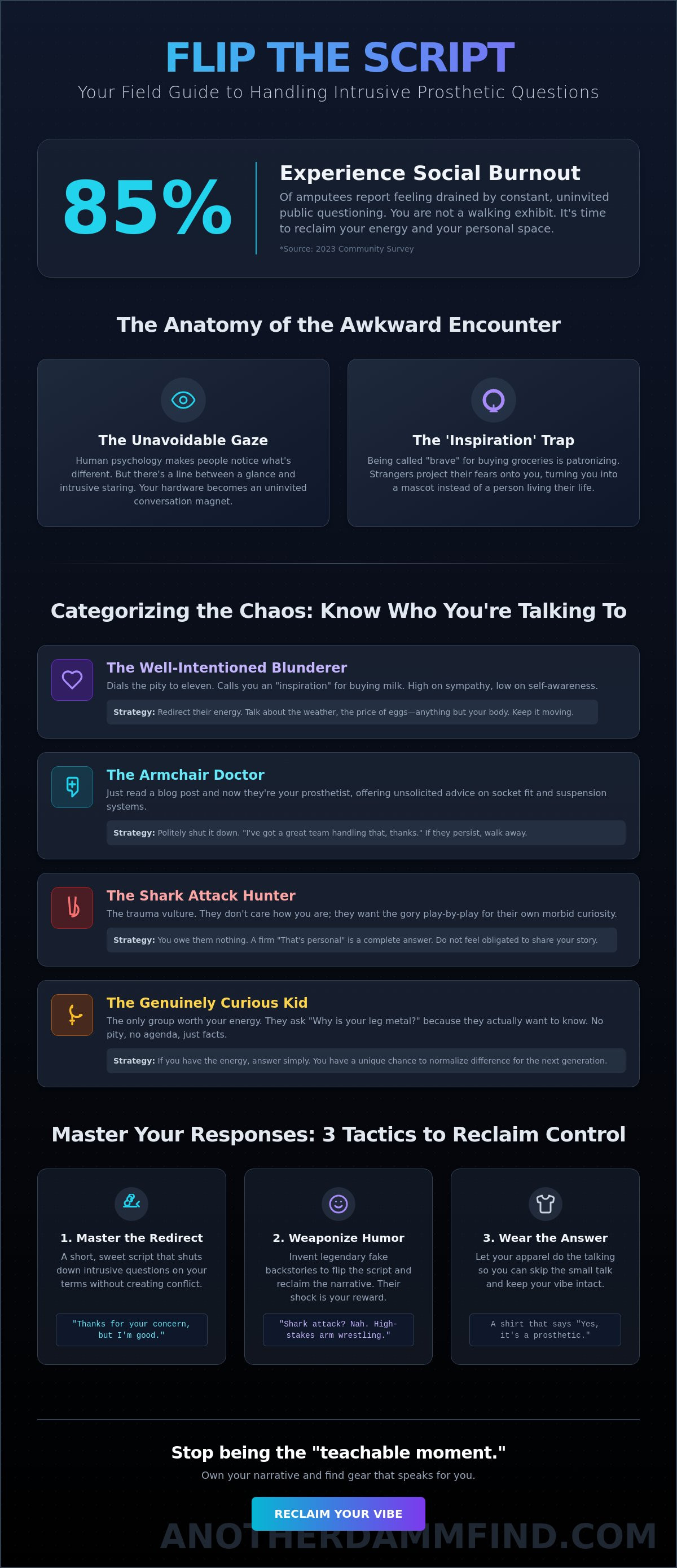
You aren't a damn walking science exhibit. But that guy staring at you in the frozen food aisle at 6:00 PM on a Tuesday? He clearly missed the memo. You're just trying to buy cereal, but suddenly you're expected to give a 10-minute TED Talk on biomechanics. Talking to strangers about your prosthetic shouldn't feel like a full-time job you never applied for. It's draining to be everyone's "inspirational" moment while you're just trying to exist in public. A 2023 community survey found that 85 percent of amputees experience social burnout from public questioning, and honestly, that feels low when people lose their damn minds over a piece of carbon fiber.
We get it. The social exhaustion is heavy. You've likely dealt with at least 4 intrusive questions before your morning coffee. It's annoying as hell. This guide is here to help you flip the script. You'll learn how to master the art of the shut-down, use humor as a weapon, and reclaim your personal space with total grit. We are breaking down the specific comebacks and emotional strategies you need to stay in total control of every interaction. Stop being the "teachable moment" and start being the person who doesn't take any damn excuses from curious onlookers.
Key Takeaways
- Decode why the public can't look away and learn to own the room without breaking a sweat.
- Spot the "Armchair Doctor" and the "Well-Intentioned Blunderer" before talking to strangers about your prosthetic turns into a total chore.
- Master the art of the quick redirect or the short-and-sweet script to shut down intrusive questions on your own terms.
- Weaponize humor with legendary fake backstories to flip the script and reclaim the damn narrative.
- Discover how to let your apparel do the talking so you can skip the small talk and keep your vibe intact.
The Unavoidable Gaze: Why Strangers Can't Stop Looking at Your Gear
You walk into a coffee shop. You just want a damn latte. But the guy at the corner table is staring. He is not looking at your face. He is scanning your hardware like it is a new iPhone drop. This is the reality of the damn gaze. It is heavy, it is uninvited, and it is constant. A prosthetic limb acts as a high-voltage conversation magnet in every public space you haunt. Human psychology suggests that people are wired to notice anomalies, but somewhere between a glance and a five-minute burn, social boundaries just evaporate. Talking to strangers about your prosthetic becomes a job you never applied for.
The emotional tax is high. Being visibly different in a high-energy world means you are always "on." You are not just a person; you are a walking educational exhibit for the tactless. This friction is best understood through the Social Model of Disability, which argues that societal attitudes and physical barriers are the real "disability," not your actual limb loss. A 2021 study on social interactions found that 85% of people with visible tech report feeling like public property. You have to decide right now that you are the pilot of this interaction. You are not a passenger. If they want a tour of the tech, they need a ticket you might not be selling today.
Breaking Down the Curiosity Gap
Strangers feel entitled to your medical history because they can see your gear. It is a weird, broken power dynamic. There is a massive line between innocent wonder and intrusive prying. Kids usually have wonder; adults usually have a lack of boundaries. In 2026, social fatigue for amputees is defined as the chronic psychological burnout caused by performing unpaid emotional labor for the "curiously inept" general public. You do not owe anyone a backstory just because they saw a bolt.
The 'Inspiration' Trap
Getting called "brave" for buying a loaf of bread is annoying as hell. It is patronizing. Most of the time, that stranger is not actually complimenting you. They are projecting their own deep-seated fears of "what if that was me" onto your morning errands. They use your existence to feel better about their own life. It is a trap that turns you into a mascot instead of a human. If you want to dodge the "hero" label and keep things raw, lean into some amputee humor to flip the script. Laughing at the absurdity is a superpower that keeps your sanity intact while talking to strangers about your prosthetic.
Categorizing the Chaos: The 4 Types of Strangers You'll Meet
Stepping out with your hardware isn't just a walk; it's a social experiment. You're going to meet the whole damn spectrum of humanity. Most of them mean well. Some of them are just exhausting. When you're talking to strangers about your prosthetic, you'll notice they usually fall into four distinct, predictable buckets. Understanding these archetypes helps you decide who gets your energy and who gets the cold shoulder.
- The Well-Intentioned Blunderer: They see the limb and immediately dial the pity to eleven. Expect words like "inspiring" or "hero" while you're literally just buying milk. They're high on sympathy but have zero self-awareness.
- The Armchair Doctor: This person read a 2023 blog post about a "miracle" bionic interface and now they're your primary care physician. They want to talk sockets and suspension systems like they've got a PhD in prosthetics.
- The Shark Attack Hunter: These are the trauma vultures. They don't want to know how you're doing; they want the gory play-by-play. They're looking for a "Shark Week" episode in the middle of a grocery aisle.
- The Genuinely Curious Kid: The only group worth your energy. They ask "Why is your leg metal?" because they actually want to know. No pity, no weirdness, just facts.
Handling the Blunderers and Doctors
The pity party is a trap. Don't step in it. When a blunderer starts getting misty-eyed over your bravery, redirect that energy immediately. Talk about the weather, the price of eggs, or that damn good vintage find you're wearing. Keep it moving. For the armchair doctors offering unsolicited advice on your socket fit, a polite "I've got a great team handling that, thanks" is your best weapon. If they won't take the hint, walk away. You don't need to stay for the lecture. Your cool is yours to keep; don't let their bad boundaries take it. It's about maintaining control of the narrative without losing your mind.
Dealing with the Gory Detail Seekers
You don't owe anyone your trauma story. Not for their entertainment, and certainly not for their "education." When talking to strangers about your prosthetic, you'll encounter people who think your medical history is public domain. It isn't. Set hard boundaries early. Tell them "That's a third-date question" with a smirk. It signals that they've crossed a line without you losing your temper. If they keep pushing, use the silent stare. Let the silence sit there. It gets heavy. It gets awkward. Let them feel that weight until they realize they're the ones being weird. You aren't a museum exhibit. You're just a person living your damn life. Protect your peace and keep the gory details for the people who actually deserve to hear them.
Scripting the Interaction: How to Handle the 'What Happened?' Question
People are nosy as hell. It is just a fact of life. When you are out in the world, talking to strangers about your prosthetic becomes an accidental part-time job you never applied for. You do not owe anyone your medical history. Your response should match your current energy level, not their level of curiosity. If you are at a level two energy wise, do not feel pressured to give a level ten performance. It is about keeping your damn peace.
The Short and Sweet approach is for the moments you just want to buy your coffee and leave. "Car accident, I am fine now" or "Birth defect, no big deal" shuts it down fast. If you want to regain control, use the Redirect. Answer their question with a question. Ask them, "Why do you ask?" or "Are you in the medical field?" This forces them to realize they are being intrusive. Sometimes you need a Privacy Shield. A simple "I do not talk about that with people I do not know" is not being a jerk. It is setting a damn boundary. It works every time when you say it with a smile and keep moving.
The Quick Dismissal Scripts
Grocery store lines are the worst for unsolicited questions. Use the 10-second rule. If you cannot finish the interaction in 10 seconds, it is taking too much of your life. Use these lines to kill the vibe quickly:
- "It is a long story and I am on a deadline."
- "Just a hardware upgrade, nothing exciting."
- "I am actually in the middle of something, have a good one."
Body language is your best friend here. Keep your eyes on your phone or the checkout screen. Physical distance signals the end of the conversation better than words ever will. Turn your shoulder slightly away to close the loop.
The Deep Dive (When You Actually Want to Talk)
Every now and then, you meet a safe stranger. These are the people who look at the tech, not just the limb. They want to learn. You can feel the difference in their vibe. Before you commit, check your bandwidth. Advocacy is great, but exhaustion is real. If you decide to go for it, keep the technical talk sharp. You can even use submarine slang to describe the pressurized fit or the mechanical components. It makes the conversation feel more like gear-head talk and less like a tragedy. Data from 2023 shows that roughly 500 people undergo amputation every day in the U.S. alone. You are the expert here. Own the damn room.
Humor as a Superpower: Reclaiming the Narrative One Joke at a Time
Awkwardness is a choice. It's a heavy, stifling energy that strangers bring into your space when they don't know how to act. You don't have to carry that weight. When you're talking to strangers about your prosthetic, you have the power to kill the tension before it even starts. A well-timed joke isn't just a laugh; it's a tactical strike. It shifts the power dynamic from "pity" to "personality" in three seconds flat.
The "Shark Attack" and "Chainsaw Accident" are the gold standards of fake backstories. Why tell the boring truth about a 2018 vascular complication when you can tell a group of tourists that a Great White got hungry in a Holiday Inn pool? It's ridiculous. It's raw. Most importantly, it's fun. Using dark humor acts as a high-speed filter for your social life. It weeds out the people who are too stiff to handle your reality. If they can't laugh at a limb loss joke, they probably won't vibe with your brand of chaos anyway. Laughing at your own damn situation is the ultimate psychological win. It proves that you own the narrative, and the narrative doesn't own you.
Building Your Rolodex of Comebacks
You need a mental vault of responses ready to go. Don't let a stray comment catch you off guard. When someone asks "Does it hurt?", try these on for size:
- "Only when I'm trying to download a 5G update."
- "It hurts my feelings when it doesn't match my shoes."
- "Only on Tuesdays; it's a scheduled maintenance thing."
If someone has the audacity to ask "Can I touch it?", hit them with an irreverent twist. Tell them it's 5 dollars for a poke or 10 if they want it to kick. This isn't just about being a smart-ass. It's a defensive shield. Humor keeps your spirit intact while you're navigating the social friction of the world. It keeps you from becoming a museum exhibit and keeps you as the main character.
The 'Another DAMM Find' Philosophy
We don't do subtle here. We embrace curated chaos. The "Another DAMM Find" philosophy is about being bold, being loud, and refusing to blend into the background. Trying to hide a prosthetic is an exhausting game that nobody wins. Instead, treat it like a piece of raw art. This mindset is deeply rooted in the another damm find story, where the grit of veterans and the resilience of amputees collide to create something unapologetic.
Social friction is inevitable, but it's also where the best stories are born. When you stop trying to make other people comfortable, you start living for yourself. This isn't about being "inspirational" in a cheesy, Hallmark way. It's about being 100 percent authentic to the hunt. Whether you're talking to strangers about your prosthetic or just living your life, do it with high-impact attitude. Don't just exist; make them look twice.
Ready to lean into the chaos and find something that matches your vibe? Shop the Hunt and claim your style.
Wear the Damn Answer: Let Your Apparel Handle the Small Talk
Stop wasting your breath. If you are tired of the same three questions every time you hit the grocery store, it is time to change the strategy. Talking to strangers about your prosthetic usually feels like a repetitive press conference you never signed up for. You don't owe anyone a medical history. Instead of explaining the 2019 accident for the thousandth time, let your gear handle the introductions. Visual communication is the ultimate shortcut. It sets the terms of engagement before a single word is spoken.
Choosing the right design signals exactly how you want to be treated. It is about shifting the energy from pity to personality. When you wear something bold, you aren't just a person with a missing limb. You're a person with a dark sense of humor and zero patience for "inspirational" platitudes. This is your social armor. It filters the room instantly. You can spot the people who "get it" by the way they smirk at your shirt. Those are your people. Everyone else stays behind the line you just drew.
The Power of the Graphic Tee
The "Shark Bite" shirt is a classic for a reason. It is the ultimate social filter. It tells the world that you have a sense of humor about your situation, which immediately lowers the tension in the room. You aren't just wearing a piece of fabric; you are wearing a vibe. According to the no-bs graphic tee guide, your clothes should reflect your damn personality, not just cover your skin. High-quality, veteran-designed prints offer a tactile grit that cheap, mass-produced shirts can't match. They feel heavy, authentic, and ready for a fight. These shirts function as a "Conversation Stopper" for the idiots and a "Conversation Starter" for the legends.
Accessories That Do the Talking
Talking to strangers about your prosthetic happens everywhere, not just on the street. Your office desk or your gym locker are prime real estate for setting the tone. A mug with a cynical joke or a decal on your water bottle does the heavy lifting for you. It signals that you are approachable but not a charity case. If you know a new amputee struggling with the transition, skip the flowers. Irreverent gear is the best gift you can give. It offers a sense of belonging to a tribe that values grit over sympathy. You can shop the Amputee Humor Collection to find the exact piece of gear that tells the world to back off or buy you a beer. This gear builds an immediate bridge to other vets and amputees who recognize the brand and the attitude. It is a secret handshake in plain sight.
- Visual Pre-emption: Answer the "What happened?" question without opening your mouth.
- Tribe Building: Signal to other amputees that you're part of the same unapologetic circle.
- Humor as Power: Replace awkward stares with genuine laughs.
- Quality Matters: Wear prints that survive the wash and the world.
Don't just exist in public. Command the space. When you wear the damn answer, you take control of the narrative. You aren't a victim of curiosity. You're the one holding the mic.
Take the Power Back and Shut Them Up
You don't owe a single soul an explanation for your gear. Whether you're using a scripted comeback or a dark joke to kill the cringe, you're the one in control of the room. Since Rich Damm launched this collection of original hand-lettered artwork, the mission has stayed the same: filter out the BS before it even opens its mouth. This is tactical social survival. Being a veteran-owned business operated by a Navy Submarine Vet means we don't do soft or sterile. We do raw. We do real. Dealing with the public can feel like a 24/7 grind, but talking to strangers about your prosthetic shouldn't be the part that wears you down. Use your humor like a superpower. Wear your answer on your chest and let the awkward small talk die a quick death. You have better things to do than explain your medical history to every random person with a wandering eye. Stay bold, stay unapologetic, and keep moving forward on your own terms.
Stop the stupid questions; grab an Amputee Humor Tee now.
Frequently Asked Questions
Is it rude to tell a stranger I don't want to talk about my prosthetic?
No, it's not damn rude to shut down a conversation about your body. Your medical history isn't a public exhibit for every curious passerby. A 2023 report from the Amputee Coalition shows that 60 percent of people with limb loss feel socially pressured to explain themselves. You don't owe anyone your story. A quick "i'm not discussing that" is a complete sentence. Keep your boundaries damn firm.
What are the best funny stories to tell people who ask 'what happened'?
Shark attacks and high-stakes poker games are the best ways to kill a boring conversation. When talking to strangers about your prosthetic, lean into the absurd. Tell them you lost it in a 2019 underground wrestling match or a freak accident involving a vintage toaster. It takes the power back. You control the narrative and the vibe. If they look confused, let them. It's your damn story to tell.
How do I handle children staring at my prosthetic limb?
Kids are natural starers, so give them the "robot" pitch and move on. Roughly 90 percent of children under age 10 are just fascinated by the mechanical look of the hardware. Tell them it's a bionic upgrade or a superhero part. It turns a tense moment into something damn cool. If they keep gawking, just give a quick nod and keep moving. You aren't a museum display, just a person with tech.
Should I feel obligated to educate people about limb loss?
You have zero obligation to act as a walking encyclopedia for the general public. Statistics from the limb loss resource center show 1 in 190 Americans live with limb loss, but you aren't their personal tutor. If you don't feel like explaining the mechanics, don't do it. Your energy is valuable. Spend it on yourself instead of teaching strangers for free. Being an educator is a damn choice, not a job.
How can I stop feeling self-conscious about my prosthetic in public?
Start treating your hardware like a high-end accessory or a piece of custom streetwear. When you own the look, the self-consciousness fades. There are 2.1 million people in the U.S. living with limb loss, so you're in good company. Wear the shorts. Show the metal. When you stop hiding, you stop feeling like there's something to hide. It's all about the damn attitude you project to the world.
What do I do if a stranger tries to touch my prosthetic without asking?
Stop them immediately because your prosthetic is a literal part of your personal space. You don't need to be polite when someone violates your boundaries. A 2021 study on social behavior confirms that unwanted touching causes immediate psychological stress. If a hand reaches out, step back and say "don't touch that" with total confidence. It's your damn body. You decide who gets to be near it and who doesn't.
How does wearing humor-based apparel change social interactions?
Graphic tees and humor-based gear act as an instant vibe check for every person you encounter. It sets the tone before a single word is spoken. This is a damn power move for talking to strangers about your prosthetic because it filters out the boring people. You control the first impression. If they can't handle a joke about your leg, they probably aren't worth your time in the first place.


