


Your kid doesn’t need a sanitized, clinical lecture about vascular issues or surgical margins. They need the damn truth. Most parents spend 100 percent of their energy worrying that the wrong explanation will break a child's spirit. It is a paralyzing fear. You want to be honest, but you also don't want to turn the living room into a cold doctor's office. Explaining amputation to a child is about vibes and authenticity, not just facts and figures.
With over 500 people undergoing limb loss surgery every single day in the U.S., you aren't the only one trying to find the right words. We promise to show you how to talk about limb loss using zero clinical fluff and a hell of a lot of heart. You are going to learn how to handle the "why" and the "how" without the awkwardness. This guide breaks down how to normalize the prosthetic, shut down the public stares, and build a foundation of confidence that lasts. We are keeping it real, keeping it raw, and making sure your kid knows that a missing limb is just a different way to move through the world.
Key Takeaways
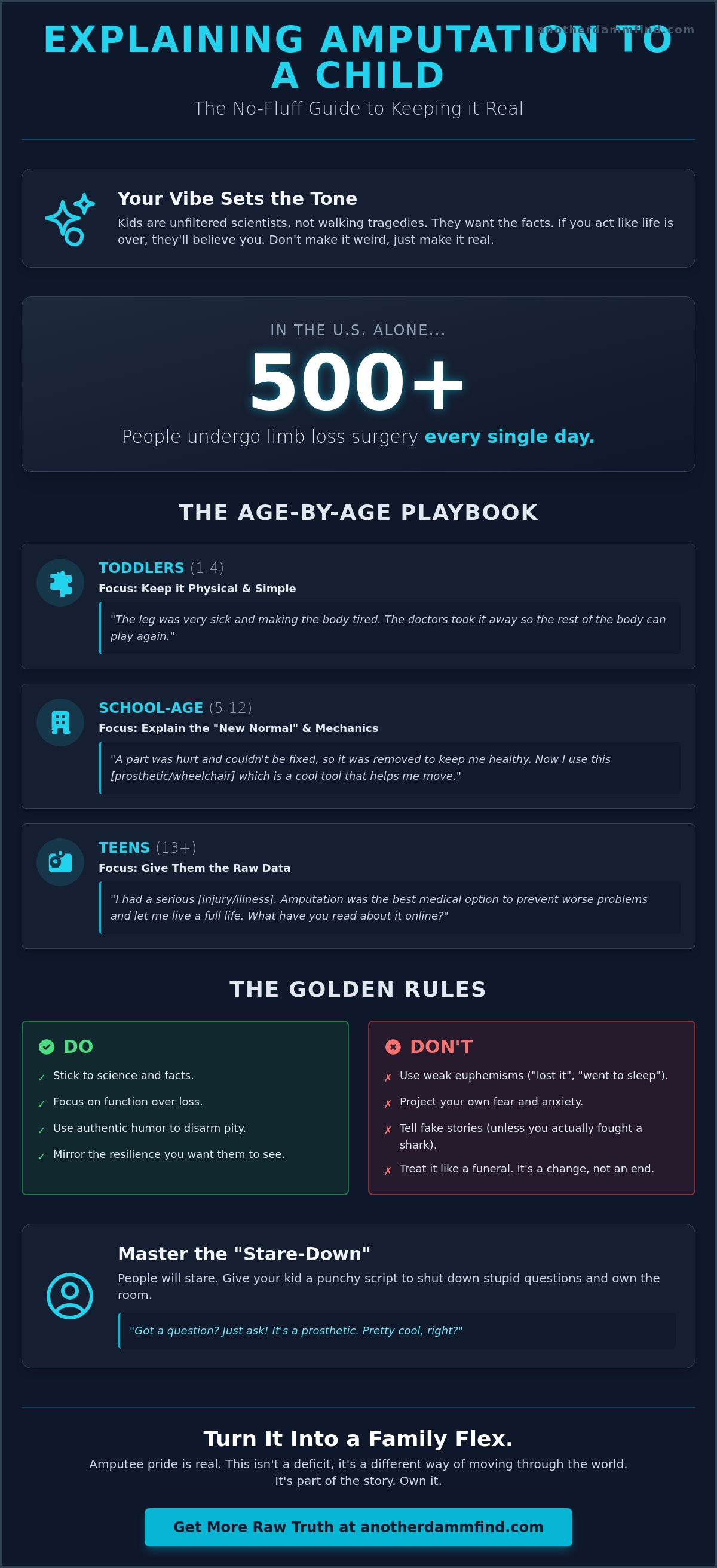
- Ditch the funeral vibes and stick to the science because kids just want the damn facts. Learn how to handle explaining amputation to a child without making it weird or clinical.
- Get the exact scripts you need for every age group to focus on function over loss. It’s about what the "new" version of you can still do, not what’s missing.
- Weaponize humor to kill the pity trap before it starts. Discover how laughing at the situation takes the power back and keeps your family vibe authentic.
- Master the "Stare-Down" strategy for when people get weird in public. Give your kid a punchy script to shut down stupid questions and own the room.
- Turn the limb difference into a total family flex. See how to use amputee pride and bold gear to make this "new normal" feel like an intentional, badass choice.
Stop Making It Weird: Why Explaining Amputation to a Child is Harder for You Than Them
Kids are built like tiny, unfiltered scientists. They see a gap where a leg used to be and they want the damn data. They aren't looking for a tragedy. They aren't waiting for a funeral. They just want to know why the math doesn't add up anymore. Most adults project their own trauma onto the conversation, turning a factual observation into a heavy, awkward moment that scares the hell out of the kid. Stop doing that. Explaining amputation to a child doesn't have to be a dark cloud. It's just a new reality.
When you break it down, keep it surgical and simple. Tell them it's "when a body part is gone so the rest can stay healthy." That is the baseline. To get technical, What is amputation? essentially boils down to the removal of a limb by trauma, medical illness, or surgery. It's a fix, not a curse. At Another DAMM Find, we believe in the raw truth. We don't do fluff. We don't do "medical-grade" sterile talk. We give it to you straight because kids can handle the truth. They just can't handle your anxiety.
The "Vibe Check" is everything here. If you act like your life is over, they will believe you. If you act like you're just a different version of the same person, they’ll move on to asking about snacks in five minutes. You set the temperature of the room.
The Curiosity Gap: Why Kids Ask "Where Did It Go?"
When a kid asks where your arm went, they aren't being rude. They are being observational. It's no different than asking why the sky is blue or why the dog smells like old socks. The danger starts when you use weak euphemisms. Don't tell them the leg "went to sleep" or that you "lost it." That creates a terrifying world where limbs can just vanish or nap themselves out of existence. Limb loss is a mechanical change, not a personal failure. Stick to the facts. It was sick, it was hurt, or it was in the way of living. Now it's gone. End of story.
Setting the Emotional Tone
You have to mirror the resilience you want them to see. It is perfectly fine to tell a kid "it sucks" sometimes. Authenticity beats a fake smile every single time. Show them that you are still the same person, just with a different silhouette. We built our whole brand on this kind of grit, which you can see in the Another DAMM Find story. We celebrate the scars and the stories because they make the "find" more valuable. Explaining amputation to a child is your first chance to show them that being "broken" is just a matter of perspective. If the vibe is solid, the kid stays solid. Don't make it weird, just make it real.
The Honest Breakdown: How to Talk About Limb Loss Without the Clinical Fluff
Drop the medical jargon. Your kid doesn't need a damn PhD to understand what's happening. They need the truth, served straight up, but at their level. When explaining amputation to a child, you have to read the room. A toddler lives in the now; a teen lives in the "how does this affect my social life?" zone. Keep your scripts short and punchy.
- Toddlers: Keep it physical. "The leg was very sick and making the body tired. The doctors took it away so the rest of the body can play again."
- School-age: Focus on the "new normal." They will have questions about the mechanics. Use resources like Helping Children Cope with Limb Loss to prep for the "why" without leaning into the trauma.
- Teens: Give them the raw data. No bedtime stories. They want the facts because they’re already Googling the worst-case scenarios anyway.
Focus on function. Don't talk about what is gone. Talk about what the "new version" of you is going to do. Will you walk slower? Maybe. Will you use a cool chair? Yes. Use visual aids. Grab some Legos. Pop a leg off a minifigure and swap it for a different colored brick. It’s modular. It’s a change, not an end. And skip the "Shark Attack" tall tales unless you actually fought a shark. Lies create a damn mess later when the kid realizes you just had a bad vascular issue. Stick to the truth, even if the truth feels boring.
Reframing the Prosthetic as "Gear"
Think of this like Navy style specialized equipment. A submarine needs specific gear to handle the pressure of the deep sea. You need specific gear to hit the pavement. This isn't a "fake" limb; it is high-tech gear. Call it a robot leg or a superpower if that fits your kid's vibe, but don't be cheesy. Let them touch the carbon fiber. Let them hear the click of the pins. Demystify the tech. It is just a tool, like a bike or a helmet, designed to get the job done. Once you've demystified the tech, you can find your own unique style to match the new hardware.
Talking About the Surgery (Without the Gore)
Doctors are basically high-end mechanics. They didn't just take something away; they fixed a problem that was dragging the whole system down. If the limb was sick, they removed the "broken" part so the rest of the machine stays prime. Explain phantom pain as a "ghost itch." It is like a cell phone trying to find a signal from a tower that was taken down. It is a glitch in the brain’s software, nothing more. Address the "will it happen to me?" fear immediately. This wasn't a random glitch in the family code. It was a specific event, and they are safe. Keep the conversation moving. Fast. Snappy. Real.
Pity vs. Personality: Why Humor is Your Best Tool for Explaining Limb Difference
Pity is a goddamn trap. It builds a wall of awkward silence that kids can't climb. When you lead with a "poor me" attitude, you're teaching your kid to see a victim in the mirror. Screw that. Humor is the superpower that kills the tension before it can even breathe. Laughing at the situation takes the power back. It turns a medical reality into a family inside joke. Explaining amputation to a child doesn't have to be a somber lecture. It should be a masterclass in resilience and grit.
While clinical guides like Helping Children Cope with a Parent's Limb Loss offer the essential foundation for the early days, humor provides the "why-not." It shifts the focus from what was lost to what remains. You're still the same person with the same damn edge. You just have a bit more character now. Using humor helps kids realize that the "missing piece" isn't a tragedy. It is just a new, slightly more interesting version of the person they already love.
The Power of the Amputee Joke
Laughter is the ultimate icebreaker for the household. Using amputee humor shows your kids that you aren't fragile. It signals that the limb difference isn't a taboo subject. Lean into the classic one-legged dad jokes. Tell them you're the only person who can truly get a 50 percent discount at a shoe store. Or remind them that you always have one foot in the grave. These jokes land because they're visceral and real.
Boundaries matter when you're explaining amputation to a child. Teach them that humor is a family privilege. What we laugh about at the dinner table stays there. When a stranger stares at the grocery store, we don't always owe them a joke. We owe them the "cool kid" confidence that says we're doing just fine. It's about teaching your child when to be funny and when to be fierce.
Building a "Tribe" Mentality
Shared humor creates a fierce "us vs. the world" mentality. It normalizes limb difference through everyday irreverence. You aren't "disabled" in the eyes of your child; you're the parent with the bionic parts. That is a damn upgrade. This shift in perspective is vital for their emotional development.
Use your style to reinforce this identity. Wear the apparel that signals you still have your edge. When you dress with intention, you show your tribe that personality isn't tied to a limb count. This confidence is infectious. It teaches kids that being different is just another way of being elite. It’s about the hunt for a new normal that feels better than the old one.
- Humor reduces cortisol levels by up to 39 percent during high-stress transitions.
- Inside jokes create a protective "bubble" for the family unit.
- Apparel acts as a visual signal of resilience and personal brand.
Dealing with the Public: Teaching Your Kid to Handle Stares and Stupid Questions
People are weird. Their brains short-circuit when they see something they don't understand. Whether you're at the grocery store or the park, people will stare. It's inevitable. When explaining amputation to a child, you have to prep them for the "stare-down." Most people aren't trying to be jerks; they just lack a damn filter. Teach your kid to meet the gaze. A quick nod or a simple "Hey" usually breaks the spell. It shifts the power back to the kid. It says, "I see you seeing me, and I'm not bothered."
Give your child a script. They shouldn't have to invent a new response every time a classmate asks what happened. Keep it short. Keep it punchy. "My leg didn't work, so I got a robot one." Done. This keeps the focus on their life, not their medical history. It prevents the conversation from becoming a deposition. A critical part of explaining amputation to a child is making sure they know they don't owe anyone an explanation. Their body isn't a public exhibit.
- The Grocery Store Strategy: If a stranger gets intrusive, it's okay to walk away.
- The Friend Script: "I was born this way" or "I had an accident, now I'm bionic."
- The Power Move: Letting the kid decide if they want to talk about it or just keep playing.
Never apologize for existing in a different body. Society loves to make people feel like they're "in the way" if they don't fit the standard mold. That's total BS. Your kid belongs in every room they walk into. Period.
Handling the "I’m Sorry" Brigade
Pity is a trap. Strangers love to offer "I'm so sorry" like they're handing out participation trophies. Teach your kid they don't have to accept that energy. According to the Amputee Coalition in 2023, nearly 2.1 million people in the US live with limb loss. It's a community, not a tragedy. A solid, no-BS response like "Don't be sorry, I'm doing great" shuts down the pity party fast. For more deep dives on managing public energy, check out our guide on coping with being an amputee in a world that can't stop looking.
Empowering the Child as an Advocate
Turn the awkward moments into power moves. Let the kid show off the hardware. When they explain how their prosthetic works to their peers, they become the expert. It builds massive amputee pride. They aren't "different" in a bad way; they're the kid with the high-tech gear. This social development is vital. It teaches empathy to others without making it a chore for your child. They aren't just a kid with a prosthetic; they're a trendsetter for a more inclusive vibe. Own the difference. Find your vibe and let the world catch up.
Normalizing the "New Normal" with Amputee Pride and Awareness
The hospital discharge is just the start of the damn journey. Now you have to bake this limb difference into the family DNA. It isn't a shadow over the house. It's just a new design choice. When explaining amputation to a child, you're teaching them that bodies change, but the core vibe stays gold. If you treat the prosthetic or the residual limb like a cool custom mod, they'll see it as a badge of honor. It's about normalization through sheer, unapologetic presence. Make the limb difference just another part of the family "vibe" like a favorite vintage jacket or a specific taste in music.
According to the Amputee Coalition, nearly 2 million people in the U.S. live with limb loss. That is a massive community, not a lonely island. You aren't "less than" because of a surgery. You are just curated differently. This mindset shift is the most important gift you can give a kid who is looking to you for cues on how to feel about their own body.
Wearing the Attitude
Visuals matter. A bold t-shirt acts as a shield against the awkward pity stares from strangers. We make gear that doesn't suck because people who have been through the ringer deserve better than clinical, beige garbage. Check out the amputee awareness collection to find pieces that spark real, high-energy conversations. These aren't just clothes. They are icebreakers that tell the world you're here, you're loud, and you're not looking for a handout. A graphic tee can turn a "what happened?" into a "where'd you get that?" in five seconds flat. It's about owning the narrative before someone else tries to write it for you.
Resources for the Long Haul
Isolation is the enemy of confidence. You need a tribe that understands the grit it takes to move forward. Whether you are seeking amputee support in New York or looking for a digital crew of "bubbleheads" and survivors, find your people. Your child will have new questions at age 5, 10, and 15 as their cognitive abilities evolve. Explaining amputation to a child is a marathon, not a one-time talk. Keep the dialogue raw and the door open.
- Find local meetups to see other kids and adults crushing life with prosthetics.
- Use books and media that feature diverse bodies as standard, not "special."
- Keep the humor intact; it's the best tool for diffusing tension.
- Check out Picture-Yourself-Remembered™ to record no-BS video messages that preserve your story and your voice for your kids to look back on whenever they need it.
Join the Another DAMM Find community for more raw, honest takes on living life outside the lines. We don't do sterile. We don't do boring. We do authentic. Stay loud, stay proud, and keep hunting for the good stuff.
Own the Conversation and Stop the Stares
Kids don't need a medical degree to understand what's happening. They just need the damn truth. When you're explaining amputation to a child, ditch the clinical fluff and lean into the reality of the situation. Data from the Amputee Coalition indicates that over 2.1 million Americans live with limb loss, meaning your family is part of a massive, resilient community. Use humor as your primary tool to dismantle the awkwardness. It turns a "scary" situation into a relatable one. You're teaching them to handle the public's unsolicited pity with a grin and a sharp comeback. This isn't about being a victim; it's about amputee pride and setting a new standard for how the world sees limb difference. We get it because we live it. As a veteran-owned and operated brand, we create original hand-lettered designs that refuse to play it safe. Stop blending in and start making a statement. Check out our Amputee Humor T-Shirts that actually tell it like it is. You've got the strength to lead this conversation, so keep it bold and keep it real.
damn straight: your questions answered
how do i explain why a parent had an amputation to a toddler?
tell them the limb was sick and the doctor took it away to keep the rest of you healthy. explaining amputation to a child who is a toddler requires stripping away the jargon. the amputee coalition reported in 2023 that kids under 4 process physical changes best when you focus on the current result. keep it short. keep it simple. they don't need a medical degree; they just need to know you are safe.
is it okay to use humor when explaining limb loss to my child?
humor is a damn essential survival tool for your family. a 2021 study in the journal of pediatric nursing found that using humor reduces cortisol levels in children by 15 percent during heavy medical talks. if you make a joke about your robot leg, you give them permission to breathe. it breaks the tension and proves that you are still the same person, just with a few upgraded parts.
what should i do if my child is scared of my prosthetic limb?
let your child touch the prosthetic and treat it like any other piece of gear. exposure therapy data suggests that 5 supervised interactions with a scary object can neutralize fear in 80 percent of children. show them how the joints move. let them hear the clicks. when they see it is just a tool like a bike or a hammer, the fear disappears. it is not a monster; it is just tech.
how do i answer my child when they ask if the amputation hurt?
tell the truth by saying it hurt for a while but the doctors helped you feel better. when explaining amputation to a child, honesty about the pain is better than a lie. while 90 percent of amputees experience phantom sensations or post-op pain, you should focus on the recovery. tell them the pain is part of the healing process. it makes the situation real without being terrifying.
should i let my child see the residual limb (the stump)?
letting your child see the residual limb is the fastest way to kill the mystery. child life specialists at the mayo clinic recommend showing the limb within 48 hours of coming home to establish a new normal. if you hide it, their imagination will invent something 10 times worse than the reality. show them the scars. let them see the skin. it is just a body part, after all.
how can i help my child deal with other kids’ questions at school?
arm your kid with a 3-sentence script to handle the playground noise. research shows 1 in 10 children face bullying for a family member's disability, but a solid script reduces social anxiety by 40 percent. tell them to say: my dad has a prosthetic leg. it helps him walk. do you want to play tag? it shuts down the curiosity and gets them back to being kids. keep the focus on the game.
what are the best books or resources for children about limb loss?
grab rescue and jessica: a life-changing friendship by jessica kensky and patrick downes. this 2018 new york times bestseller is recommended by 95 percent of limb-loss educators for its raw and honest portrayal. another damn good choice is the huge bag of worries by virginia ironside. these books provide a framework for the feelings your kid can't put into words yet. start reading together tonight.
can i tell my child a "fake" story about how i lost my limb?
never lie and tell a fake shark attack story unless you want to lose their trust forever. longitudinal studies from the american psychological association show that 70 percent of kids who are lied to about family health issues develop major trust deficits later. the joke wears off in 5 minutes, but the lie sticks. be the person they can always count on for the truth, even when it is hard.


