


Losing a limb isn't some sanitized "brave journey"; it’s a chaotic, high-stakes gear swap you never signed up for. Most medical pamphlets treat you like a fragile glass vase, but you’re actually just a person trying to figure out why a foot that isn't there still itches at 3:15 AM. You're likely searching for a life as a new amputee blog that doesn't smell like a sterile hospital lobby. We get it. The logistics of a prosthetic socket are a damn nightmare, and the 80% of amputees who deal with phantom limb pain know it feels like a cruel, invisible joke. It’s exhausting, it’s loud, and it’s okay to be cynical about the whole thing.
This is your raw survival guide for the first 365 days of your new normal. We’re ditching the "inspirational" fluff to give you the real tactics for daily living. You’ll learn how to handle the awkward stares from strangers, the technical grind of limb care, and the art of the perfect comeback. We’re here to validate the frustration and find the humor in the damn absurdity of it all. It’s time to stop just "coping" and start owning the hunt for your new vibe. Welcome to the community where the truth is high-impact and the attitude is even higher.
Key Takeaways
- Navigate the messy, loud reality of the first 90 days without losing your damn mind during the hospital-to-home transition.
- Master the hardware grind by focusing on the only thing that actually matters: a perfect damn socket fit and a skin care ritual that keeps you mobile.
- Learn how to handle the grocery store paparazzi and "inspiration porn" comments with the right mix of grit and shut-down comebacks.
- Discover why dark humor is the fastest way to heal and how to find a "one-legged" tribe that skips the damn pity party.
- Use this life as a new amputee blog to source gear that looks better than hospital beige and find resources that actually fit your vibe.
The First 90 Days: Navigating the "Wait, What?" Phase
The first 90 days are a damn blur. You wake up, and the world is different. It’s loud. It’s clinical. It’s messy. You’re dealing with surgeons, nurses, and physical therapists who all want something from you. This is the "Wait, What?" phase. It’s the period where you realize that What is Amputation? isn't just a medical definition anymore; it's your daily reality. This life as a new amputee blog isn't here to sugarcoat the transition. It's here to tell you that feeling confused is the only sane reaction to a world turned upside down.
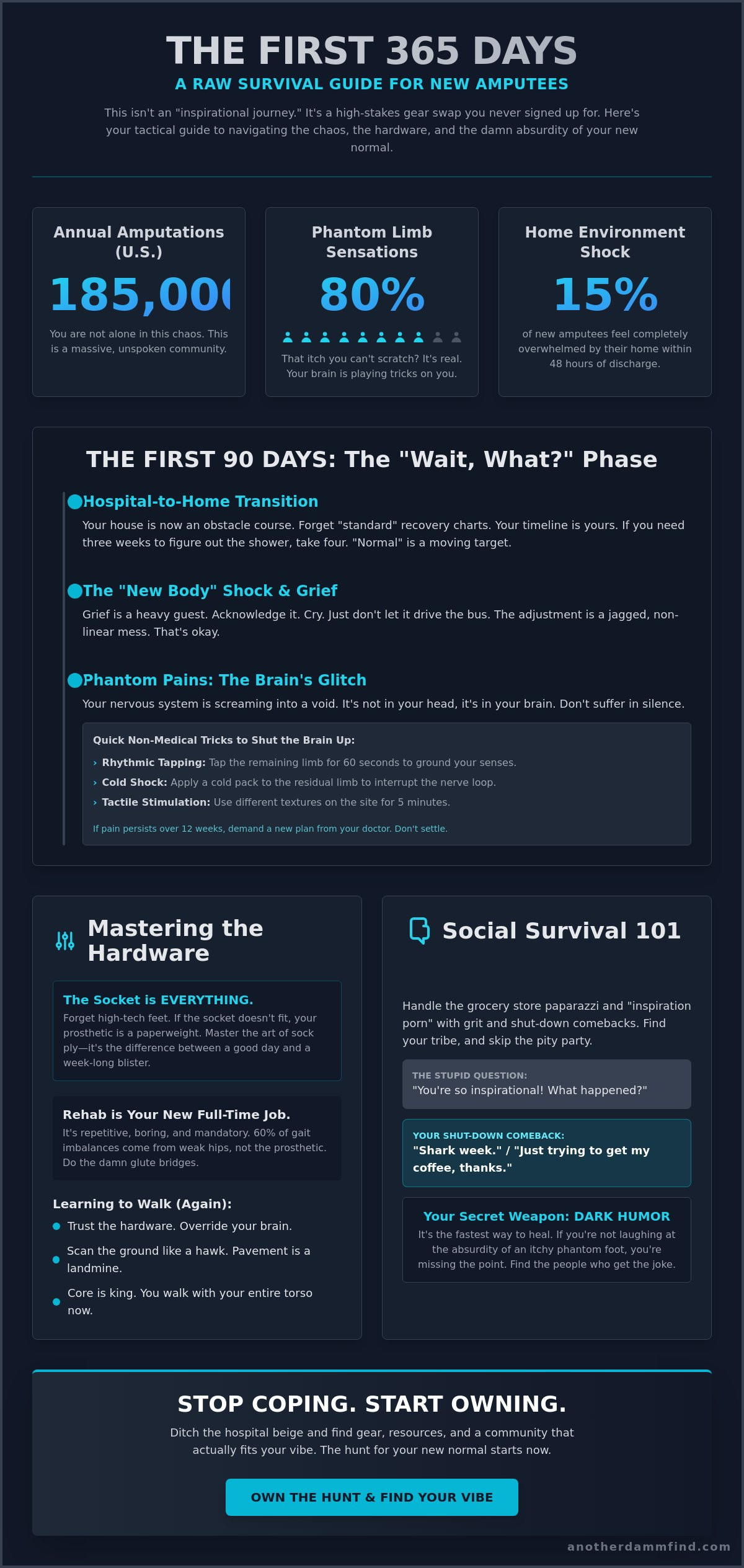
Coming home is a trip. Your house feels like a damn obstacle course. Data shows that 15 percent of new amputees report feeling completely overwhelmed by their home environment within the first 48 hours of discharge. Your timeline is yours alone. Forget the "standard" recovery charts you see in the hospital lobby. If you need three weeks to figure out how to shower without a meltdown, take four. "Normal" is a moving target. It changes every damn day. You aren't "recovering" back to an old version of yourself. You are building something new from the ground up, and that takes as long as it takes.
The Mental Fog and the "New Body" Shock
Grief is a heavy guest. It sits on your chest and refuses to leave. Acknowledge it. Cry if you have to. Just don't let it drive the damn bus. When the "why me?" moments hit, remember that 185,000 amputations happen in the U.S. every year. You aren't alone in this chaos. The adjustment period is a jagged, non-linear mess that refuses to follow a schedule.
Phantom Pains: The Brain Playing Tricks
Phantom pain is real. It feels like an itch you can’t scratch or a bolt of electricity in a limb that isn't there. Your brain is just confused. It’s trying to find a signal that’s gone. It's a glitch in the hardware. This life as a new amputee blog is about the raw truth: it hurts, and it's frustrating as hell. Your nervous system is basically screaming into a void.
Try these non-medical tricks to shut the brain up:
- Tap the remaining limb in a rhythmic pattern for 60 seconds to ground your senses.
- Apply a cold pack to the residual limb to shock the nerves out of their loop.
- Engage in 5 minutes of focused tactile stimulation on the site using different textures.
If the mirror box feels like a joke, tell your doctor. 80 percent of amputees experience phantom sensations, but you don't have to suffer in silence. If the pain persists for more than 12 weeks without relief, demand a new plan. Don't settle for the "it's just part of it" excuse. You're the one living in your body, so you're the one who calls the shots on what's acceptable.
Mastering the Hardware: The Grind of Prosthetic Life
The socket is the most important damn thing you will ever care about. Forget the high-tech carbon fiber feet or the microprocessors for a second. If that socket doesn't fit, your expensive hardware is just a heavy paperweight. Finding a real-talk life as a new amputee blog that tells you the truth is rare, so here it is: your stump is going to change. It shrinks. It swells. It reacts to the weather and your salt intake. You have to master the art of the sock ply. Adding or removing a thin layer of wool can be the difference between a productive day and a blister that benched you for a week.
Rehab is your new full-time job. It is repetitive. It is boring. It is absolutely mandatory. Data from clinical studies suggests that nearly 60 percent of gait imbalances in new amputees stem from weak hip stabilizers rather than the prosthetic itself. If you skip the glute bridges, you pay for it with back pain later. You are transitioning from a temporary "check socket" to your definitive limb, and that process takes grit. If you need the technical deep dive on insurance or peer support during this shift, check out the Amputee Coalition's Resource Center for the full breakdown.
The Learning Curve of Walking (Again)
- Trust the hardware: Putting your full weight on a piece of plastic and metal feels like a betrayal of your senses. You have to override your brain.
- Terrain is the enemy: A 2 percent grade on a sidewalk feels like a mountain. Cracked pavement is a landmine. You will learn to scan the ground like a hawk.
- Core is king: You aren't just walking with your legs anymore. You are walking with your entire torso.
Limb Care 101: Preventing the Breakdown
You have to pull a nightly guard shift on your skin. Use a hand mirror. Check for hot spots or redness that doesn't fade after twenty minutes. One small sore can turn into a surgical disaster in a matter of days. Hygiene is the other half of the battle. Liners trap sweat and bacteria, turning them into something that smells like a high school locker room if you aren't diligent. Use a mild, fragrance-free soap every single night. Your residual limb changes shape faster than a hype cycle; a good fit is a daily negotiation, not a one-time event. Just like hunting for a rare score at anotherdammfind.com, maintaining your mobility requires a sharp eye and zero tolerance for "good enough." This life as a new amputee blog isn't about fluff; it's about the daily maintenance that keeps you in the game.
Social Dynamics: Stares, Stupid Questions, and Comebacks
You’re at the checkout line. Suddenly, you’re the main attraction. The grocery store paparazzi are out in full force. They aren't looking at your choice of cereal. They’re staring at the carbon fiber or the empty pant leg. It’s annoying. It’s raw. It is the reality of life as a new amputee blog readers know all too well. You have a choice here. You can go with grace or you can go with grit. Some days you smile. Other days you give them a look that says mind your damn business. Both are valid. You aren't a public exhibit.
Then come the comments. The inspiration porn. Strangers will tell you that you’re "so brave" just for existing. It’s a backhanded compliment that feels like a heavy weight. You aren't a hero for going to the bank. You’re just a person with one less limb. Setting boundaries with your inner circle is even harder. Your family will try to help you into an early grave by doing everything for you. Stop them. Independence is a muscle. If you don't use it, you lose it. If you need a script for these awkward talks, check out Amputee Coalition resources for tips on navigating social minefields. They have helped over 1 million people find their footing in these exact situations.
Your new limb is the ultimate conversation starter. It’s a filter for the boring people. If someone can’t look past the hardware, they aren't worth your damn time. Use the attention to curate your circle. Own the room. You’re the one with the bionic parts. That is a vibe all its own.
The Art of the Irreverent Comeback
People will ask "What happened?" like they’re entitled to your medical history. Don't give it to them for free. Develop a script. Tell them a shark got you in a bathtub. Tell them you forgot to eat your vegetables. Use humor to diffuse the tension. Or use it to make them realize how weird they’re being. This is where amputee humor becomes your damn superpower. It puts you back in the driver’s seat. It turns their pity into your punchline.
Dating and Intimacy as a New Amputee
Let’s talk about the bedroom. Or the bar. When do you "drop the leg" in a new relationship? There’s no rulebook for this. Some do it on the first date. Others wait for the third. Navigating the physical logistics of intimacy isn't a tragedy. It’s just physics. You’re still a damn catch. Your worth isn't tied to your limb count. Confidence is the ultimate aphrodisiac. If they can’t handle a little missing hardware, they aren't worth the hunt anyway. Focus on the connection. The rest is just logistics and pillows.
Why Humor is the Only Damn Way to Survive
You are sitting there with a missing limb and the world expects you to be "brave" or "inspirational." Forget that. Sometimes the only way to keep your head above water is to laugh at the absolute wreckage. Humor isn't a distraction from the pain. It is a weapon against it. When you spend time on a life as a new amputee blog, you quickly realize the people who thrive are the ones who can joke about their missing parts without flinching.
Laughter kills despair faster than any therapy session. It creates a shield. When you make a joke that makes an able-bodied person look for the nearest exit, you are taking the power back. You aren't the victim of a tragedy anymore. You are the loudest person in the room with the best damn stories. Finding your tribe of fellow "one-legged" misfits is crucial. This community understands the specific, gritty reality of your situation. They won't give you a pitying look. They will give you a punchline.
The Psychology of the Dark Side
Using dark humor is about control. You are choosing how the world sees your body. It is a rebellious act. Research from 2017 published in the journal Evolution and Human Behavior suggests that humor serves as a high-level coping mechanism that signals resilience to others. It is the difference between "laughing it off" and building genuine mental toughness. You are reframing the disability label. You are no longer "impaired." You are just playing the game on a harder setting. This shift in perspective turns a mark of loss into a badge of badassery. It is about owning the narrative before someone else tries to write it for you.
Wearing Your Attitude
Your vibe starts with what you wear. If you walk into a room with a "missing: leg" graphic on your chest, you've already won. You control the conversation. Apparel is a signal to the world that you aren't looking for sympathy. You are looking for a drink or a laugh. A funny shirt or a custom-painted prosthetic stops the prying, awkward questions before they even start. It turns your limb into a conversation piece rather than a secret. You can see this in action by checking out the another damm find story to see how we turn limb loss into raw art. We don't do sterile. We do authentic. We do damn loud.
Stop settling for the boring, clinical path. It is time to lean into the chaos and find your own style. Grab the gear that matches your new reality. This is your life as a new amputee blog moment of truth. You can either fade into the background or make some noise.
Owning the New Normal: Gear, Resources, and Next Steps
Hospital beige is a soul-killer. It’s the color of "patienthood" and sterile hallways. You’re done with that. Life as a new amputee blog content often focuses on the clinical side, but we’re here for the lifestyle side. Owning your new normal means choosing gear that reflects your damn pulse. Whether it’s a carbon fiber blade that looks like it belongs in a sci-fi flick or custom socket wraps that scream your personality, the aesthetic matters. It’s about reclaiming your agency. You aren't a medical case; you’re a person with a bit more titanium than the average human.
Resilience isn't a buzzword here. As a veteran-owned perspective, we see it as a tactical requirement. In the military, you adapt or you fail. There is no middle ground. Applying that same grit to your recovery changes the math. You stop asking "why me" and start asking "what’s next." This mindset shift is the most essential piece of gear you’ll ever own. It’s heavier than a prosthetic but carries you much further.
Resources for the Long Haul
You need allies who actually move the needle. The Amputee Coalition is a massive resource, providing peer support and advocacy that keeps the system honest. If you want to get back into the dirt, the Challenged Athletes Foundation (CAF) is legendary. Since 1994, they’ve provided over $159 million in grants to help people get the specialized sports tech insurance won't touch. For the raw, unfiltered truth, hit up r/amputee on Reddit. It’s 24/7 real talk about everything from phantom pain to the best stump socks. When your body changes, your style has to keep up. Check out this graphic tee guide to learn how to dress for your new silhouette without losing your edge.
The Another DAMM Find Way
We don't do pity. We don't do "inspirational" posters with sunsets. Another DAMM Find was built for the unapologetic. Our mission is simple: provide apparel that matches the intensity of your journey. We’re building a community of bubbleheads and badasses who refuse to blend into the background. This is about more than just fabric; it’s about a shared attitude that says we’re still here and we’re still loud. This life as a new amputee blog series is just the beginning of your new chapter. You’re the same person you were before, just reinforced. Stop waiting for permission to feel like yourself again. It’s time to grab some gear and own your damn story. The hunt for your best self doesn't stop just because the hardware changed.
Take Back the Room and Own Your Evolution
The first 90 days are a total grind, but you're still here. You've survived the initial "wait, what?" phase and started mastering the hardware that makes you a literal cyborg. This isn't just another life as a new amputee blog; it's a survival manual for the 185,000 people who face amputation in the U.S. every year. You've learned that humor is the only way to handle the stares and that your new normal is whatever you decide to make it. You aren't a patient anymore. You're a survivor with a story that most people couldn't handle for a single afternoon.
Another Damn Find is veteran-owned and operated, built on the same grit you're using to get through today. We feature original artwork by Rich Damm that captures the raw, rebellious energy of the hunt. We provide national shipping on all badass apparel, ensuring you can represent no matter where you're located. Don't just exist in your new body. Set the tone for every room you walk into. Check out our Amputee Awareness gear and own the damn room.
Keep pushing, keep laughing, and keep making them look. You've got this.
The Hard Truth: Your New Normal FAQ
How long does it take to feel "normal" after becoming an amputee?
Expect it to take 12 to 18 months before you hit a level of functional stability. This isn't a damn overnight transformation. According to data from the Amputee Coalition, the first year is a gauntlet of physical and mental rewiring. This life as a new amputee blog is here to remind you that 365 days is just the baseline for finding your footing.
What is the best way to deal with phantom limb pain?
Mirror therapy is the top-tier move, proven to reduce pain intensity by 27 percent in clinical studies. It tricks your brain into thinking the missing limb is actually moving and relaxing. About 80 percent of us deal with this damn ghost pain. Use TENS units or targeted massage to kill the signals before they ruin your day. Don't just sit there and take it.
How do I choose the right prosthetic clinic?
Find an ABC-certified facility with at least 10 years of specialized experience in your specific level of loss. Don't settle for the shop that's just a 5-minute drive away. Interview your prosthetist like they're applying for a damn job, because they are. Ask if they work with the 4 major insurance providers and check their patient success rates. You need a partner, not a corporate vendor.
Can I still drive or play sports as a new amputee?
You can absolutely drive with hand controls or left-foot accelerators, and there are over 50 adaptive sports organizations in the US. Move United provides access to everything from rock climbing to skiing for thousands of athletes. You'll need a DMV re-evaluation to stay legal. It's a damn hurdle, sure, but the technology exists to keep you moving. Get your license updated and get back out there.
What should I say when people ask what happened to my limb?
Give them a 10-second "mind your business" script or a wild shark attack story if you're feeling petty. You don't owe random strangers your medical history. This life as a new amputee blog recommends setting hard boundaries early. If they aren't 1 of the 3 people who actually support you, keep the details damn thin. Your trauma isn't their afternoon entertainment.
Is it normal to feel angry or cynical about my situation?
It's 100 percent normal, especially since 1 in 3 amputees face clinical depression or anxiety after surgery. You're grieving a piece of yourself. Don't buy into the "inspiration" bullshit if you aren't feeling it. Rage is a tool if you use it to push through rehab. It's a damn heavy weight to carry, so don't apologize for not smiling through the struggle.
How do I keep my residual limb healthy and avoid sores?
Wash your limb daily with pH-balanced soap and do a mirror check for red spots every single night. Skin breakdown hits roughly 60 percent of prosthetic users at some point. Keep your liners clean and dry to avoid bacterial growth. If you see a blister, stop wearing the damn socket immediately. One day of rest prevents a month of infection and surgery.
Where can I find clothes that fit over my prosthetic?
Look for adaptive lines like Tommy Hilfiger or Zappos Adaptive which feature magnetic closures and wider leg openings. Standard denim usually lacks the 2-inch clearance needed for prosthetic knee hinges. You can also take your favorite vintage finds to a tailor for side-zipper installs. Don't dress like a damn patient just because the industry doesn't prioritize your style. Modify your gear to fit your vibe.


