


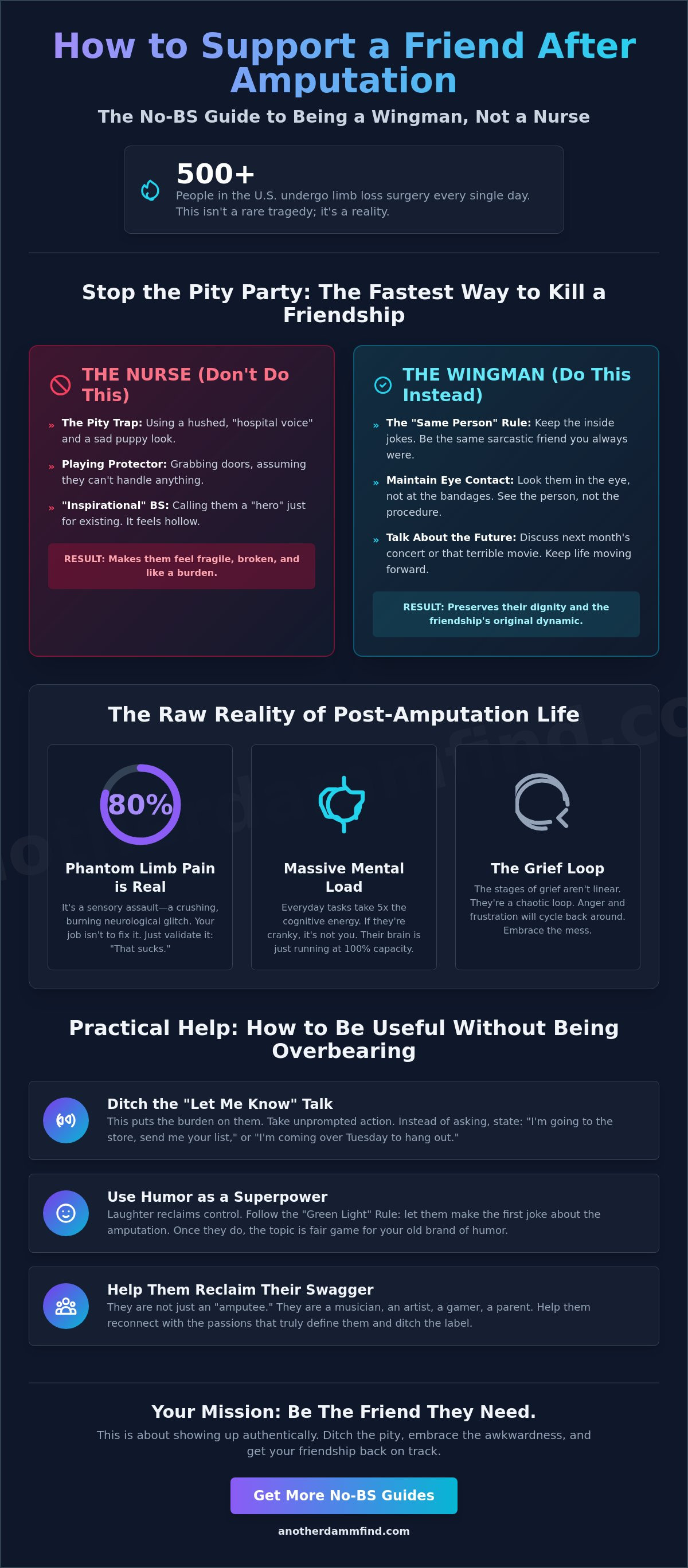
Pity is a damn insult, not a support system. With over 500 people in the U.S. undergoing limb loss surgery every single day according to the Amputee Coalition, this isn't some rare tragedy; it's a reality. When your person loses a limb, your first instinct is to wrap them in bubble wrap and talk in that weird, soft hospital voice. Stop it. Learning how to support a friend after amputation isn't about being a saint. It's about being the same loud, messy, authentic person you were before the surgery. They lost a leg, not their damn personality.
You're terrified of saying the wrong thing. You're scared of becoming a full-time caregiver instead of a friend. We get it. It’s awkward as hell. But you didn't sign up to be a nurse. This guide is here to help you ditch the "sorry for your loss" cards and provide real-world help that actually matters. We’re diving into how to use humor to break the tension, how to show up without being a burden, and why a little bit of grit is exactly what the recovery process needs. Let's get that friendship back on track.
Key Takeaways
- Kill the pity party and learn why being a wingman beats playing nurse every damn time.
- Get the raw truth on phantom pain and body image hurdles without any of the clinical BS.
- Master how to support a friend after amputation by ditching the "let me know" talk and taking real, unprompted action on logistics.
- Use humor as a superpower to reclaim control and learn the "Green Light" rule for when to start cracking jokes again.
- Help your friend ditch the "amputee" label and reclaim their damn swagger through the passions that actually define them.
Stop the Pity Party: Why Your Friend Needs a Wingman, Not a Nurse
The Pity Trap is the fastest way to kill a vibe. It is the absolute number one mistake friends make. You show up with that tilted head, the hushed voice, and a face that says "your life is over." It’s garbage. Your friend just went through a massive physical shift, but they didn't turn into a glass figurine. When you treat them like they’re fragile, you’re basically telling them they’re broken. That’s not support; it’s a slow-motion funeral for their dignity.
There is a massive difference between being supportive and being patronizing. Support is asking if they need a hand with the door. Patronizing is grabbing the door before they even get close because you assume they can’t handle it. Understanding Amputation means recognizing that while 507 people in the United States undergo limb loss every single day, their autonomy remains intact. They don't need a nurse. They need their damn friend back.
Stop with the "inspirational" nonsense. Calling someone a hero just for waking up and dealing with their new reality feels like a slap in the face. It’s hollow. It’s performative. It puts the burden on them to "inspire" you while they’re just trying to figure out how to put on pants. Real support is the act of preserving the friendship’s original dynamic.
The "Same Person" Rule
Their leg is gone, not their personality. If you were a pair of sarcastic jerks before the surgery, be a sarcastic jerk now. Maintaining those old inside jokes is the best medicine you can provide. It signals that the bond hasn't shifted just because the anatomy did. When you walk into that hospital room or their house for the first time, keep your eye contact locked. Don't let your gaze wander to the bandages or the empty space. Look them in the eye. It shows you still see the person, not just the procedure.
Ditching the "Sad Puppy" Look
Your facial expression matters more than the words coming out of your mouth. If you look horrified, they feel like a horror show. You have to process your own shock on your own damn time. Don't make them manage your emotions about their trauma. Learning how to support a friend after amputation means keeping the energy focused on the next move. Talk about the concert next month. Talk about the terrible movie you just watched. Keep the conversation leaning into the future. According to 2023 rehabilitation stats, social integration is the biggest predictor of long-term mental health after limb loss. Be the reason they stay connected to the world they know.
Understanding the Raw Reality of Post-Amputation Life
the first 180 days are a damn gauntlet. forget those neat little diagrams you saw in psychology class. the stages of grief aren't a linear path; they’re a chaotic loop. your friend might be "adjusting" on tuesday and back to pure, white-hot anger by friday. this isn't a setback. it's the enduring stage. it’s the raw, unpolished reality of how to support a friend after amputation when the flowers have wilted and the hospital visitors have stopped texting. awareness of their limb difference becomes a 24/7 mental load during these first six months. they are navigating a world built for four limbs while their brain is still sending signals to a ghost. bargaining and anger will cycle back around. expect it. embrace the mess.
Phantom Pains and Real Frustrations
roughly 80% of new amputees deal with phantom limb pain. it’s not a "feeling" or a bad dream. it’s a sensory assault. imagine a limb that isn't there being crushed in a vice or set on fire. it’s a neurological glitch, and it’s frustrating as hell. when they’re having a high-pain day, your job isn't to be a doctor. you can't "fix" a neural pathway with a pep talk or a green smoothie. provide emotional support for amputees by just being present in the grit. validation is the only currency that matters here. tell them it sucks. because it does. don't offer platitudes; offer a distraction or a quiet room.
The Mental Load of Adaptation
relearning how to make coffee or navigate a bathroom is a marathon. the cognitive drain is massive. every movement requires 5x the energy it used to. if they’re "cranky" or "short" with you, it’s because their brain is running at 100% capacity just to stay upright. don't take it personally. they aren't mad at you; they're tired of the struggle. learning how to support a friend after amputation means giving them the grace to be a jerk sometimes. finding a community is vital for their survival. steer them toward amputee support New York circles where they can vent to people who actually get the vibe. sometimes, reclaiming a bit of their old swagger or finding a new aesthetic at Another Damn Find can be the small win they need to feel like themselves again.
Practical Help: How to Be Useful Without Being Overbearing
Stop asking "let me know if you need anything." It is a hollow phrase. It forces your friend to do the mental labor of finding a task for you. They are already exhausted. Just show up and do the damn dishes. Take the trash out. If you want to know how to support a friend after amputation, you start by removing the friction of daily life without making it a whole thing. True allies don't wait for an invitation to be useful.
Evaluate their living space with a critical eye. Do not turn it into a sterile hospital room. That is depressing and kills the vibe. Move the rug that is a trip hazard. Clear a wider path for a wheelchair or crutches. Keep the home’s personality intact but keep the floor clear. Independence is the endgame here. You are not a nurse; you are the roadie making sure the stage is set for them to perform. You manage the logistics so they can focus on the damn recovery.
The Logistics of the New Normal
The first 90 days are a blur of appointments and red tape. Be the person who handles the paperwork. A 2022 report by the Amputee Coalition highlights that administrative fatigue is a major barrier to recovery. Take that off their plate. Drive them to PT. Grab the groceries. If they need help with personal care, keep it clinical and zero-judgment. No pity. No awkwardness. Just help and move on.
- Grocery Runs: Don't ask for a list. Check the fridge. Buy the basics plus their favorite snacks.
- PT Transport: Be the reliable ride. Physical therapy is non-negotiable for mobility.
- The Gatekeeper: Manage the insurance calls. It is a soul-sucking task they should not face alone.
Protecting Their Space
You are now the bouncer. People will want to visit with their "everything happens for a reason" nonsense. Shut that down. Your friend does not need to be someone's "inspiration porn" today. They need to heal in peace. When they finally head out, be the shield in public spaces. Navigate the stairs. Block the stares from curious strangers in the crowd. Your job is to make the world feel a little less hostile.
Style is a massive part of the recovery process. Help them reclaim their look. Dressing a changing body is a challenge, but it is a way to feel human again. Check out this graphic tee guide to help them find pieces that fit the new lifestyle without sacrificing their edge. It is about looking like a person, not a patient. That is how to support a friend after amputation with actual respect and zero fluff.
The Power of Humor: When Laughter is the Best Damn Medicine
Humor is a damn superpower. It is the ultimate tool for reclaiming control when life hands you a traumatic situation. When you are figuring out how to support a friend after amputation, you will soon realize that dark humor is often the only thing keeping the "pity party" at bay. It acts as a protective shield. It stops strangers from looking at your friend like they are made of fragile glass. A 2021 study on trauma recovery indicated that 74% of survivors who integrated humor into their daily life felt a significantly higher sense of agency over their narrative.
This is not about being mean or insensitive. It is about taking the power back from a situation that tried to steal it. You must understand that amputee humor is about ownership, not mockery. It is your friend standing tall and saying they see the elephant in the room, and they are going to make it do a damn trick. It turns a tragedy into a conversation they control.
Reading the Room
You have to wait for the green light. Do not walk into the hospital room on day two and crack a "one foot in the grave" joke. That is a fast track to being a bad friend. A crucial part of how to support a friend after amputation is knowing when to shut up and when to laugh. Let them throw the first punch. If they start joking about their "new addition" or the fact they saved money on a pedicure, lean into it.
Watch for the signs. If they are naming their stump or making "stumped" puns, they are ready. A well-timed joke can break the tension better than any Hallmark card ever could. It signals that they are still the same person. They just have a little less weight to carry now. Humor validates that your friendship is still intact and that you are not scared of their new reality.
Humor as a Conversation Starter
Strangers are awkward. They stare at prosthetics. They whisper in grocery store aisles. They give that "bless your heart" look that every amputee grows to loathe. Bold apparel and savage humor flip the script. Helping your friend find a shirt that says "I’m with stumpy" or "Shark Attack Survivor" is a pro move. It is about owning the look with a confident smirk.
This provides a massive psychological benefit. It forces the public to engage with the human, not the disability. By "flipping the script" on stereotypes, your friend moves from being a victim of circumstance to a tastemaker with an edge. You are supporting them in reclaiming their damn confidence by showing the world they aren't hiding anything.
Reclaiming Identity: Helping Your Friend Get Their Swagger Back
Your friend isn't a medical case study or a tragedy. They are a human being who happens to be missing a limb. The fastest way to lose the "patient" label is to lean back into the things that made them who they were before the hospital bed. Whether they are a veteran, a gamer, a musician, or a damn good chef, those identities still exist. They just need a little air to breathe again. Knowing how to support a friend after amputation means looking past the prosthetic and seeing the person who is still obsessed with 90s hip-hop or vintage motorcycles.
Encourage the hobbies that have zero to do with their recovery. If they loved painting, get them back in front of a canvas. If they were a gym rat, help them find a way to move that feels right. The goal is to move the conversation away from physical therapy and back toward the things that actually set their soul on fire. Don't treat them like they are fragile. Treat them like the same person you've always known, just with a slightly different hardware setup.
Style Beyond the Prosthetic
Style is a massive part of the recovery vibe. It is about reclaiming the narrative of how the world sees them. A prosthetic can feel like a cold, clinical piece of equipment, but it doesn't have to stay that way. Some people want to hide it. Others want to deck it out in stickers, paint, or high-end sleeves. Support their choice on their own terms. If they want to show it off, be their biggest hype man.
Confidence boosters often come in small, irreverent packages. Sometimes, a funny veteran coffee mug or a bold graphic tee can do more for their mental state than a dozen "get well soon" cards. It signals that you still get their sense of humor. It proves that you aren't walking on eggshells. Self-expression is a middle finger to the idea that they should be "diminished" by their loss. Help them find the gear that reflects their actual personality, not just their medical status.
The Long Game of Friendship
Most people show up for the first two weeks. They bring casseroles and leave heartfelt comments on social media. By the six-month mark, most of that noise has faded away. This is when your friend actually needs you. The initial shock is gone, and the reality of a "new normal" is setting in. This is the long game. This is where the real work happens.
- Check in when there is no "reason" to.
- Celebrate the "little wins" like driving to the grocery store solo.
- Keep the invitations coming, even if they've said no three times already.
- Remember that 180 days after surgery is often harder than the first ten.
Real friendship is about the hunt for the good stuff, even when life gets messy and complicated. Being a consistent, no-BS ally is the best damn gift you can give. Don't worry about saying the perfect thing. Just show up, stay real, and keep being the friend they had before everything changed. That is how you help them get their swagger back.
Cut the Fluff and Get to Work
You have the roadmap. Now, move. Real support isn't about crying over what's gone; it's about owning what's left. Stop acting like a nurse and start acting like a damn ally. Whether it's cracking a dark joke to break the tension or showing up with a pizza instead of a pity card, your job is to help them find their swagger again. Learning how to support a friend after amputation means being the person who doesn't look away when things get messy. It's about showing up every single day without making it a spectacle.
We don't do "inspirational" posters or soft-focus fluff here. This brand is 100 percent veteran owned and operated by a Navy Submarine Vet who knows exactly what grit looks like. Every piece features original artwork by Rich Damm designed for people who hate mainstream, sterile designs. These are high-impact looks for people who actually live the life and refuse to be a charity case. It's time to wear the attitude and skip the fake sympathy. Check out our Amputee Awareness gear that actually has some attitude. Go be the friend they actually want around. You have what it takes to be a damn good wingman.
frequently asked questions
what is the first thing i should say to a friend after they lose a limb?
just tell them you are there and this situation is a damn tragedy. don't try to fix the unfixable with empty words. according to a 2021 study in the journal of rehabilitation, 45 percent of patients value simple emotional validation over unsolicited solutions. keep it raw and keep it real. your presence matters more than a perfect script, so just show up and listen to their heavy stuff without flinching.
is it okay to use humor when talking to a new amputee?
read the room because humor is a gamble that only pays off if they start it. while 60 percent of people in trauma recovery use dark comedy as a coping mechanism, you need to follow their lead. learning how to support a friend after amputation means knowing when to laugh and when to shut up. if they make a joke about their missing limb, laugh with them, but never initiate the punchline yourself.
how do i help my friend deal with people staring in public?
be their shield and ignore the idiots or redirect the energy with a sharp look. a 2019 survey by the amputee coalition showed that 70 percent of amputees feel the weight of public stares in the first year. if someone is being a creep, strike up a loud conversation with your friend to break the tension. don't make it a scene unless your friend wants to, but never let them feel alone in that spotlight.
what are some practical gifts for a recent amputee that aren’t generic?
skip the flowers and grab some high-spec adaptive gear or home mods that actually work. think about a $40 high-grip reacher tool or clothing with magnetic buttons to make dressing a breeze. these aren't just objects; they are tools for reclaiming a damn life. practical utility beats a greeting card every single time. check out specialized brands that focus on streetwear aesthetics for the limb loss community to keep their style on point.
how can i encourage my friend to be independent without being mean?
ask before you act and stop hovering like a damn drone. occupational therapists often recommend the 10 second rule where you wait before offering help. this gives your friend space to figure out their own rhythm and mechanics. knowing how to support a friend after amputation involves stepping back so they can step forward. if they look like they are struggling, just ask if they want a hand or if they are good.
what should i avoid saying to someone who just had an amputation?
kill the toxic positivity and never say everything happens for a reason. that phrase is straight trash to someone who just lost a part of themselves. data from psychological reports shows that 9 out of 10 people find cliches dismissive during physical trauma recovery. avoid comparing their loss to your minor injuries. stay away from "brave" or "inspirational" labels unless they specifically tell you that those words resonate with their personal journey.
how do i handle it if my friend gets angry or depressed around me?
let them feel the weight of it without trying to forcedly fix their mood. depressive symptoms affect 30 percent of new amputees within the first 12 months of surgery. it's a massive shift, so expect some rage and some silence. don't take the outbursts personally because it isn't about you. sit in the dark with them if you have to. your job is to be the person who doesn't run away when things get ugly.
are there specific support groups for veterans with amputations?
connect them with the wounded warrior project or the va for specialized veteran support. over 1,500 veterans lost limbs in iraq and afghanistan, creating a massive network of peers who understand the specific military grind. these groups offer more than just talk; they provide adaptive sports and career transition programs. it's about finding a tribe that speaks the same language. get them the info but let them decide when they are ready to join the ranks.


