


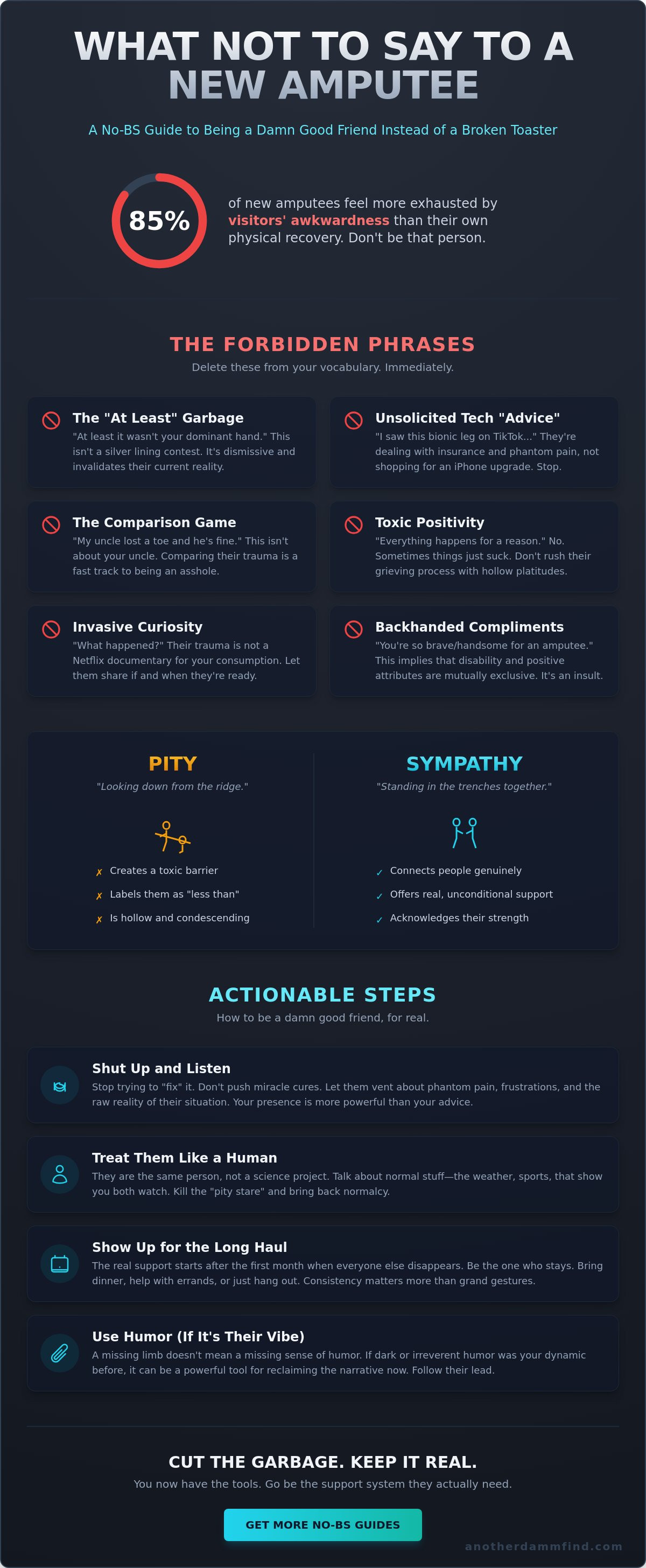
Your best friend just lost a leg and suddenly you have the social IQ of a broken toaster. It's a damn mess. You're hovering, stuttering, and sweating through your favorite vintage tee because you're terrified of being offensive. We get it. Statistics from recent peer support surveys show that 85 percent of new amputees feel more exhausted by visitors' awkwardness than their own physical recovery. Nobody wants to be the person who makes a tragedy about their own discomfort. But here is the cold, hard truth: knowing what not to say to a new amputee is the difference between being a solid support system and being the reason they stop answering their phone.
It’s okay to feel out of your depth, but it’s not okay to stay there. We're stripping away the clinical fluff to give you a raw, no-bs guide on how to actually show up. You’re going to learn how to kill the pity, stop the patronizing "help," and start being a damn good friend again. We are breaking down the specific toxic phrases to delete from your vocabulary and the exact boundaries you need to respect to keep your relationship intact. By the time you finish this, you'll have the confidence to walk into that hospital room without making it weird. Let’s get to work.
Key Takeaways
- Cut the "at least" garbage and learn exactly what not to say to a new amputee before you open your damn mouth.
- Keep it real and treat your friend like the same person they’ve always been, not some fragile science project.
- Be the one who actually stays—learn why showing up after the first month matters more than any hollow "get well soon" card.
- Shut up and listen; stop pushing TikTok "miracle cures" and let them vent about the raw reality of phantom pain.
- Reclaim the power with irreverent humor that proves a missing limb doesn't mean a missing sense of damn soul.
The "Foot-in-Mouth" Syndrome: Why Everyone Gets Amputee Etiquette Wrong
You want to help. You really do. But right now, you're a walking disaster of social cues. This is the "clueless supporter" archetype. It's that person who thinks their unsolicited advice or generic "thoughts and prayers" is a damn gift to the universe. It isn't. When someone goes through a major medical event like an Amputation, their world just shifted 180 degrees. They aren't looking for a motivational speaker. They're looking for their damn life back. Most well-meaning comments backfire because they center the supporter's feelings instead of the patient's reality.
The initial shock phase is raw. It's messy. A 2021 study on limb loss recovery suggests that the first six months are critical for psychological adjustment. During this window, the person needs normalcy. They need to talk about the latest gear or the damn weather, not their surgical site. Your "pity stare" is the fastest way to kill the vibe. It makes them a specimen, not a person. It's okay to feel awkward. It's a weird situation. But it's not okay to make your discomfort the amputee's problem to solve. They have enough on their plate without managing your social anxiety. Knowing what not to say to a new amputee is about checking your ego at the hospital door.
The Difference Between Sympathy and Pity
Sympathy connects people. It's about standing in the trenches together. Pity is about looking down from the safety of the ridge, silently thanking God it's not you. That energy is toxic. It creates a barrier to genuine recovery and kills the friendship dynamic. Pity is the emotional equivalent of a participation trophy. It's hollow and condescending. Real friends offer support, not a damn sad face that screams "I feel sorry for you." When you pity someone, you're subconsciously labeling them as "less than," which is the last thing a new amputee needs to feel.
Why Your Curiosity is Not an Emergency
People feel entitled to the "story" like it's a damn Netflix documentary. They see a missing limb and suddenly they're an investigative reporter. "What happened?" is a heavy, invasive question. It's a total violation of medical privacy. In those early stages, the amputee is still processing the trauma. They're busy relearning how to navigate the world. Your curiosity is not an emergency they need to address. Wait for them to lead the narrative. If they want to talk about the accident or the illness, they will. If they don't, you talk about anything else. Understanding what not to say to a new amputee means respecting their right to keep their medical history private until they're ready to share the hunt.
The Forbidden Phrases: What Never to Say to an Amputee
Look, we get it. You're nervous. You want to help. But most of the garbage coming out of your mouth is making it worse. If you want to know what not to say to a new amputee, start by deleting the phrase "at least" from your damn brain. "At least it wasn't your dominant hand." "At least you're still here." Stop. Just stop. You're trying to find a silver lining in a situation that is currently pitch black. It's not helpful. It's dismissive. It's a low bar that ignores the massive shift in their reality.
Then there's the TikTok tech experts. You saw a video of a guy doing backflips on a bionic leg and now you think you're a prosthetics pro. Don't offer unsolicited advice on "new bionic tech" you saw while doomscrolling. According to the Amputee Coalition, nearly 50% of people with limb loss experience depression or anxiety. Your friend is dealing with surgical sites, insurance battles, and phantom pain. They aren't shopping for a new gadget like it’s a damn iPhone upgrade.
The comparison game is another fast track to being an asshole. Don't play it.
- "My uncle lost a toe in 1994 and he's fine." Not the same.
- "I broke my leg once, I totally get it." No, you don't.
- "You're so handsome for an amputee." This is a backhanded insult.
Toxic Positivity and the "Everything Happens for a Reason" Lie
Searching for a "silver lining" is a trap. It invalidates the real, raw trauma of amputation. When you say "everything happens for a reason," you're essentially telling them their loss was a cosmic necessity. That's a lie. Sometimes things just suck. Don't rush them through the grieving process. Instead of trying to fix the unfixable, learn to sit in the "suck" with them. Just be there without the fake smiles. If you want to show up with something authentic, check out our curated finds that prioritize vibe over pity.
The "Brave" and "Inspirational" Label
Calling someone "brave" for buying groceries or "inspirational" for existing is patronizing. It’s called inspiration porn. It turns a human being into a motivational tool for able-bodied people to feel better about their own lives. It objectifies the struggle. We have already explored Why "Inspirational" Amputee Content Misses the Mark because it strips away personhood. They aren't a damn Hallmark card. They're a person navigating a new world. Treat them like one. Knowing what not to say to a new amputee means recognizing they don't want to be your morning motivation; they just want their life back.
Treat Them Like a Human, Not a Science Project
Cut the clinical crap. Your friend didn't suddenly become a medical curiosity or a fragile piece of glass. They are still the same damn "bubblehead" who forgot your birthday last year. If you treat them like a patient, you're making their world smaller. Focus on the person, not the missing part. Knowing what not to say to a new amputee often starts with recognizing that they are still the same person. Maintaining those pre-amputation dynamics is vital for their mental health. Keep the inside jokes flowing. If you used to talk trash during a game, keep talking trash. It signals that the core of your relationship hasn't changed, even if their body has.
Your body language speaks louder than your words. Look them in the eye. Avoid the pity tilt of the head. When you fixate on the limb, you're telling them that’s all they are now. Use steady eye contact to anchor the conversation. It reduces the social anxiety that hits 30 percent of people facing limb loss, according to 2023 industry surveys. Skip the generic "How's it going?" and go for "How are you actually doing?" It shows you’re ready for the raw truth, not just the polite version. Being real is the best way to show you give a damn.
Normalizing the New Reality
Don’t be a hero. Grabbing a wheelchair without asking or shoving a door open isn't helpful; it’s damn intrusive. It strips away their autonomy. Always follow the "Ask First" rule. A simple "Want me to get that?" gives them the power to say no. When you make plans, don’t make the disability the center of the universe. Just pick the bar with the ramp. Don't announce it like it's a grand gesture. Just do it. It makes the accommodation feel natural rather than a burden. This is the gold standard for what not to say to a new amputee because it focuses on action over awkward commentary.
Handling the Stares Together
Public outings can feel like a damn circus. People will stare. It’s inevitable and it’s awkward. Your job is to be the wingman, not the bodyguard. You don't need to start a confrontation every time someone gawks. Instead, use a look away or a well-timed joke to break the tension. If you need a playbook for this, check out our Dealing With Stares: A No-BS Guide for Amputees. Humor is a weapon. It takes the power back from the strangers and puts it back in your hands. Be the person who makes them feel like they belong in the room, because they damn well do.
How to Be a Damn Good Friend: Actionable Steps
Showing up is easy when the trauma is fresh. The first 30 days are usually a circus of flowers, casseroles, and "thinking of you" texts. Then, the silence hits. Most people vanish once the initial shock wears off. Don't be that person. Real support starts at month three, when the adrenaline dies and the reality of the "new normal" sets in. Stick around. Be the person who still calls when the hospital bed is long gone.
Listen more than you talk. It sounds simple, but most people suck at it. When your friend vents about phantom limb pain, shut up. They don't need your cousin's herbal remedy or a link to a miracle cure you found on a late-night Reddit thread. They need a witness to the struggle. Knowing what not to say to a new amputee means realizing that your advice is usually just noise. Let them be angry. Let them be raw. Just stay in the room.
Do your own damn homework. Don't make them teach Amputation 101 while they're trying to heal. Spend twenty minutes on Google. Understand the basics of the recovery timeline so they don't have to explain why they're exhausted or why the socket doesn't fit today. Also, keep the dark humor in the holster. Unless they draw first and crack a "leg up" joke, keep your comedy routine to yourself. Let them set the vibe.
Practical Support That Actually Helps
Stop saying "let me know if you need anything." It’s a lazy phrase that puts the mental load on the person who is already drowning. Be specific. Tell them, "I’m bringing dinner Thursday at 6 PM," or "I’m coming over Saturday to mow the lawn." Handle the logistics that feel heavy right now. This includes transportation to physical therapy or helping with home adjustments like removing trip hazards. If they need a community, point them toward localized resources like Amputee Support in New York to help them find their tribe.
Learning the Language of Limb Loss
Words have weight. Learn the terminology so you don't sound like a tourist in their life. Use the right terms:
- Prosthesis: The device itself, not a "fake leg."
- Residual limb: The part of the limb that remains.
- Phantom pain: Real neurological pain in a limb that is no longer there.
Never call it a "stump" unless they use that word first. To many, that word feels clinical and cold. The vocabulary of support is rooted in respect, not clinical labels. Using the right language shows you actually give a damn about their dignity. If you want to keep the vibe right while they recover, grab some gear that matches their energy at Another Damn Find.
Owning the Narrative: Why Humor is the Ultimate Recovery Tool
Recovery isn't just about physical therapy and learning to walk on a new leg. It's a head game. When people come at you with the wrong questions, you have two choices. You can get mad, or you can get funny. Laughing at the "damn" situation isn't about denial. It's about taking the wheel. You're reclaiming power from a world that wants to treat you like a fragile glass doll. That's the ultimate win. It changes the dynamic from "poor you" to "damn, you're cool."
Knowing what not to say to a new amputee is a skill most people lack. They trip over their words. They offer unsolicited advice. They look at you with those sad, puppy-dog eyes. Humor shuts that down. It puts you back in the driver's seat. It's about being the hunter, not the hunted. When you crack a joke about your missing limb, you give everyone else permission to breathe. You set the rules of the game. You're not a victim of your circumstances; you're the lead character in a very dark, very funny comedy.
When Humor is a Superpower
Finding the "funny" in dark places is a survival skill. It's a literal superpower. Clinical research from organizations like the Mayo Clinic shows that laughter triggers the release of endorphins, the body's natural feel-good chemicals. It physically lowers cortisol and cools down your stress response. Beyond the biology, humor is the ultimate social filter. It separates the real ones from the people who will always see you as a tragedy. Real friends laugh with you. They don't walk on eggshells. They understand that Amputee Humor: Why Laughing at Limb Loss is a Superpower because it turns a heavy moment into a shared bond. It kills the awkwardness before it can even start.
Wear the Attitude
You're tired of explaining. We get it. People stare. They wonder. They ask the same questions you've answered 100 times this week. A bold t-shirt does the heavy lifting for you. It answers the "what happened" question before some stranger even opens their mouth. Another DAMM Find isn't here to give you "inspirational" quotes on a sunset background. We don't do sterile. We don't do "brave." We do raw. We do real.
We're here for the bold and the irreverent. Our gear provides a voice for those who refuse to be victims. It's a conversation starter that sets the terms on your own ground. You control the vibe. You own the narrative. Stop the pity party before it starts. It's time to show the world that you're still here, and you're still the loudest person in the room. Check out our Amputee Humor T-shirts and stop the awkward stares.
stop the pity and start the riot
Navigating the world after a limb loss is enough of a grind without dealing with everyone else's awkwardness. You now know what not to say to a new amputee; so stop the "brave" talk and the tragic head tilts. Focus on the two big takeaways: treat people like humans and use humor as a damn weapon. Authenticity beats etiquette every single time. It's about taking up space and refusing to be a background character in your own life. It's your story, not their curiosity project.
Rich Damm started this veteran-owned brand to give you the tools to talk back without saying a word. Every piece features original hand-lettered designs that are bold, raw, and built to start the right kind of conversations. We don't do sterile. We do high-impact apparel for people who've been through the fire and came out swinging. It's time to flip the script and show the world exactly who's in charge. No apologies, just vibe.
Shop the Amputee Humor Collection and reclaim the narrative.
The road ahead is yours to pave. Grab some gear, find your tribe, and keep making them look twice. stay loud.
frequently asked questions
is it okay to ask an amputee how they lost their limb?
no, it is never okay to treat someone's trauma like a damn circus side show. unless they volunteer the info, keep your curiosity on a leash. a 2021 study by the amputee coalition found that 42 percent of people with limb loss find these questions intrusive. it's a private medical history, not a conversation starter for your commute. respect the boundary and talk about literally anything else.
why do amputees hate being called 'inspirational'?
most amputees hate being called inspirational because it feels patronizing and performative. they are just living their lives, not auditioning for a motivational poster. when you use that word, you're often centering your own feelings about their struggle. over 60 percent of respondents in a limb loss community survey noted that inspiration porn makes them feel like an exhibit rather than a person. it's exhausting.
what should i do if i accidentally say the wrong thing to an amputee?
apologize fast, mean it, and then drop it immediately. don't turn your mistake into a damn therapy session where they have to comfort you for being insensitive. learning what not to say to a new amputee takes time, but making it about your own guilt is a rookie move. a 2022 survey showed that 85 percent of patients prefer a quick "my bad" over a long, awkward explanation.
how can i help a new amputee without being overbearing?
offer specific, low pressure help like grabbing groceries on a set day instead of giving vague "let me know" offers. research from the journal of rehabilitation research and development shows that 75 percent of patients prefer task oriented support over emotional hovering. don't grab their wheelchair or prosthetic without asking. just be a damn human and respect their space while they figure out their new normal.
is it okay to joke about an amputee's missing limb?
only joke if they lead the way and set the vibe first. humour is a common coping mechanism, with 1 in 3 amputees using it to manage social awkwardness, but it's their joke to tell, not yours. if you jump the gun, you're just being a jerk. wait for them to crack the first one. if they don't, then your comedy career stays on ice for the day.
what are some good gifts for a new amputee that aren't generic?
skip the "get well" cards and go for high quality adaptive gear or premium skincare. data from the hanger clinic suggests that 90 percent of new amputees deal with skin irritation in the first 12 months. a gift card for a meal delivery service is a damn lifesaver too. focus on things that actually solve a problem or make their new daily routine easier and less of a chore.
what is phantom limb pain and should i ask my friend about it?
phantom limb pain is a brutal neurological glitch where the brain sends pain signals to a limb that is gone. it hits about 80 percent of amputees according to johns hopkins medicine. don't bring it up just to satisfy your curiosity. unless you're offering actual help or they're venting, it's just another thing on the list of what not to say to a new amputee if you want to keep the friendship intact.


