


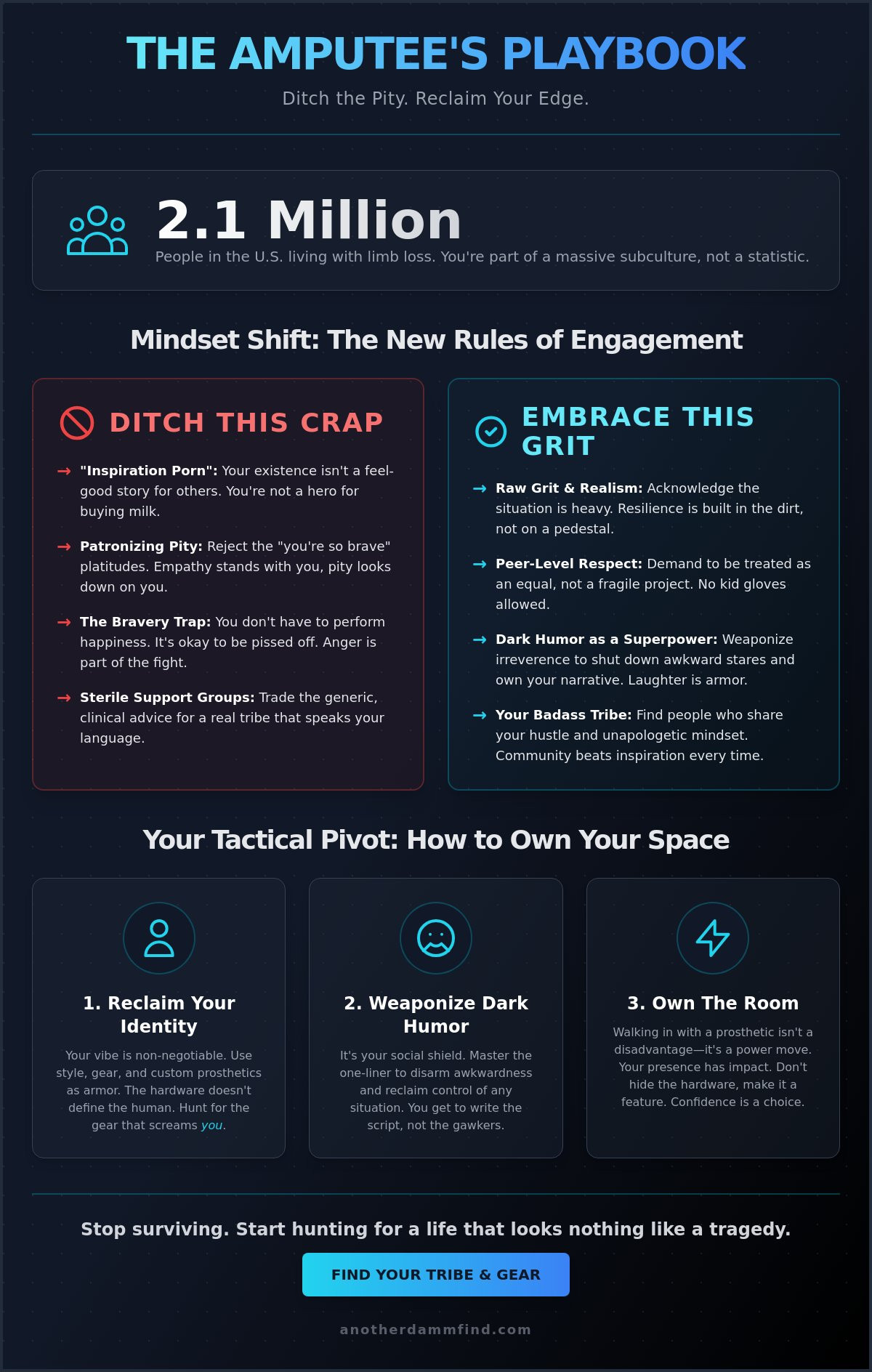
most encouraging words for amputees are patronizing garbage. you don't need another hallmark card. you don't need a "brave" sticker for just existing. around 2.1 million people in the u.s. are living with limb loss according to the amputee coalition, yet most advice feels like it was written by someone who has never tripped over their own prosthetic. it's frustrating. every conversation feels like a charity case transaction. we get it. the world sees a medical statistic. you’re just trying to live your damn life without the constant pity party.
you’re ready for a shift. no toxic positivity here. we promise to give you the irreverent, grit-heavy encouragement you actually need to find your humor and your edge again. this isn't about "getting back to normal." it's about joining a badass subculture. we're talking about people who know exactly how to laugh at the absurdity of it all. we’re diving into mental frameworks for resilience, ways to shut down awkward questions, and how to own your damn space with total confidence. let’s get to work.
Key Takeaways
- Ditch the "inspiration porn" and learn to spot the difference between genuine empathy and patronizing pity.
- Master the mental shift to a "new normal" that keeps your personality intact without surrendering your damn vibe.
- Weaponize dark humor as a social superpower to shut down awkward stares and reclaim your narrative.
- Find out why the right encouraging words for amputees focus on raw grit rather than empty, generic platitudes.
- Trade the sterile support groups for a tribe of badasses who actually speak your language and share your hustle.
Why Most Encouraging Words for Amputees Miss the Damn Mark
Most people mean well. They really do. But the generic encouraging words for amputees you hear in the hospital or at the grocery store usually feel like a participation trophy you never asked for. It’s patronizing. It’s soft. It feels like someone is trying to wrap your reality in bubble wrap so they feel less awkward about your situation. You don't need a pat on the head; you need a roadmap back to yourself.
Authentic encouragement isn't about being nice. It’s about being real. There is a massive gap between empathy and pity. Pity looks down at you. Empathy stands right next to you in the dirt. Before you can even think about reclaiming your life, you have to acknowledge that the current situation is heavy. The loss of a limb brings a specific type of psychological trauma and emotional discomfort that cannot be cured by a "hang in there" poster. You need a shield, not a platitude. A bold, irreverent mindset is the only thing that actually protects your peace when the world tries to make you feel like a charity case.
The Problem with 'Inspiration Porn'
Media portrayals are the worst offenders. They love a "miracle" story. They turn every person with a limb loss into a hero just for walking to the mailbox. This is inspiration porn. It dehumanizes you. It turns your daily existence into a feel-good clip for someone else's social media feed. This creates the bravery trap, which is a damn heavy weight to carry. The bravery trap sucks because:
- It forces you to perform "happiness" to make non-amputees feel comfortable.
- It makes you feel like a failure on days when you just want to stay in bed.
- It ignores the grueling physical and mental grind of prosthetic training.
It is okay to be pissed off. In fact, it’s necessary. You didn't ask for this. Being angry isn't a sign of weakness; it’s a sign that you’re still in the fight. Don't let someone's need for a "miracle" story rob you of your right to be human.
Trading Pity for Peer-Level Respect
We are done with the victim narrative. That’s a dead end. The goal is to move from survivor to total badass. This shift doesn't happen with soft words. It happens with raw honesty. You need people who look you in the eye and treat you with peer-level respect, not fragile care. Building mental resilience requires a certain level of grit and a refusal to be handled with kid gloves. You aren't a project to be fixed. You are a person reclaiming your damn edge. Real encouragement is the raw, unapologetic fuel used to reclaim your identity and hunt down a life that looks nothing like a tragedy.
Reclaiming Your Identity: The Mental Shift to the New Normal
Losing a limb is a massive shift. There is no point in sugarcoating it. Your body looks different, but your vibe? That's still yours to control. The "New Normal" isn't about surrendering who you are. It's about a tactical pivot. You are still the same person with the same dark jokes and the same taste in music. You just have a different silhouette now. Research on the psychological impact of amputation shows that identity disruption is a major hurdle. But here is the damn truth: you don't have to fit into the sterile, quiet box the medical world built for you.
Your style is your loudest signal. It tells the world you aren't just surviving; you're still playing the game. Reclaiming your identity means finding gear that feels like you. If you were a gearhead before, be a gearhead with a carbon fiber finish. If you loved vintage, find the most weathered leather jacket to pair with your prosthetic. These aren't just clothes. They are armor. Using specific apparel and accessories helps bridge the gap between who you were and who you are becoming. These are the most encouraging words for amputees you'll hear: your personality is non-negotiable. Don't let the hardware define the human.
The 'Hunt' for Your New Self
Stop looking at recovery like a medical sentence. Start treating it like a mission. The "hunt" is about finding the unique pieces that make you feel like the cool kid again. Don't settle for the hospital-beige life. Search for prosthetic covers that scream your aesthetic. Whether it's raw metal or custom paint, your gear should match your energy. Confidence doesn't come from being "whole" by society's standards. It comes from the intentional choice to look damn good on your own terms. It's about that specific, self-assured subculture of people who refuse to fade into the background. You are hunting for a version of yourself that is even more resilient than the last one.
Owning the Room (With or Without the Limb)
Walking into a room with a prosthetic is a power move if you play it right. High-impact presence isn't about hiding the change. It's about owning it. Authenticity is the most exclusive find you can offer anyone. People gravitate toward raw, unfiltered truth. Look at the Another DAMM Find story. It's about veterans and amputees who took their narrative back through art and grit. They didn't ask for permission to be bold. They just were. You can do the same by curating a look that feels like a middle finger to "normal." These are encouraging words for amputees because they remind you that you still hold the cards. If you need to refresh your kit, go find something that hits hard and keep moving.
The Healing Power of Dark Humor and Irreverence
People stare. It’s a fact of life now. You can hide under layers of fabric or you can make it weird. Laughter is the ultimate damn superpower for the limb-loss community. It isn't just about being the life of the party. It’s about total control. When you crack a joke about your missing limb, you suck the oxygen out of their pity. Science shows that humor can drop cortisol levels by nearly 39 percent. It’s a biological stress-regulator. It’s a social icebreaker. It’s how you take the power back from the "stare."
Why We Laugh at the Absurd
Life after limb loss is inherently strange. The "staccato" nature of amputee humor works because it’s fast, sharp, and entirely unexpected. It de-escalates that heavy, awkward social tension that follows you into a room. Someone looks at your prosthetic like it’s a tragedy. You tell them you lost it in a high-stakes thumb war. Suddenly, the vibe shifts. You aren't the victim. You are the funniest person in the room. That’s a 100 percent psychological win every single day. Humor turns a perceived weakness into a high-impact personality trait.
Mantras for the Irreverent Amputee
Forget the soft, generic platitudes. You don't need fluffy clouds. You need grit. Real encouraging words for amputees often come wrapped in a thick layer of cynicism. If you're struggling to find your footing, checking out amputee support and resources helps keep your physical game on point. But for your head? You need a script that hits hard. Start building your own list of one-liners to shut down the pity party before it starts.
- At least I don't have to clip five more damn toenails.
- I’m 10 percent lighter and 100 percent more interesting than you.
- Parking just got significantly easier; 10/10 would recommend.
- I’m not missing a leg. I’m just more aerodynamic now.
- Half off on pedicures, twice the attitude.
- My prosthetic costs more than your car, so watch the paint.
- I’m literally a cyborg. What’s your excuse?
There’s a clear line between self-deprecation and self-empowerment. You aren't the punchline. The situation is. Self-deprecation is a shield you use to protect others from their own discomfort. Self-empowerment is the sword you use to carve out your own space. These are the encouraging words for amputees that actually matter because they are honest. They are raw. They are unapologetically you. You’re building a brand. Your own brand. Authentic and unfiltered.
What to Say When the Stares Get Old: A No-BS Script
People are going to stare. It is a fact of life that is annoying as hell. You are trying to buy groceries or grab a drink, and suddenly you are the main attraction. You need a toolkit to shut that noise down without losing your damn mind. The "stare-back" is your first line of defense. If someone is burning a hole in your prosthetic with their eyes, look right back at them. Hold the gaze. Wait for them to realize they are being weird. Usually, they blink first and look away. It shifts the awkwardness from your lap to theirs in about three seconds.
Setting boundaries is about keeping your edge. You are not a public exhibit. You are a person with things to do. Managing the "unsolicited advice" from people who have no clue is a skill. When a stranger starts recommending "miracle" diets or weird supplements they saw on a late-night infomercial, cut them off. A simple "I have a medical team for that, but thanks" is enough. You don't need to be mean, but you do need to be firm. Your energy is valuable. Don't waste it on people who think they know your body better than you do.
Scripts for the Curious Public
Sometimes you want to have fun with the "What happened?" question. Give them a story they won't forget. Tell them it was a highly classified submarine accident in the Pacific. Or tell them a shark got you, but you should see the state of the shark. It keeps the mood light for you while highlighting how ridiculous their prying is. Pivot the conversation immediately. Ask them where they got their jacket or what they recommend on the menu. Your medical history is private property, and you never owe a stranger an explanation for how your body looks or functions.
Dealing with the 'Inspirational' Stranger
The "you are so brave" crowd is often the most draining. It feels patronizing. It feels like corporate-wellness-retreat energy that nobody asked for. You are just living your life, not auditioning for a motivational poster. If someone hits you with that "bless you" vibe, it is okay to shut it down. A short "I am just grabbing coffee, not climbing Everest" usually does the trick. Stay raw and stay authentic to who you are. These are the real encouraging words for amputees: you define your own narrative, not the person in the checkout line. For more tactical maneuvers on handling the public, check out this guide on coping with being an amputee to keep your sanity intact.
Data from limb loss advocacy groups shows that 85 percent of amputees deal with unwanted public attention on a weekly basis. You are not alone in this frustration. Finding your voice is part of the hunt for your new normal. Sometimes the most encouraging words for amputees are the ones you use to stand up for yourself. Keep your vibe high and your patience for nonsense low.
Finding Your Tribe: Why Community Beats Inspiration Every Day
Inspiration is cheap. It's a sunset quote on a dusty Hallmark card. You don't need a greeting card; you need a damn crew. You need people who know the specific, localized heat of a silicone liner in the middle of July. Most support groups feel like a slow leak in a tire. They're clinical. They're heavy. They focus on the loss. A tribe is different. A tribe is a group of badasses who prioritize the hunt for a better life over the pity party. They speak your slang. They get the dark humor. They don't flinch when you make a joke about your missing parts.
Vetting your community is a survival skill. If the vibe is "woe is me," leave immediately. If the vibe is "let's get after it," you've found home. According to a 2022 study on social integration, amputees with strong peer networks reported 30% higher life satisfaction scores than those who remained isolated. That isn't just a coincidence; it's a blueprint. Long-term mental health isn't about therapy alone. It's about shared attitude. It's about having people who push you to be better, not just people who feel sorry for you. Find the ones who make you forget you're "different" and remind you that you're elite.
Beyond the Hospital Gown
Forget the sterile white walls and the smell of antiseptic. Real connection happens in the garage, the art studio, or the dive bar. You need amputee support that feels like real life, not a clinical trial. Look for communities built around hobbies first and disability second. Whether it's a group of veterans rebuilding vintage bikes or artists creating custom prosthetic covers, these spaces offer a raw side of life that hospitals can't touch. Veteran-owned spaces are particularly effective for this. They don't sugarcoat the struggle. They value the grit. They understand that recovery is a mission, not a destination.
Wearing Your Pride
Sometimes, the most powerful encouraging words for amputees aren't spoken at all. They're worn. A bold, high-impact t-shirt is more than just fabric. It's a uniform for your new subculture. It's a signal to the world that you aren't hiding and you sure as hell aren't asking for permission to exist. A card ends up in the trash by Tuesday. A piece of high-attitude apparel tells your story every time you walk into a room. It creates a sense of shared identity. It says you're part of a specific, self-assured group that values authenticity over polished perfection.
reclaim the damn day. Stop waiting for the world to make you feel comfortable. Join the subculture. Wear the grit. Move fast. Your life isn't on hold; it's just getting interesting. The hunt for your best self starts when you stop acting like a patient and start acting like the tastemaker you are. Find your tribe. Wear your pride. Don't look back.
Stop Waiting for Permission to Live Your Damn Life
You've heard enough soft-soap bullshit to last a lifetime. Real progress starts when you stop looking for pity and start leaning into the grit. We've broken down why those sugar-coated platitudes fail 100 percent of the time. You know now that dark humor is a survival tool, not a sign of weakness. Reclaiming your identity isn't about getting back to who you were before the surgery. It's about owning exactly who you are right now. True encouraging words for amputees don't come from a scripted card; they come from the community that refuses to let you disappear into the background.
At Another DAMM Find, we don't do victims. We're a veteran-owned operation run by a Navy Submarine Vet who understands the mission doesn't stop because the terrain changed. Every piece of gear features original hand-lettered designs by Rich Damm that reject the "inspiration porn" narrative. These are bold, conversation-starting pieces designed for people who'd rather be respected than pitied. Ready to wear your attitude? Shop our Amputee Awareness collection at Another DAMM Find. You've got a hell of a life left to live. Go get it.
Frequently Asked Questions
What are some short, encouraging words for a new amputee?
You are still the same person, just with a new set of operating instructions. Finding encouraging words for amputees starts with acknowledging that 2.1 million Americans are currently living with limb loss according to the Amputee Coalition. It’s about the grind, not the pity. Tell them they have the grit to handle the 4 to 6 months of initial physical therapy ahead.
How do I encourage an amputee friend without sounding patronizing?
Talk to your friend exactly how you did before the surgery. If you were jerks to each other before, keep that same damn energy now. Offer specific help like driving them to their 2 PM prosthetic fitting instead of asking vague questions. Real support means showing up for the 100 percent of their life, not just the parts that look like a tragedy.
Is it okay to use humor when talking to someone with limb loss?
Humor is a requirement for survival in the limb loss community. A 2017 study on coping mechanisms showed that nearly 70 percent of patients use humor to reclaim their sense of agency. If they make a joke about their missing piece, laugh along. It signals that you still see the person, not just the medical history. Don't make it weird.
What do you say to an amputee who is having a bad day?
Validate the struggle without trying to fix their mood. Sometimes the most encouraging words for amputees are simply, this situation is absolute garbage and I’m here for it. Don't push toxic positivity when they’re dealing with phantom pain or a bad socket fit. Just sit there. Being present during the 24 hour bad days matters more than any Hallmark card quote.
How can I help an amputee regain their confidence?
Confidence returns through physical mastery and intentional style. Encourage them to join one of the 500 plus adaptive sports chapters in the U.S. to see what’s possible. Owning the aesthetic of a prosthetic can change everything. When they start hitting 5,000 steps a day or mastering a new hobby, that self assurance builds naturally. It’s about the hunt for a new normal.
What should I avoid saying to someone who just lost a limb?
Avoid comparison stories about your cousin’s neighbor or inspiration talk. Never say I know how you feel unless you’ve actually lost a limb yourself. 90 percent of new amputees find these clichés exhausting rather than helpful. Skip the everything happens for a reason nonsense. It’s dismissive of the massive physical and emotional hurdle they’re currently jumping over.
Where can I find a community of amputees who don't act like victims?
Check out the Amputee Coalition’s Peer Support network or the Lucky Fin Project for a community that values grit. You want the crews that treat their hardware like custom gear, not a curse. These groups focus on the what's next instead of the why me. Look for local meetups that prioritize 100 percent activity and zero percent victimhood.
How do I deal with people who keep calling me 'brave'?
Deflect the brave label with a quick, honest reality check. Tell people, I’m not brave, I’m just trying to get my damn coffee. It resets the dynamic immediately. You aren't a mascot for their comfort, and you don't owe them a heroic narrative. Setting that boundary helps people see the actual person instead of a walking inspiration poster.


