


Most people think they know how sailors talk, but unless you've spent 1,460 days breathing recycled oxygen and hydraulic fluid, you don't know shit about real submarine slang. It isn't the sanitized, polished crap you find in a generic dictionary. It's raw. It's offensive. It's the only thing that keeps a crew from losing their damn minds during a 90 day deployment in a pressurized steel tube. You want the authentic vibe of the Silent Service, not some damn corporate version of military history.
You probably hate those sterile lists that look like they were pulled from a 1945 training manual; we do too. We're fixing that right now. This guide gives you the keys to the damn kingdom, teaching you to talk like a true bubblehead while avoiding the "skimmer" labels. We're diving deep into the technical jargon and the social insults used 800 feet below the surface. We'll cover everything from "nuke" elitism to the absolute horror of "midrats" so you can finally sound like you belong in the mess decks while rocking gear that actually respects the hustle.
Key Takeaways
- Dive into the psychological pressure cooker of the Silent Service to understand why "Bubbleheads" talk the way they damn well do.
- Master the essential submarine slang that covers the gritty reality of eating, sleeping, and surviving in a deep-sea vacuum.
- Decode the brutal hierarchy of the iron tube and find out why being a "NUB" is a rite of passage you have to earn.
- Call out the sanitized Hollywood myths and get the raw, unfiltered truth that corporate blogs are too damn scared to publish.
- Learn how to wear the culture on your back with gear that serves as a silent handshake for those who actually lived the grind.
Welcome to the Iron Tube: Why Submariners Talk Like That
Welcome to the iron tube. It's dark, it's cramped, and it smells like amine, diesel, and recycled sweat. When you lock 150 people in a steel pressurized cylinder for 90 days, things get weird. The sun becomes a myth. Fresh milk disappears after 14 days. After that, you're living on grit and sarcasm. This isolation creates a linguistic vacuum where standard English goes to die. Submariners don't just speak a different language; they inhabit a different reality. Most "submarine slang" lists you find online are sanitized trash written by people who never spent a single night in a rack that's still warm from the last guy. We aren't here for the PG version. This is about the raw, unfiltered talk that keeps a crew sane when the world is 800 feet of crushing salt water away.
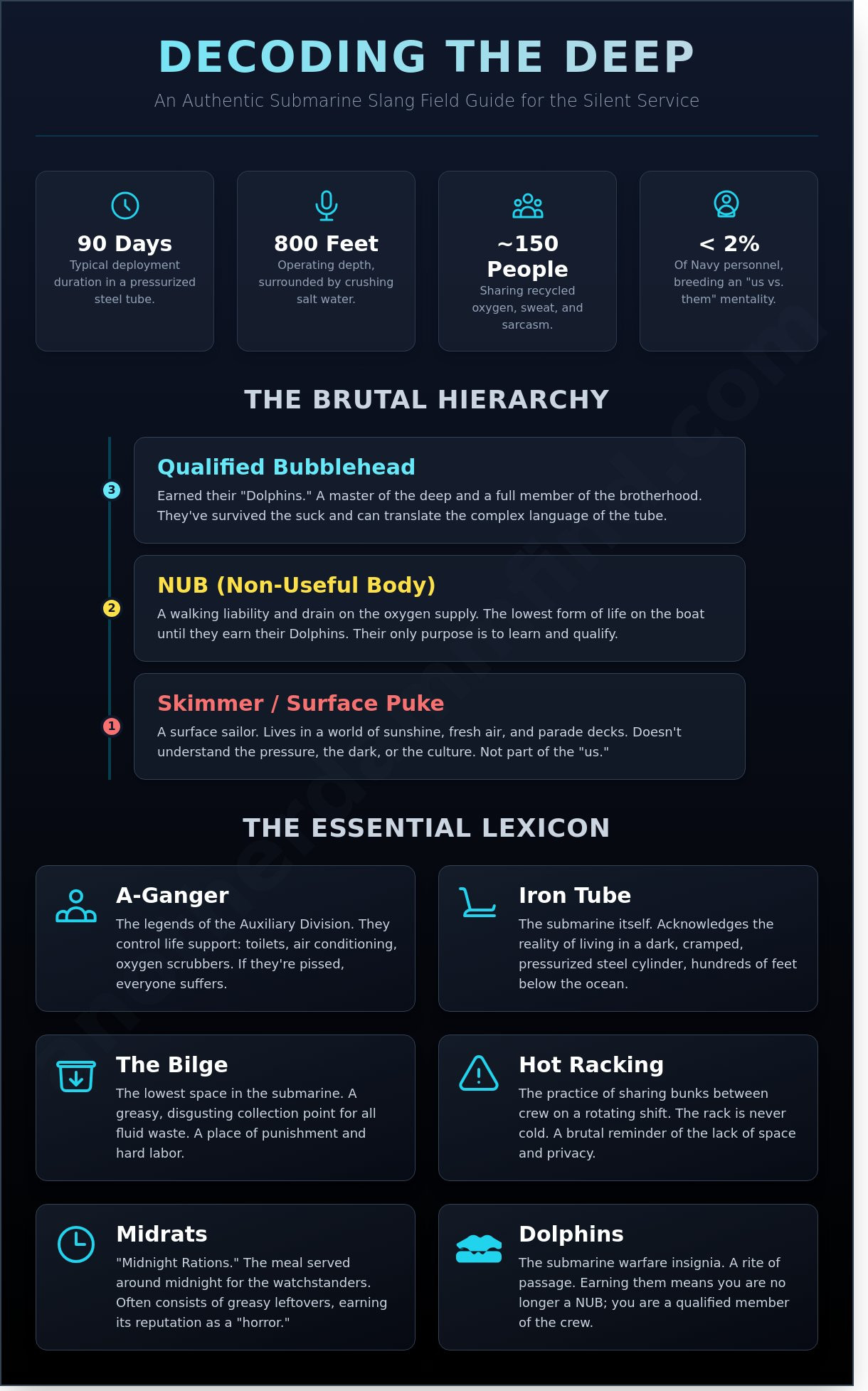
The Silent Service is built on psychological pressure that would break a surface sailor. Since the USS Nautilus launched in 1954, the sub community has operated as the Navy’s black sheep. We make up less than 2 percent of total Navy personnel. That exclusivity breeds a specific kind of "us vs. them" mentality. If you haven't earned your dolphins, you don't get the jokes. The lingo is a filter. It separates the qualified from the "nubs" who are just taking up valuable oxygen. It's about efficiency, gallows humor, and a damn deep sense of brotherhood that civilians will never understand.
The Psychology of the Deep
Living 800 feet below the waves for months on end changes how your brain processes communication. You lose the luxury of nuance. Efficiency becomes the only metric that matters. When you're "hot racking" sharing two bunks between three people on a rotating shift you don't have time for polite small talk. The vocabulary reflects this brutal utility. It's high-speed, high-impact, and usually soaked in cynical humor. This isn't just about being "edgy." It's a survival mechanism for people who haven't seen a tree or a civilian in 2,160 hours. The "black sheep" label isn't an insult; it's a lifestyle. We thrive in the dark where the rest of the Navy is afraid to go.
Acronyms vs. Slang: Knowing the Difference
Don't confuse technical jargon with actual sub culture. The Navy loves its acronyms. NAVSEA, COB, and SONAR are just bureaucratic noise. Real submarine slang is the corruption of that official nonsense into something visceral. It’s taking a sterile term and dragging it through the bilge until it feels real. For a deeper look at the broad strokes, check out this Glossary of U.S. Navy Slang to see where the general Navy ends and the sub world begins. While the surface fleet worries about paint chips and parade decks, bubbleheads are busy reinventing the English language to fit inside a 360-foot hull. A Bubblehead is a badge of honor worn by those who choose the deep, a term of endearment for the few who can handle the pressure.
Other sites give you the "dictionary" definition. They tell you what a word means but not how it feels when you're 45 days into a WestPac deployment and the coffee tastes like fuel. Sub slang is a damn brotherhood. It's a way to signal that you've survived the suck. Every word is a trophy. Every insult is a handshake. If you can't handle the talk, you can't handle the tube. It's that simple.
The Essential Lexicon: Living, Eating, and Hating in the Deep
Listen up, nubber. You don't know shit yet. If you just stepped onto a fast-attack boat, you're a Non-Useful Body. You're a drain on the oxygen supply. You're a walking liability until you earn your dolphins. To survive the 800-foot crush, you need to speak the language. Submarine slang isn't just some cute nautical dialect; it's a survival mechanism designed to mask the misery of living in a pressurized steel tube. It's raw. It's cynical. It's damn necessary.
While the brass wants you to follow the Standard Submarine Phraseology found in 1944 training manuals, the real talk happens in the mess decks and the engine room. This is where the "Holy Trinity" of boat life comes into play: Food, Sleep, and Maintenance. If you aren't doing one of those three, you're probably dying or getting yelled at by a Chief. Grab your notebook. Don't be a damn statistic.
Life and Death in the Bilge
Life on a boat is 10 percent adrenaline and 90 percent scrubbing things that are already clean. You'll learn to hate the sound of your own name. You'll learn that "free time" is a myth invented by recruiters to trick 19-year-olds into signing six-year contracts.
- A-Ganger: These are the Auxiliary Division legends. They fix the toilets, the air conditioning, and the oxygen scrubbers. If the A-Ganger is pissed, everyone stops breathing or starts smelling everyone else's business. They are covered in grease and 2190 TEP oil 100 percent of the time.
- Crank: This is your life for the first 90 days. Every new guy, regardless of rank or rate, becomes a mess cook. You wash dishes. You scrub decks. You serve food. It's a brutal rite of passage that breaks your spirit before the boat even leaves the pier.
- Field Day: The most hated phrase in the English language. It's not a day, and there are no fields. It's a 4-hour block of intensive cleaning where you use a toothbrush to scrub the grout in the head while the boat is rocking at a 20-degree angle.
- Hot Racking: Space is a luxury you don't have. In a 3-man-to-2-rack rotation, you crawl into a bunk that is still warm from the guy who just got up for watch. It's damp. It smells like another man's sweat. It's the ultimate intimacy you never asked for.
The Culinary "Delights" of the Boat
Food is the only thing that keeps a crew from mutiny. The Navy spends more on sub food than surface food because they know a happy belly ignores the fact that there's 400 psi of seawater trying to get inside. You get 15 minutes to eat. Make them count. If you're looking for that authentic military aesthetic without the 90-day dishwashing stint, you should check out our latest vintage military drops for some real-deal style.
- Midrats: Midnight Rations. Served between 2300 and 0100. It's usually leftovers from lunch or some bizarre "breakfast" concoction. It's the best meal because the atmosphere is relaxed, and it's the worst because it's usually 40 percent grease.
- Bug Juice: A mysterious, neon-colored powder drink that tastes like industrial chemicals and sugar. Legend says it can clean the corrosion off a copper pipe in under 10 minutes. We still drink it by the gallon.
- Horse Cock: Don't get weird. It's just the giant, unsliced tubes of bologna or salami found in the galley. It's a staple of the 0200 sandwich run.
- Slider: A greasy, thin hamburger patty that slides right through your system. Usually served on "Burger Day," which is the only way we track the passing of a week when the sun doesn't exist.
Master this submarine slang or stay a nubber forever. The choice is yours. Just don't complain when the A-Ganger tells you to go find a gallon of prop wash or a sound-powered phone battery. You've been warned.
Qualified vs. Non-Qual: The Brutal Hierarchy of Slang
Submarine life isn't a damn democracy. It’s a cold, binary caste system. You either have the fish or you're a ghost. The hierarchy on a boat isn't built on Navy rank; it’s built on qualification. Until you earn those Dolphins, you're a sub-human entity. The submarine slang reflects this brutal reality. It’s a linguistic gatekeeping tool used to separate the assets from the liabilities. If you haven't earned the right to speak, the boat will let you know in the most colorful ways possible. It’s raw. It’s high-stakes. It’s the only way 130 people survive in a steel tube 800 feet below the waves.
The divide is simple. You are "Qualified" or you are a "NUB." There is no middle ground. There is no "trying your best." You either know how to save the ship or you're an obstacle. This social structure ensures that every single person on board can handle a casualty at 3:00 AM without thinking. The slang is the friction that polishes the diamond. It’s a damn grind, and it’s meant to be.
The Quest for the Fish
Getting your Dolphins is a 6 to 12 month marathon of pure sleep deprivation. You have to master 100% of the ship’s systems. This isn't just about your job. A cook needs to know how to operate the ballast tanks. A sonar tech needs to understand the nuclear reactor’s cooling loop. You carry a Qual Card, a 50-page document of misery. You need signatures for every damn component on the boat. You spend 18-hour days chasing salty senior guys for a single initial. The final board is a multi-hour interrogation. When you pass, the ceremony is a rite of passage. Those silver or gold pins are dropped into a glass, and you earn your place in the deep. You’re finally a bubblehead.
NUB Life: The Lowest Form of Existence
If you don't have your fish, you're a NUB. That stands for Non-Useful Body. It’s the most common piece of submarine slang you'll hear, and it’s never a compliment. You are a guest. You are a burden. You are an "Oxygen Thief" because you’re consuming air that a qualified sailor could be using. The insults are specific and constant:
- Oxygen Thief: A NUB who is breathing but not contributing.
- Dino: A NUB who has been on board for 9 months and still hasn't qualified. They are a dinosaur heading for extinction.
- Puke: A general term for the uninitiated who haven't found their sea legs.
- Target: What surface ships are called, but also how a NUB feels during a checkout.
The check-in process is a wake-up call. From the second you step on the pier, you're told you're nothing. NUBs aren't allowed to sit in the galley if space is tight. They don't get to watch movies in the crew's mess. They don't get to use the cool, irreverent slang the seniors use. If a NUB tries to act salty, they get shut down fast. You don't get to participate in the culture until you've paid the tax in sweat and study hours. It’s a damn hard way to live, but it’s the only way to ensure the guy next to you won't kill you by mistake.
Myth vs. Reality: Sanitized Slang vs. The Real Navy
Most lists of submarine slang you find on corporate blogs or Wikipedia are sanitized garbage. They're written by people who have never smelled the "amine" scent of a sub after 60 days at sea. If the slang is clean enough for a Navy recruiter's brochure, it's fake. The actual language used in a steel tube 800 feet below the Atlantic is jagged, cynical, and raw. It's a dialect born from 18-hour "days," recycled air, and the constant, low-level stress of living in a pressurized pipe. It's about the "vibe" of the boat, not the dictionary definition.
The Hollywood Version vs. The Hull Version
Hollywood loves the drama. They want sweat, red lights, and actors screaming "Dive! Dive!" like their lives depend on it. In reality, that performance gets you mocked. Real communication on a Virginia-class boat is whisper-quiet. It's a flat, monotonous loop of "aye" and "very well." It sounds more like a bored data entry office than a blockbuster. Shouting is for the "nubs" who haven't earned their dolphins yet. If the CO is raising his voice, you’ve got bigger problems than a bad movie script. Consider these standard reality checks:
- "Dive! Dive!": In reality, the OOD (Officer of the Deck) simply says "Dive the ship," followed by a two-bell signal. No one screams.
- The Red Light: It's used for "Rig for Dark" to preserve night vision, not because the ship is about to explode.
- The Wardroom: It's not a place for dramatic speeches. It's where officers eat "midrats" and complain about paperwork.
The "Earthy" Reality
Sub life is sketchy. You're living in a pressurized pipe with 130 other people. That environment breeds a specific type of dark humor. Profanity isn't just for shock value. It's a rhythmic device. It functions exactly like the word "damn" does in our daily vocabulary. It punctuates the boredom. It makes the long patrols manageable. This isn't about being "unprofessional." It's about survival. When you're dealing with a "hot run" on a torpedo, a well-placed curse word is more effective than a formal memo. It’s the linguistic glue that keeps the crew from losing their minds.
Take the term "Blow Job" for example. On land, it's one thing. On a boat, it refers to the Emergency Main Ballast Tank (EMBT) Blow. This procedure uses high-pressure air to blast water out of the tanks, forcing the sub to the surface like a cork. It’s a violent, necessary maneuver that saves lives. Submariners lean into the double entendre with zero shame. It's a favorite for messing with "skimmers" (surface sailors) or civilians who don't know the tech. It’s about owning the absurdity of the job.
The force has evolved significantly since the 2010 policy change allowed female officers on subs, followed by enlisted women in 2015. Did the submarine slang get sanitized? Not really. The "dirty" nature of the talk is about the environment, not the gender. It’s about the shared misery and the absolute bond of the hull. The grit remains because the mission remains the same. It's still about the hunt. It's still about the independent spirit of the silent service. The language is just as sharp as it was in the 1970s, even if the faces in the mess deck have changed.
You don't need a sonar screen to find the good stuff. Grab some authentic gear and shop the latest vintage finds to build your own damn legacy.
Wear the Lingo: Why Submarine Slang Belongs on Your Back
Submarine slang isn't just a collection of weird words used in the dark. It’s a survival mechanism. It’s the verbal glue that holds a crew together when the pressure hulls start groaning at test depth. You’ve spent your career mastering this language, so why would you settle for wearing generic, mass-produced veteran gear that looks like it was designed by a corporate committee in a windowless office? You deserve something that carries the same raw energy as a 2:00 AM watch in the engine room. At Another DAMM Find, we don't do polished. We don't do sterile. We do grit. We take that "Bubblehead" spirit and bake it into every stitch of our apparel, ensuring that what you wear is as authentic as the life you lived beneath the waves.
Wearing a design that features "Dolphins" or specific sub-culture references is more than a fashion choice; it’s a silent handshake. It is a signal to the 1% of the population who actually knows what it means to rig for dive. When you walk into a room wearing our gear, you aren't just another guy in a military shirt. You’re a member of an elite subculture. Our "curated chaos" aesthetic matches the intensity of the silent service, replacing boring, predictable layouts with designs that actually have a pulse. We believe that if you’re going to represent the Navy’s most demanding community, your gear should look like it has some damn teeth.
Apparel for Those Who Know
Our Submarine Veteran Hoodies and Snapbacks are built for the guys who find "Thank You For Your Service" platitudes a little too shiny. We know that roughly 92% of military apparel on the market is generic crap designed for the masses. We aren't for the masses. We’re veteran-owned and operated, which means we understand the difference between a "boat" and a "ship" and why that distinction matters. Our gear focuses on the "Bubblehead" identity with a rebellious edge that rejects the standard PX aesthetic. It’s high-impact, high-attitude clothing for people who value the hunt for something truly unique.
- Authentic Veteran Design: Every piece is conceptualized by people who have actually stood the watch.
- Premium Comfort: Our hoodies are heavy enough for a cold pier and soft enough for a long flight.
- Zero Fluff: No eagles, no flags, no cheesy slogans; just raw submarine culture.
The "Another DAMM Find" Difference
Rich Damm brings 20 years of creative fire and a deep respect for military history to every single design. We don't use stock fonts or "off the shelf" clip art because your service wasn't "off the shelf." Every letter is hand-drawn to capture a vibe that is both nostalgic and forward-thinking. We prioritize the "hunt" for the perfect look, ensuring our Submarine Veteran collection feels like a one-of-a-kind discovery rather than a retail afterthought. This is about joining a self-assured subculture that operates outside the boundaries of mainstream fashion. It’s bold, it’s irreverent, and it’s damn well earned.
Ready to upgrade your locker? Check out our Submarine Veteran collection and find your new favorite hoodie.
The submarine slang you use defines your history. It’s time your wardrobe caught up. Stop buying the same boring gear as everyone else and start wearing the hunt. Our apparel is designed to hit hard and move fast, just like a Mk 48 ADCAP. Whether you are looking for a snapback that actually fits or a hoodie that tells a story without saying a word, we’ve got you covered. Join the community, embrace the curated chaos, and wear your "Bubblehead" status with the pride it deserves. This isn't just clothing; it’s a damn statement of intent.
Own the Lingo, Earn the Fish
You’ve spent years in a steel pressure cooker. You know that submarine slang isn't some cute dialect for tourists; it’s a 100% authentic survival tool used to navigate the brutal hierarchy of the boat. This language separates the qualified from the useless nub from the moment you earn your fish until you finally surface for good. The Navy might try to sanitize the fleet for public relations, but the 150 sailors living in that iron tube know the truth. It’s raw. It’s loud. It’s ours.
Don't let the culture die in a dusty sea bag. Rich Damm spent his time on the boats and he pours that same grit into every hand-lettered design we drop. This isn't mass-produced corporate trash. We’re talking 100% veteran-owned gear with bold prints designed to outlast a 180-day deployment. It’s time to stop blending in with the surface dwellers and wear your history on your back. It’s a damn good day to look like you’ve actually been there.
Grab your gear and join the bubblehead brotherhood. Browse our Submarine Veteran Apparel now.
frequently asked questions
What Does "Bubblehead" Mean in the Navy?
A bubblehead is a badge of honor for anyone serving on a U.S. Navy submarine. The name comes from the air bubbles trapped in the inner ear during depth changes. It’s a damn title earned by 22,000 active sailors who live under the waves today. This essential piece of submarine slang separates the real deep-sea hunters from the surface fleet sailors who just float on top.
What Are "Dolphins" on a Submarine?
Dolphins are the warfare insignia pins worn on a uniform to prove you aren’t just a tourist on the boat. This insignia was officially authorized on June 13, 1924, by the Bureau of Navigation. It’s a damn status symbol featuring two stylized dolphins flanking a submarine silhouette. Enlisted sailors wear silver pins while officers sport gold ones to show they’ve mastered the boat.
What Is "Hot Racking" and Do They Still Do It?
Hot racking is the gritty reality of three sailors sharing two bunks in rotating 8-hour shifts. It’s still standard practice on 28 remaining Los Angeles-class fast attack submarines where space is a luxury. Your bed is literally still warm from the last guy when you crawl in. It’s a damn tight squeeze in a rack that measures just 24 inches wide.
What Does "NUB" Stand For in Submarine Slang?
NUB stands for Non-Useful Body, the title given to any sailor who hasn’t earned their dolphins yet. They’re basically oxygen thieves until they prove they can save the ship in a fire or flood. This bit of submarine slang reminds the 150 crew members exactly who hasn't put in the damn work. You don't get a real seat at the table until that pin is on your chest.
What Are "Midrats" on a Navy Boat?
Midrats are the midnight rations served between 23:00 and 00:00 to fuel the night watch. It’s usually a mix of dinner leftovers or greasy sliders designed to keep a sailor awake during a long shift. On a 90-day deployment, these meals are the only thing keeping the crew from losing their damn minds. It’s the fuel that keeps the Silent Service running through the night.
What Is a "Field Day" on a Submarine?
A field day is a mandatory 3-hour deep clean where every sailor scrubs every inch of the boat with Simple Green. It usually goes down every Friday to keep the 360-foot steel tube from smelling like a locker room. You’ll be wiping deck plates and polishing brass until the boat looks damn near brand new. It is a relentless grind that keeps the ship functional.
Why Do Submariners Call Themselves the "Silent Service"?
The Silent Service is the nickname for the submarine force because they operate in total stealth to avoid detection. During World War II, U.S. submarines accounted for only 2 percent of the Navy but sank 55 percent of all Japanese ships. They strike from the shadows and disappear without a damn sound. It’s about being invisible, lethal, and completely independent while submerged for months.
What Does "Qualifying" Mean for a Submariner?
Qualifying is the grueling 6 to 12-month process of learning every valve, pipe, and circuit on the boat. You carry a qual card and get signed off by senior crew before facing a 3-hour oral board. It’s the only way to shed the NUB label and finally get some damn respect. Once you finish, you’re trusted to handle any emergency that happens 800 feet below.


