


If you think every boat in the Silent Service is just a generic steel tube filled with stale air and caffeine, you're dead wrong. Most civilians look at the fleet and see a confusing mess of acronyms that sound like a bad bowl of alphabet soup. It's frustrating. It's boring. You want to know why one boat carries nukes while another hunts shadows. We're talking about the different types of us navy submarines; it's time to cut through the technical manual garbage that puts people to sleep.
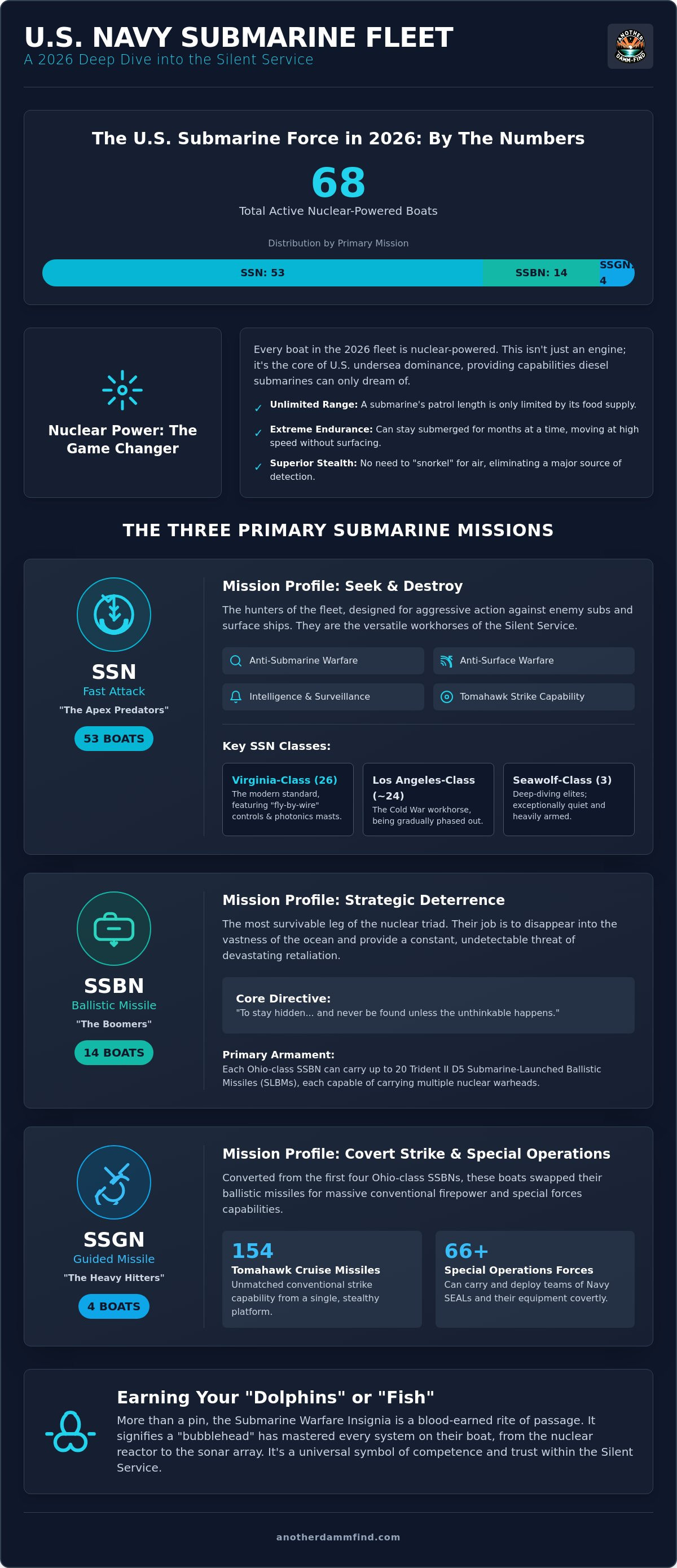
I get it. The Navy loves its jargon. Most guides feel like they were written by a robot in a cubicle. You want the raw truth from a bubblehead who actually earned their fish. This is your no-BS breakdown of the 68 active boats currently patrolling the deep in 2026. We're going deep on the 53 attack subs like the Virginia-class, the 14 Ohio-class BOOMERS holding the line, and the four specialized SSGNs. We'll even check the new 2026 commissions like the USS Idaho. By the time we surface, you'll know exactly what separates a hunter-killer from a city-leveler. No fluff. Just the grit. It's damm time you knew the difference.
Key Takeaways
- Cut through the alphabet soup and master the three primary types of us navy submarines currently patrolling in 2026.
- Identify the apex predators of the fleet, including why the Virginia-class is the ultimate nuclear-powered hot rod for underwater hunting.
- Decode the difference between the stealthy Boomers protecting the nuclear triad and the converted SSGNs designed for massive Tomahawk strikes.
- Get the raw truth about earning your fish and why the qualification process is a blood-earned rite of passage for every bubblehead.
- Understand why submarine heritage is a lifelong bond that stays with you long after you have surfaced for the last time.
What Are the Main Types of US Navy Submarines?
The modern US Navy submarine force is a nuclear-powered machine built for global stealth and total dominance. Forget the old movies with diesel engines coughing black smoke; we haven't played that game in decades. In 2026, every single hull in the fleet runs on a nuclear reactor. It's clean, it's quiet, and it's lethal. If you're trying to understand the different types of us navy submarines, you have to start with the fact that we don't need to surface for air. We only surface when we run out of food or when the mission is done. It's a raw, high-stakes environment where the reactor is the heartbeat of the boat.
Decoding the Alphabet Soup: SSN, SSBN, and SSGN
Walking onto a pier can feel like drowning in acronyms. The Navy loves its letters, but it boils down to three specific jobs. You've got the SSN, the SSBN, and the SSGN. These U.S. Navy submarine designations tell you exactly how a boat is going to ruin someone's day. Each one has a distinct culture and a different way of doing business under the waves.
- SSN (Fast Attack Submarines): These are the hunters. They are designed to seek and destroy enemy subs and surface ships. Think of them as the apex predators of the deep.
- SSBN (Ballistic Missile Submarines): We call these "Boomers." They carry the nation's nuclear deterrent. Their job is to stay hidden in a hole in the ocean and never be found unless the unthinkable happens.
- SSGN (Guided Missile Submarines): These are the heavy hitters. Converted from older Boomer hulls, they now carry up to 154 Tomahawk cruise missiles and teams of Navy SEALs for special ops.
Why Nuclear Power Changed Everything
Nuclear power isn't just a technical flex; it's the reason we own the underwater space. Back in the day, boats had to "snorkel" to recharge batteries, which made them easy targets. Now, we have unlimited range and endurance. We stay submerged for months at a time, moving at high speeds without ever needing to come up for a breath of fresh air. It's a game changer for the types of us navy submarines currently in service.
The only real limit we face is the amount of food we can cram into the decks. We're talking about stuffing cans of coffee and frozen meats into every spare inch of floor space. This creates the intense, high-stakes environment that bubbleheads live for. Nuclear propulsion allows for a level of aggression and persistence that diesel boats can't touch. It's about being the invisible ghost in the machine, waiting for the right moment to strike while the world above has no idea you're even there.
Fast Attack Submarines (SSN): The Apex Predators
If the Silent Service has a rockstar, it's the SSN. These are the hunters. They don't sit around waiting for orders; they are out there seeking and destroying enemy subs and surface ships before the bad guys even know they're being watched. These are the "hot rods" of the deep. They're fast, maneuverable, and constantly looking for a fight. While other boats might be focused on staying hidden, the Fast Attack Submarines (SSN) are the ones pushing the envelope in every corner of the globe. They handle everything from intelligence gathering and special forces delivery to high-stakes cruise missile strikes. For a deeper look at the grind, check our Navy Submarine Service crash course to see what life is like on a hunter-killer mission.
The Virginia-Class: The Modern Standard
As of July 2026, the Virginia-class is the undisputed backbone of the fleet with 26 boats currently in service. This includes the fresh commissions of the USS Idaho and USS Arkansas earlier this year. These aren't your grandfather's boats. They feature "fly-by-wire" ship control for insane precision in shallow littoral waters and photonics masts that replaced the old-school periscopes. No more looking through a glass tube; it's all high-def cameras and joystick control now. The real kicker is the Virginia Payload Module (VPM). It gives these boats a massive boost in strike capacity, making them one of the most lethal types of us navy submarines ever put to sea. If you've ever spent a deployment in one of these racks, you know that a Submarine Veteran Hoodie is the only way to show you survived the grind.
The Los Angeles and Seawolf Classes
We can't talk about SSNs without respecting the legends. The "688s" or Los Angeles-class submarines are the workhorses that defined the Cold War. There are still approximately 24 of these gritty boats in commission, though they are slowly being phased out. Then you have the Seawolf-class. These things are unicorns. Only three were ever built because they were too damn expensive, but they remain the fastest and quietest hunters in the water. They are armed to the teeth and designed for pure, unadulterated sea dominance. In the bubblehead community, these older boats still command the most respect. They weren't built for comfort; they were built to win. Whether you're on a 688 or a Seawolf, you're part of a legacy that doesn't accept second place.
Boomers and Guided Missile Boats: SSBN vs. SSGN
If the SSN is a high-speed street racer, the SSBN is a mobile, underwater fortress. These massive hulls represent a completely different side of the Silent Service. While the Fast Attack guys are out there playing tag with the surface fleet, the big boys are busy holding the world together through pure, unadulterated stealth. These types of us navy submarines are built on the massive Ohio-class hull, stretching nearly 560 feet long. That is almost two football fields of nuclear-powered steel designed to vanish into the deep for months at a time. It is a different kind of grind, defined by silence and the heavy weight of the nuclear triad.
The rivalry between boat types is real. Fast Attack crews love to talk trash about the "cushy" life on a big boat, while Boomer sailors know they are the ones carrying the ultimate big stick. To get a real feel for the trash talk and the culture, you need to dive into our guide on submarine slang. It is the only way to understand why we call them Boomers and why the "hide and seek" mission is the most stressful game on the planet.
The Ohio-Class: The Stealthy Giants
The 14 active Ohio-class SSBNs carry up to 20 Trident II D5 ballistic missiles each. Their mission is simple: stay hidden. If a Boomer is ever detected, the mission has failed. To keep these boats at sea as much as possible, the Navy uses a "Blue" and "Gold" crew system. One crew takes the boat out for a 70 to 90-day patrol while the other crew stays back for training and refit. Then they swap. This rotation ensures the boat stays on station while the sailors get a chance to see daylight. Life on a Boomer offers a bit more space than a cramped 688, but the mental toll of 90 days of total radio silence is no joke. It is a high-stakes waiting game that requires a specific kind of mental toughness.
The Future: Columbia-Class
The aging Ohio-class won't last forever. That is why the Columbia-class is the Navy's number one acquisition priority in 2026. These next-generation SSBNs are being built to replace the Ohios starting in the 2030s. The big tech leap here is the "life-of-the-ship" reactor core. Unlike older types of us navy submarines that require a massive mid-life refueling overhaul, the Columbia-class will run on its original fuel for its entire 42-year service life. It is a $62 billion investment in keeping the sea-based leg of our nuclear deterrent invisible and invincible. The first hull, the District of Columbia, is already under construction, signaling a new era for the bubbleheads who pull the long, silent watches in the dark.
Earning Your Fish: The Universal Submarine Rite of Passage
No matter which of the types of us navy submarines you get stationed on, you start your journey as a "numb-nut." You are a non-qual. You are a burden to the crew until you prove you can save the boat when things go south. It doesn't matter if you are on a high-tech Virginia-class or a gritty Los Angeles-class workhorse; the standard is the same. You have to earn your Dolphins. These insignia are the blood-earned stamp of a true submariner, signaling to the rest of the fleet that you are trusted to keep everyone alive in a steel tube thousands of feet below the surface.
The "Qual Card" is a brutal, soul-crushing grind that every bubblehead hates and loves. You spend months walking through every cramped space, tracing every single pipe, valve, and electrical system on the boat. It is about survival. If the boat floods or a fire breaks out in the middle of the night, you need to know how to isolate that system in total darkness. There is no calling 911 down there. You are the fire department, the medic, and the damage control team. If you haven't earned your fish yet, you're just taking up oxygen. Grab a Submarine Veteran Hoodie to show the world you actually survived the board and earned your place in the Silent Service.
The Enlisted vs. Officer Qualification
The grind is universal, but the color of the fish is different. Enlisted sailors earn Silver Dolphins, while officers earn Gold. Don't let the color fool you; both are equally hard-earned. The final hurdle is the "Qual Board." This is a multi-hour oral exam where a panel of senior vets tries to break you with impossible scenarios. They want to see how you handle pressure before they let you wear the pin. The moment those fish are pinned on your chest is the best day of your damn career. It is the moment you finally belong.
Life on Board: The Daily Grind
Represent Your Boat: Why Submarine Heritage Matters
Once you step off that brow for the last time, the boat doesn't just disappear. That hull number is etched into your DNA. It stays with you forever. It does not matter which of the types of us navy submarines you called home; the bond is the same. Whether you were sweating in the engine room of a 688 or pulling a silent vigil on a Boomer, you are part of a tribe that most people will never understand. You lived the life. You breathed the recycled air. You earned the right to carry that legacy into the civilian world. But let's be real: most of the gear out there is garbage. The generic, sanitized stuff you find at the PX or some corporate big-box store doesn't have the grit. It doesn't have the attitude of a bubblehead who actually lived the grind.
That is why Another DAMM Find exists. This isn't some corporate boardroom project. This brand was built by a Submarine Vet who knows exactly what it means to earn your fish and live the Silent Service life. We wanted to give the community a louder voice and gear that actually looks like it belongs on a pier, not in a gift shop. You can read the Another DAMM Find story to see how we are blending veteran culture, amputee awareness, and raw art to create something that finally feels authentic. It is about honoring the history of the different types of us navy submarines while styling it for a modern, edgy audience that values independence.
Conversation Starters for Bubbleheads
Our gear is designed to be a beacon. When you're wearing one of our pieces, you're signaling to every other vet in the room that you "get it." We use original hand-lettering and raw designs because the fleet wasn't built on polished perfection; it was built on sweat and steel. A custom-designed submarine hoodie beats a generic "Navy" shirt every single time. It is a conversation starter. It is a way to find your brothers in a crowd without saying a word. We focus on the tactile, visceral quality of the pieces because your service was real, and your gear should be too.
Wear the Fish with Pride
It doesn't matter if you were on a 688, a Seawolf, a Boomer, or one of the new Virginia-class boats. You did the time. You passed the board. You earned your place in the most exclusive club in the world. It is time to stop wearing corporate, sanitized crap that treats your service like a footnote. Get some gear with some damn personality that represents the grit of the life you lived. You are a qualified bubblehead. Wear it like you mean it. Shop our Submarine Veteran Apparel and show 'em you're a qualified bubblehead.
Own Your History Under the Waves
The 2026 fleet is a high-tech beast, but the silent grind remains the same. We have stripped back the technical jargon to give you the raw truth about the three main types of us navy submarines and the brotherhood that keeps them running. From the apex predator Virginia-class to the invisible Boomers holding the line, every boat has a soul that stays with you long after you surface for the last time. You earned those fish through sweat and long watches in the dark. Don't disrespect that legacy with generic, corporate gear that lacks a pulse.
Another DAMM Find is veteran-owned and operated by a real US Navy bubblehead who knows the difference between a mission and a paycheck. We offer original hand-lettered designs that you won't find at any PX. This is high-quality gear built to survive more than just a laundry cycle. It is time to wear your boat's identity with the attitude it deserves. Grab your Submarine Veteran Apparel and show 'em you earned your fish! Keep the watch and stay dangerous.
Frequently Asked Questions
What is the difference between an SSN and an SSBN?
SSNs are the hunters while SSBNs are the hiders. SSNs are fast attack boats designed to seek and destroy enemy ships and other submarines. SSBNs, known as Boomers, carry the nation's nuclear deterrent and spend their patrols staying invisible in a hole in the ocean. It is the difference between a street fighter looking for trouble and a sniper waiting in the shadows.
How many types of submarines does the US Navy have?
The fleet is currently split into three primary types of us navy submarines: Fast Attack (SSN), Ballistic Missile (SSBN), and Guided Missile (SSGN). As of 2026, the Navy operates a total of 68 active boats. Every single one of them is 100% nuclear-powered, meaning we don't have any diesel clunkers left in the inventory.
What is the newest submarine class in the US Navy?
The Virginia-class is the newest attack sub in the water, with the USS Idaho and USS Arkansas being commissioned in 2026. These boats represent the cutting edge of underwater tech. On the horizon, the Columbia-class is the newest ballistic missile class currently under construction. It is designed to replace the aging Ohio-class hulls starting in the 2030s.
Why are US Navy submarines nuclear-powered?
Nuclear power is all about endurance and stealth. It lets us stay submerged for months at a time without ever needing to surface or "snorkel" for air. Diesel-electric boats have to come up eventually, which makes them easy to find. A nuclear reactor gives us unlimited range and the ability to move at high speeds for as long as the food lasts.
What does 'SSGN' stand for in the Navy?
SSGN stands for Guided Missile Submarine (Nuclear). These are the heavy hitters that were originally built as Boomers but got converted to carry conventional weapons. Instead of nuclear missiles, they carry up to 154 Tomahawk cruise missiles. They also have specialized lockout chambers for Navy SEALs to launch clandestine missions without the boat ever surfacing.
How long do US Navy submarines stay underwater?
We stay down as long as the mission requires, which is usually between 70 and 90 days. The reactor doesn't need a break, so the only real limit is the amount of food we can cram into the decks. Once the frozen steaks and coffee run out, it is time to head back to the pier for a refit.
What is the hardest part of qualifying for submarine 'Dolphins'?
The final "Qual Board" is the absolute worst part of the process. It is a multi-hour oral exam where a panel of senior vets grills you on every pipe, valve, and electrical system on the boat. You have to prove you can save the boat in total darkness before they let you wear those fish on your chest.
Are there any diesel-electric submarines left in the US Navy?
There are zero diesel-electric boats left in active service. The US Navy retired its last diesel boat, the USS Blueback, back in 1990. Since then, the fleet has been entirely nuclear-powered. We don't deal with the limitations of batteries and fuel oil anymore; we only build nuclear-powered predators designed for global dominance.


