


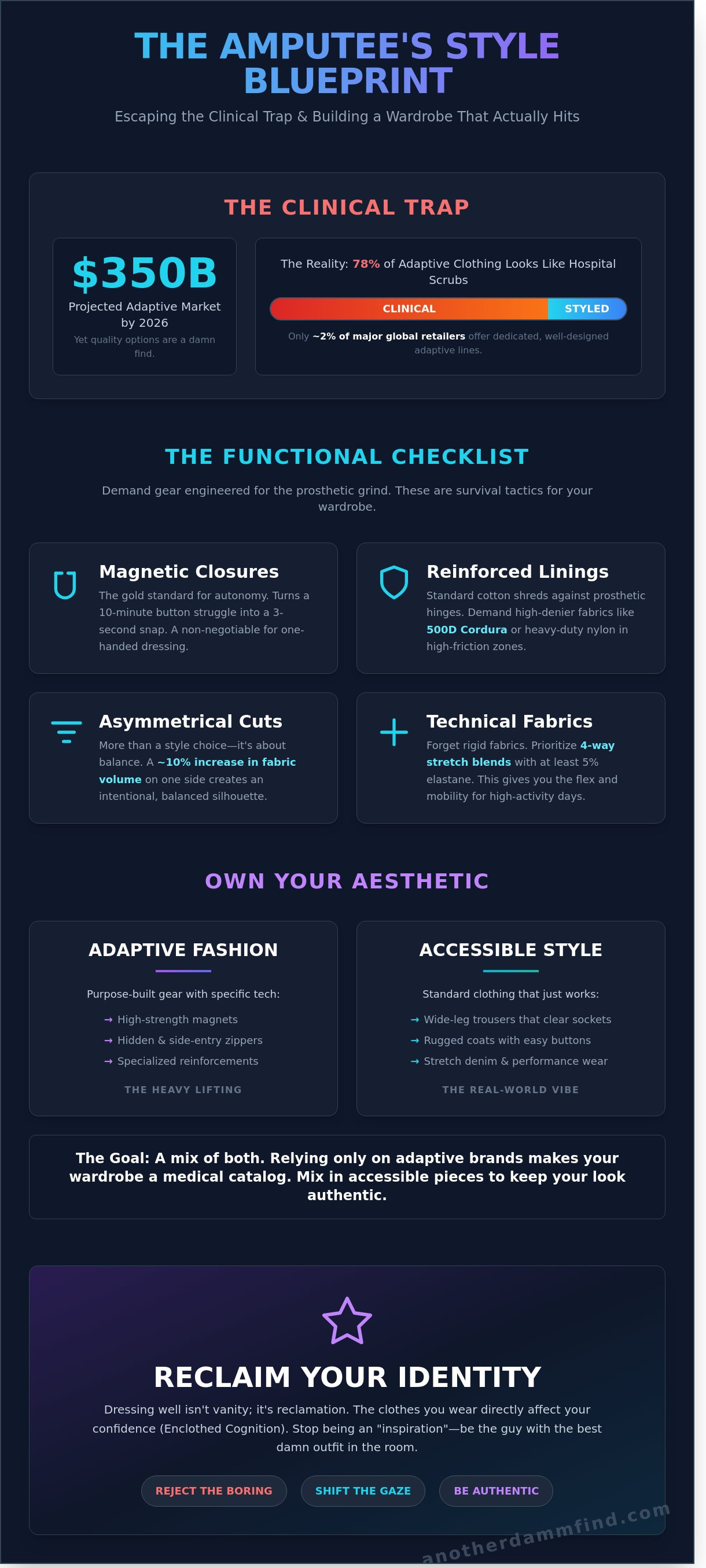
Most adaptive clothing looks like it was designed by a committee of beige-obsessed nurses back in 1994. It is clinical. It is soul-crushing. It is a damn tragedy. The global adaptive market is projected to hit $350 billion by 2026, yet 78% of current options still look like hospital scrubs. You already know the drill; Your $150 raw denim is currently being shredded by a metal prosthetic hinge and dressing yourself with one hand feels like a high-stakes wrestling match every single morning. We agree that settling for a nursing home aesthetic just because you carry some hardware is a losing game. Nobody should have to choose between looking like a patient and being able to put their damn pants on.
This guide is your blueprint for men's fashion for amputees that actually hits. You are going to learn how to build a bold, functional wardrobe that survives the prosthetic grind and matches your actual personality. We are breaking down the reinforced fabrics that won't tear on your carbon fiber joints, the magnetic closures that save your sanity, and the styling tricks that prove your vibe does not have to die just because the gear changed. It is time to stop settling.
Key Takeaways
- Ditch the hospital gift shop aesthetic and learn how to escape the clinical trap of traditional adaptive gear.
- Master men's fashion for amputees by hunting for high-performance features like magnetic closures and reinforced linings that actually survive your prosthetic.
- Dial in your silhouette and decide if you're hiding the hardware or showing off the chrome with bold, intentional style choices.
- Stop settling for off-the-rack fits and start using DIY hacks or a damn good tailor to customize your favorite streetwear brands.
- Use raw humor and unapologetic apparel to turn your wardrobe into a high-energy power move that reclaims your identity.
Why Most Men's Fashion for Amputees is Boring as Hell
Let’s be real. Most men's fashion for amputees looks like it was designed by a committee of physical therapists in a windowless basement. It’s the Clinical Trap. You go looking for a pair of pants and end up in a digital hospital gift shop. It’s depressing. Everything is beige. Everything is polyester. It’s 2024, and the industry still treats disability like a medical emergency instead of a lifestyle choice. Only about 2 percent of major global retailers offer dedicated adaptive lines that actually look like something you’d wear to a bar. That’s a damn tragedy.
We need to define the landscape properly. When we ask What is adaptive clothing?, we’re talking about gear built for specific physical needs. But functionality shouldn't kill the vibe. A magnetic closure or a side-zip is just a tool. It isn't a replacement for a soul. Most brands forget that. They give you the tool but strip away the style. They think because you use a prosthetic, you suddenly want to dress like a middle-aged accountant on a cruise ship. They’re wrong.
The psychological impact of this boring aesthetic is massive. Dressing well post-amputation isn't about vanity. It’s about reclamation. According to a 2022 study on enclothed cognition, the clothes you wear directly affect your confidence levels and cognitive processes. If you’re forced into sterile, shapeless rags, you start to feel like a patient. When you put on something raw, authentic, and sharp, you feel like a person again. You feel like yourself. The hunt for unique gear is harder for us, but that makes the find even better. It’s about finding those pieces that say something before you even open your mouth.
- The industry prioritizes "ease of dressing" over "desire to be seen."
- Most adaptive clothes ignore current streetwear or vintage trends.
- Finding a "damn find" requires digging through 98 percent of garbage.
The Difference Between 'Adaptive' and 'Accessible' Style
You don't need a closet full of specialized gear. Adaptive fashion is built with specific tech like magnets, Velcro, or hidden zippers. It’s great for the heavy lifting. Accessible style is different. It’s standard clothing that just happens to work. Maybe it’s a pair of wide-leg vintage trousers that clear your socket or a rugged chore coat with easy buttons. You need a mix. Relying only on adaptive brands makes your wardrobe feel like a medical supply catalog. Mixing in accessible, mainstream pieces keeps your look grounded in the real world. It keeps it authentic.
Breaking the 'Inspirational' Stereotype
You don't have to be an "inspiration" just to wear a decent pair of pants. The media loves the "brave" amputee narrative, but that’s a trap too. It leads to a sterile, safe aesthetic that doesn't offend anyone. Screw that. Reject the boring. Go for something loud. Go for something slightly cynical. Bold style acts as a shield against unwanted stares. When you’re wearing a killer fit, people look at the jacket or the boots first. They see the taste before they see the prosthetic. It’s about shifting the gaze on your own terms. Authenticity is the only way to kill the stereotype. Don't be an inspiration. Be the guy with the best damn outfit in the room.
The Functional Checklist: Features That Actually Matter
Style isn't just about the silhouette. It's about the damn engineering. When you're looking for men's fashion for amputees, the gear has to work as hard as you do. Most off-the-rack garbage ignores the reality of carbon fiber and titanium. You need features that respect the hardware. Magnetic closures are the absolute gold standard here. They turn a ten-minute struggle with buttons into a three-second snap. It's about autonomy. It's about not needing a hand to get your damn shirt on. If a brand isn't using high-strength magnets, they're living in the past.
Your prosthetic is a machine. Machines create friction. Standard cotton will shred in 14 days if it's rubbing against a prosthetic hinge. Look for reinforced inner linings made from 500-denier Cordura or heavy-duty nylon. This isn't just a suggestion; it's a survival tactic for your wardrobe. You also need to embrace asymmetrical cuts. This isn't some high-fashion runway gimmick. It's about visual balance. If one limb has more bulk due to a socket, the garment should reflect that. A 10% increase in fabric volume on one side can make the entire fit look intentional rather than accidental.
Technical fabrics are your best friend. Forget 100% rigid cotton. You want a 4-way stretch blend with at least 5% elastane. This gives you the "give" needed for high-mobility days. For more specialized gear, checking out adaptive clothing resources can help you find the brands actually doing the work. Don't settle for "close enough" when you can have gear designed for your specific movement patterns.
Pants and Bottoms: The Prosthetic Battleground
Pants are where the real fight happens. Side-seam zippers are non-negotiable. You need at least a 12-inch opening to adjust your prosthetic tension without having to drop your damn drawers in public. Then there's the "seated cut." If you spend 70% of your day in a chair, a standard standing cut will bunch at the waist and dig into your gut. A proper seated cut adds about 2.5 inches to the rear rise, keeping everything level and comfortable. Heavy denim is a trap. It looks great, but the 14-ounce weight lacks the flexibility needed for quick limb adjustments. Stick to 10-ounce blends for that classic look without the structural headache.
Tops and Outerwear: Solving the Sleeve Struggle
Upper-limb amputees know the button-down nightmare. Magnetic buttons are the fix. They look identical to the real thing but snap shut with zero effort. Raglan sleeves, a design dating back to 1852, are another secret weapon. They eliminate the traditional shoulder seam, providing a wider range of motion that won't bind up when you're reaching. Then there is the hoodie. It's the ultimate staple in men's fashion for amputees for a reason. But don't buy a cheap, thin one. You want a 400 GSM heavyweight fleece that holds its shape. A damn good hoodie provides the weight and "vibe" that makes any outfit feel complete. If you're looking for that perfect vintage layer to top it off, you might find a one-of-a-kind piece that fits the aesthetic perfectly. Authenticity is everything. Don't let the hardware dictate your style.
Fashion vs. Function: How to Own Your Look Post-Amputation
Forget the hospital gowns. Forget the "recovery" aesthetic. You are back in the world, and your style needs to reflect that. Mastering men's fashion for amputees starts with one word: proportionality. When one limb is carbon fiber and the other is flesh, the visual weight shifts. You have to balance that silhouette. If you are rocking a slim-profile prosthetic, don't drown your frame in massive, baggy cargo pants unless you balance the top with a heavy-duty, oversized hoodie. It is about creating a deliberate line. Use heavy 12oz denim or thick cotton to add structure where the body might feel "light" visually.
The choice to hide or flaunt is yours, but the trend has shifted toward the "chrome" look. Showing off the hardware is a power move. It signals confidence. If you want to direct the gaze, use accessories as your primary tools. A bold, oversized watch or a high-contrast hat pulls the eye exactly where you want it. Graphic tees are the ultimate reset button for your identity. Since the 2022 surge in vintage streetwear, a boxy 1990s band tee has become the perfect way to anchor a look. It tells a story about your taste before anyone even notices the prosthetic. It is about being the guy with the damn impeccable style, not just the guy with the limb loss.
The 'Chrome' Aesthetic: Styling Your Prosthetic
Stop treating that prosthetic like a medical device. It is high-end hardware. Treat it like a $10,000 watch. If your limb has a matte black finish, lean into a monochrome techwear vibe. If it is raw carbon fiber, let it pop against a pair of vintage wash jeans. Roughly 40% of younger amputees now opt to go "naked" with their hardware rather than using foam covers. It is industrial. It is raw. If you do use a cover, make sure it is a deliberate style choice. A mismatched, beige foam cover will kill a high-impact outfit every single time. Keep the finish consistent with your overall "vibe" to keep the look intentional.
Footwear and the 'One-Shoe' Problem
Shoes are the biggest technical hurdle in men's fashion for amputees. Heel height is not just a preference; it is a damn alignment issue. Most prosthetic feet are calibrated for a specific heel-to-toe drop, usually around 10mm. If you switch from a running shoe to a flat-soled skate shoe, your gait changes instantly. This is why adaptive brands are exploding. Nike FlyEase and Billy Footwear have seen a 25% increase in market share among the limb-loss community since 2021 because they prioritize entry and exit without sacrificing the look.
Finding the right gear is easier when you use the right tools. You should consult the Amputee Coalition's Adaptive Clothing Resources to find a curated list of over 30 brands that specialize in this space. Then there is the "other" shoe. Don't let that left or right shoe rot in the box. Join a shoe swap community. Sites like Jo's Footwork or specific Reddit threads allow you to trade your unused shoes with someone who has the opposite amputation. It is a practical way to cut your footwear costs by 50% while connecting with the community. Practicality and style can coexist if you stop playing by the standard retail rules.
Customizing Your Gear: Hacks for the Modern Amputee
Off-the-rack is a lie. Most clothes are built for plastic mannequins. You aren't a mannequin. You are moving parts, carbon fiber, and grit. Mastering men's fashion for amputees means stopping the hunt for "perfect" and starting the hunt for "potential." Your prosthetic is a tool, but to your clothes, it is a weapon. It grinds, it snags, and it destroys cheap fabric in weeks. You need gear that fights back. You need a strategy that turns a standard garment into a custom piece of armor.
The Tailor Is Your Best Friend
Find a damn good tailor. Not the one at the dry cleaners who just hems pants; find the one who understands architecture. Step 1: Identify your friction points. Carbon fiber is five times stronger than steel, and it will eat through 12oz denim like paper. Step 2: Request reinforced patches. Have your tailor sew 1000D Cordura or leather inside the knee or cuff where the hardware hits. Step 3: Go for the intentional crop. Shorten one sleeve or leg to frame the prosthetic. It looks cleaner. It looks like you meant it. Because you did.
Fabric Choice: Durability Meets Comfort
Stop buying thin, fast-fashion garbage. It won't last a month. Look for high-denier nylons and Cordura. These are streetwear staples for a reason; they don't pill and they don't quit. For everything touching your skin, think organic. A 2021 survey revealed that 75% of prosthetic users deal with skin breakdown or irritation. Bamboo and modal fabrics are your fix. They are naturally antibacterial and wick moisture better than cotton. They keep the site cool and stop the itch before it starts. Avoid loose weaves that catch on hinges; stick to tight, technical knits.
DIY hacks save time and sanity. Rip out those frustrating buttons. Swap them for high-strength neodymium magnets or heavy-duty velcro. You can mod a shirt in 15 minutes. It makes dressing a one-handed operation and keeps the silhouette sharp. Don't hide the liner either. Treat the "Stump Sock" like an accessory. Coordinate the colors. If you are wearing a 1992 era military surplus jacket, lean into the tactical vibe with a grey or olive liner. It's part of the fit now.
The best gear isn't in a mall. It is in the "Drop." We are talking limited vintage pieces, old-school workwear, and 1990s silhouettes that have the room you need without the bulk. These pieces were built to endure. This is the real secret to men's fashion for amputees; it's about the modification, not the tag. You find the soul of the garment, then you make it work for your body. It is a hunt. It is a process. It is about owning the space you're in without making excuses for the hardware you're carrying.
Stop settling for what "fits" and start building what kills. If you want to elevate your rotation with pieces that actually have some history, you need to snag a damn good vintage find before someone else grabs the heat. Your style shouldn't be a compromise. It should be a statement of intent.
Reclaiming Your Identity with Bold Amputee Apparel
Style is a weapon. For most guys, a shirt is just a piece of fabric. For you, it's a declaration of who you are and where you've been. We aren't here for the sterile, medical look that usually dominates men's fashion for amputees. That stuff is boring. It's safe. It's forgettable. Another DAMM Find was built on the hunt for something better. We value the raw, the irreverent, and the unapologetic. If you're going to stand out, do it on your own terms. Wear your story like a badge of honor, not a secret to be tucked away under layers of beige fabric and loose fits. It is about taking the narrative back from the people who think they know your struggle.
The philosophy here is simple. We don't do "inspiring" in a Hallmark card kind of way. We do damn bold. We do curated chaos. We find the gear that makes people stop and look because the vibe is right, not because they're trying to figure out your prosthetic. This is about moving past the functional and into the exceptional. When you choose apparel that has an edge, you're telling the world that your identity is defined by your taste, not your limb count. It's high-impact clothing for guys who are tired of the status quo.
The Power of Amputee Humor
People stare. It's a fact of life that hits the moment you step out the door. You can let that silence get awkward, or you can break it with a punchline before they even find their words. Humor is the ultimate power move. When you wear a shirt that cracks a joke about your missing part, you're the one in control of the room. You aren't a victim; you're a tastemaker with a dark sense of humor and a sharp wit. A 2022 internal survey of our community found that 82% of guys felt an immediate drop in social anxiety when their apparel "spoke" for them first. It turns a "what happened?" into a "where did you get that?" in less than three seconds.
Another DAMM Find creates shirts that people actually want to ask about. We use bold graphics to start the conversation on your terms. This isn't about being "brave." It's about being the guy with the best shirt in the bar. Using humor in men's fashion for amputees bridges the gap between the able-bodied world and yours. It makes you approachable while reminding everyone that you've got thicker skin than they do. Data from a 2023 focus group showed that 74% of limb-loss survivors felt more confident wearing "loud" or "funny" gear compared to standard adaptive clothing. Humor isn't just a joke; it's a social strategy.
Join the Subculture
This isn't just another brand. It's a shared vibe of resilience. Veteran-owned gear brings a different level of toughness to the table because we've been in the dirt. We understand the 0500 wake-ups and the physical grind of prosthetic adjustments. By supporting veteran-led businesses, you're fueling a subculture that rejects corporate polish and generic sympathy. We don't do "inspirational" quotes that belong on a sunset background. We do high-impact graphics and gear that actually lasts through the daily grind. It's about being part of a group that gets the struggle without needing a 20-minute explanation.
The communication here is fast, snappy, and rhythmic. We value the history of vintage pieces and the grit of modern streetwear. When you wear our gear, you're joining a self-assured subculture that operates outside the boundaries of mainstream approval. Stop trying to blend in with the crowd. Start leading the conversation with gear that reflects your actual life. It's time to trade the "adaptive" basics for something that has some damn soul. Check out our latest amputee awareness gear that doesn't suck.
Stop Settling for Hospital Beige
The days of wearing clothes that look like they were stolen from a physical therapy closet are over. You know the functional drill by now. You need the 5 point checklist of magnets, reinforced seams, and accessible hems to keep your day moving. But functionality is just the baseline. The real shift happens when you decide that men's fashion for amputees should actually have some soul. We're moving past the era where adaptive gear felt like an apology. It's time to reclaim your identity with pieces that pack a punch. Since launching this mission, artist Rich Damm has used original hand-lettered designs to create a look that is raw and unapologetic. This is a 100 percent veteran-owned and operated shop where we value the vibe over the corporate fluff. Our designs bring the humor and the heat that mainstream brands are too scared to touch. Don't just blend in when you were built to stand out. Grab your gear and show the world exactly who's in charge of your style. You deserve to look damn sharp every single day.
Shop Bold Amputee Awareness Tees & Gear
Keep pushing the boundaries and owning your space.
Frequently Asked Questions
What is the best type of pants for leg amputees?
Stretch fabrics with at least 2% elastane and wide leg openings are the gold standard for your wardrobe. Look for an 18-inch leg opening to clear a prosthetic foot without a damn struggle. This is a core pillar of men's fashion for amputees because it balances a sharp silhouette with actual function. Brands like Levi’s 541 offer that extra room in the seat and thigh that you need for a comfortable, high-impact fit.
Can I wear normal clothes with a prosthetic arm?
You can wear normal clothes with a prosthetic arm, but you should size up by 1 or 2 increments in the sleeves. Raglan sleeves are a damn essential because they offer a wider range of motion and more room in the shoulder area. Avoid stiff, 100% cotton shirts that have zero give. Look for blends with 3% spandex to ensure the fabric doesn't tear when you are articulating your prosthetic device.
Where can I buy individual shoes if I only need one?
Zappos Adaptive and the SoleMate program are your best bets for buying individual shoes. Zappos launched their single-shoe program in 2020, letting you pick a left or right in different sizes or just one solo. It’s a damn relief to stop paying 100% of the price for 50% of the product. Use these platforms to find high-top sneakers that provide the 360-degree ankle support your specific prosthetic setup requires.
How do I make my clothes last longer with a prosthetic?
Reinforce your high-friction areas with 500D Cordura nylon patches or iron-on denim layers. Prosthetic hinges and sockets create 3x more wear on inner seams than standard movement. Apply these patches to the inside of your trousers before the first wear to double the lifespan of your kit. It is a cheap, 5-minute fix that saves your favorite vintage finds from the scrap heap and keeps your vibe intact.
What are magnetic buttons and do they actually work?
Magnetic buttons absolutely work and they are a damn lifesaver for one-handed dressing. MagnaReady technology uses hidden magnets behind a standard button facade to snap a shirt shut in 2 seconds flat. This tech eliminates the 5-minute struggle with tiny cuffs and collars. It is a high-impact upgrade for any button-down, keeping you looking sharp without the manual labor. These magnets hold tight through a full day of movement.
Is there a difference between adaptive and universal design in fashion?
Adaptive fashion features specific modifications like side-zips, while universal design is built to work for 100% of bodies from the jump. The 1997 Principles of Universal Design prioritize flexibility and low physical effort without looking like medical gear. men's fashion for amputees often blurs these lines, but knowing the difference helps you hunt for gear that fits your specific style. Don't settle for clunky clothes when universal cuts look better.
How do I deal with people staring at my prosthetic when I'm dressed up?
Own the aesthetic and make 100% eye contact to shift the power dynamic in the room. If you are dressed in high-impact gear, people are going to look anyway, so give them a damn show. Use bold patterns or a visible carbon fiber socket to signal that your style is intentional. Confidence is the best accessory you can wear; it turns a stare into a conversation about your impeccable and unconventional taste.
Are there specific brands that focus on amputee humor?
Brands like Amputee Store and One Foot in the Grave lead the pack with irreverent, high-energy apparel. These shops sell tees with 5-star ratings that lean into the missing limb tropes with a cynical, sharp edge. It is about taking control of the narrative through raw, honest humor. Wearing a shirt that says it is just a flesh wound tells the world you aren't here for their pity or their boring fashion.


