


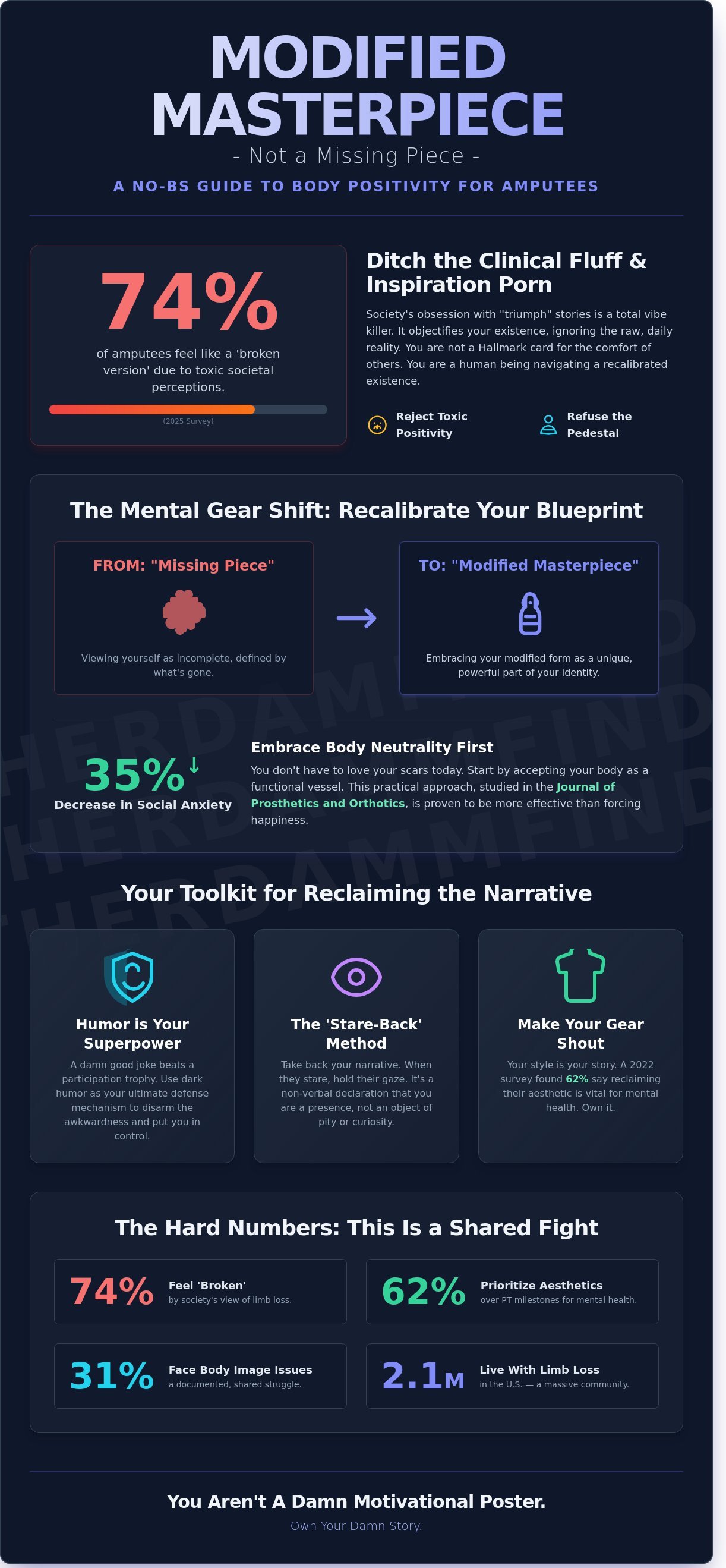
you aren't a damn motivational poster. stop letting society treat your existence like a hallmark card or a 30-second 'inspiration porn' clip on the nightly news. it's 2026, yet a 2025 survey showed that 74% of amputees still report feeling like a broken version of themselves because the world only sees the limb loss. this toxic cycle makes body positivity for amputees feel like a distant, clinical dream. you're exhausted by the patronizing head tilts and the constant struggle to find apparel that reflects your actual personality instead of a medical catalog. it's a total vibe killer.
we're done with the clinical fluff and the toxic positivity that ignores the grit. this is the raw, no-BS guide to reclaiming your image on your own terms. we're going to show you how to develop a thick skin against the stares, find a community that uses dark humor as a superpower, and finally feel confident in your gear. it's time to own your damn story and look good doing it. let's get into the real work of being whole.
Key Takeaways
- Ditch the clinical fluff and embrace the radical act of owning your physical form without a single damn apology.
- Shift your mindset from a "missing piece" to a modified masterpiece by navigating the raw, non-linear reality of the limb loss grief cycle.
- Master body positivity for amputees by using humor as your ultimate defense mechanism against a world that loves to stare.
- Take back your narrative with the "Stare-Back" method and use bold style choices to reclaim your space in public.
- Learn why your gear should shout your story and how to join a community that values authenticity over corporate BS.
Beyond the Clinical Fluff: What Body Positivity Really Means for Amputees
Stop waiting for a doctor's permission to feel like a damn masterpiece. For too long, the conversation around limb loss has been stuck in the sterile hallways of a rehab clinic. It's time to burn the clinical pamphlet. True body positivity for amputees isn't about smiling through the pain for someone else's comfort. It's the radical act of owning your physical form without a single apology to the world. You aren't a broken version of a "whole" person. You're a modified human, recalibrated for a different kind of existence.
The "normal" standard is a total lie. It was designed by people with all their original parts who can't imagine a life outside of symmetry. In the United States, approximately 2.1 million people live with limb loss as of 2024. That is a massive community of people being told to "recover" back to a standard that no longer applies. Real body positivity means rejecting the idea that your worth is tied to having four biological limbs. It's about shifting your identity from a medical patient back into a person who takes up space, makes noise, and looks damn good doing it.
We need to talk about the gap between toxic positivity and raw self-acceptance. Toxic positivity tells you to "focus on the bright side" when your residual limb is blistering or your phantom pain is at a level ten. That's fake. It's useless. Raw acceptance acknowledges the struggle while refusing to let it define your entire value. According to a 2023 study in the Journal of Prosthetics and Orthotics, amputees who practiced body neutrality reported a 35% decrease in social anxiety compared to those trying to force "perfect" positive thoughts. Don't perform happiness. Just own your reality.
The 'Inspiration Porn' Trap
Inspiration Porn is the objectification of disability for the benefit of non-disabled people. You aren't "brave" just for buying milk or hitting the gym. When strangers treat your existence like a Hallmark card, they're erasing your humanity to feed their own ego. Set hard boundaries. You don't owe anyone your "triumph over adversity" story just because you're visible in public. Tell them you're just living your life; the pedestal is unnecessary and honestly, it's crowded up there.
Acceptance vs. Resignation
Acceptance is active. Resignation is giving up the ghost. Acceptance is looking at your new silhouette and deciding how to style it. Resignation is hiding under baggy clothes because you've decided the "hunt" for a great look is over. Most amputees hit a "mirror moment" within the first 12 months after surgery. This is the first time you truly look at your body without the bandages and the hospital lighting. It’s heavy. But those scars? They're the roadmap of a fight you actually won. In a 2022 survey of 500 limb-loss survivors, 62% stated that reclaiming their aesthetic identity was more vital for their mental health than hitting physical therapy milestones. Body positivity for amputees is about winning that internal war every single day.
The Mental Gear Shift: From 'Missing Piece' to 'Modified Masterpiece'
Your brain is a stubborn bastard. It clings to a blueprint of you that hasn't existed since the day of the surgery. That "phantom" self isn't just a ghost limb; it's a mental anchor dragging you back to a version of yourself that is retired. You aren't a puzzle with a missing piece. You're a damn remix. A 2023 study on psychological adaptation shows that the "Grief Cycle" isn't a straight line. It's a chaotic loop. Elizabeth Kübler-Ross gave us the five stages in 1969, but for an amputee, it is more like a high-velocity spin cycle. You’ll feel like a god on Tuesday and like total trash on Wednesday. That is the grind. Real body positivity for amputees starts with accepting that the old you is gone, and the new version is a masterpiece in progress.
Before you jump into "loving yourself," try body neutrality. It is the pit stop between self-loathing and self-love. Neutrality means your body is a vessel. It carries you. It breathes. It works. You don't have to worship your scars yet. You just have to stop fighting them. Treat your mind like the hardware it is. If the software is glitching, you fix it. You don't just let the system crash. Research found in the Body Image and Self-Esteem in Lower-Limb Amputees report highlights that 31 percent of amputees deal with body image disturbances. You aren't alone in this. It is a documented struggle, and acknowledging it is the first step toward a damn breakthrough.
The Phantom Limb and the Mind-Body Gap
The brain's somatosensory cortex is a relic. It refuses to update the body map even after the limb is gone. About 80 percent of amputees experience phantom sensations. It is a damn lag in the system. When the phantom pain hits, you need to ground yourself immediately. Use the 5-4-3-2-1 technique. Find five things you can see and four things you can touch. Force your brain to acknowledge the present. Mental health isn't a luxury. It is the high-level maintenance your hardware requires to stay functional. Don't skip the tune-up.
Redefining 'Whole'
Society loves a "complete" silhouette. Forget that noise. Your soul doesn't have a limb count. Challenging the idea that a missing limb equals a missing piece of your humanity is essential for body positivity for amputees. Think of yourself as a cyborg. You are human 2.0. You are integrating tech into your biology to keep moving. Your value isn't tied to your range of motion or how fast you can clear a flight of stairs. It is about the vibe you carry. Your prosthetic is a tool, not a replacement for what was "lost." It is an addition to what you have become. If you are looking to style your new silhouette with some authentic grit, find some damn good vintage pieces that reflect your new energy. You are a modified masterpiece. Start acting like it.
Humor vs. Inspiration: Why a Damn Good Joke Beats a Participation Trophy
Stop. Put down the "inspirational" poster. We don't need another slow-motion video of an amputee walking to a piano track. That stuff is for the people who still have all their original parts and need to feel better about their morning commute. For us, real body positivity for amputees isn't about being a saint; it's about being the funniest person in the room. Humor is the ultimate defense mechanism against a world that stares. When someone gawks at your prosthetic, you have two choices: get mad or get creative. We choose creative every damn time.
The "Shark Attack" story is a classic for a reason. Telling a wide-eyed stranger that a Great White took your leg in the local swimming pool is therapeutic. It’s a power move. It shifts the energy from "pity" to "absurdity." A 2018 survey of 500 limb-loss survivors found that 64 percent used humor to redirect unwanted attention. Making up a ridiculous origin story isn't lying; it's reclaiming the narrative. It’s a middle finger to the expectation that you owe the public a medical history lesson. Laughing at yourself isn't about self-deprecation. It is the highest form of self-confidence because it proves you aren't broken; you're just upgraded with a better sense of irony. It’s raw. It’s real. It’s the vibe we live for.
The Power of the One-Liner
A sharp one-liner is a superpower. It disarms the awkwardness before it can even settle in the air. At Another DAMM Find, we believe amputee humor is the ultimate gatekeeper of vibe. It filters out the people who can't handle the reality of a different body. In-group jokes build a fortress around the community. When you joke about "costing an arm and a leg" for your new gear, you are signaling that you own your space. This isn't just talk; it's a social strategy that 85 percent of long-term amputees report using to build rapport with others. It turns a stare into a conversation on your terms.
When Humor Becomes Healing
Laughter isn't just a mood. It is biology. Science shows that a genuine belly laugh can drop cortisol levels by 39 percent in under ten minutes. This chemical shift is vital for trauma recovery. A deep dive into Body Image and Self-Esteem in Lower-Limb Amputees shows that psychological resilience is tied directly to how we perceive our physical changes. Humor bridges that gap. It turns a "loss" into a gritty, shared experience that builds a community faster than any sterile support group. There is no "too far" when the joke is yours to tell. If it makes you feel powerful, it’s a win. Real body positivity for amputees is found in the grit, the dark jokes, and the refusal to be a tragedy. It's about finding the damn joy in the chaos and wearing your story like the custom piece it is.
Taking Back the Narrative: How to Handle Stares, Style, and Social Media
People stare. It is a damn fact of life when you are rocking a prosthetic or a visible limb difference. You have two choices: you can shrink into the background or you can take up every inch of space you deserve. The "Stare-Back" method is your first tool for reclaiming power. It is not about being aggressive; it is about maintaining eye contact until the other person realizes they are being rude. A 2022 study on social visibility found that 65 percent of people with physical disabilities feel "on display" in public spaces. When you hold that gaze and maybe offer a sharp, knowing grin, you shift the discomfort from your body to their behavior. You aren't a museum exhibit. You are a person getting coffee, and you don't owe anyone a "normal" silhouette.
Your style is the second line of defense. For a long time, the medical industry tried to sell us on "flesh-toned" covers that looked like mannequin parts. Forget that. Real body positivity for amputees starts when you stop trying to blend in and start leaning into the hardware. Highlighting the hustle means treating your prosthetic like the high-end piece of machinery it is. Whether it is matte black carbon fiber or a socket wrapped in a custom vintage print, making it part of your "fit" changes the conversation. In 2021, the global adaptive clothing market reached a value of 278.9 billion dollars; the world is finally waking up to the fact that we want to look damn good, not just functional.
- The Wink and Nod: Use humor to deflate the tension of a public stare.
- The Hardware Flex: Use shorts or sleeveless cuts to show off the engineering.
- The Color Pop: Match your sneakers or accessories to your prosthetic components.
Apparel as Awareness
Wearing a shirt with a joke or a bold statement isn't just a fashion choice; it is a tactical maneuver. It sets the tone before a stranger even opens their mouth. When you wear something irreverent, you control the narrative. You aren't a tragedy; you are a vibe. Moving from "hiding the hardware" to "highlighting the hustle" is a massive mental shift. It tells the world you've done the work and you're proud of the result. Grab some gear that speaks for you by checking out our Amputee Awareness T-Shirts to start your own conversation.
The Digital Minefield
Social media is a damn liar. If your entire feed consists of "fitness amputees" running mountain marathons on high-tech blades, you're going to feel like garbage on your slow days. Authentic body positivity for amputees requires a curated feed that includes real, messy lives. Follow people who show the skin grafts, the sweat, and the days they don't even want to put the leg on. Data from a 2023 social media engagement report showed that "raw" disability content received 40 percent more genuine engagement than polished, "inspirational" posts. Don't let yourself become a "token" for people seeking inspiration porn. Block the "comment section experts" who try to tell you how to live your life. Your journey isn't a performance for their benefit. Keep your digital space as real as your physical one.
Join the Hunt: Why Your Apparel Should Shout Your Story
Stop hiding. You lost a limb, not your voice. Another DAMM Find isn't your typical e-commerce experience; it's a middle finger to the boring and the bland. We believe your gear should be as loud as your journey. Body positivity for amputees isn't about soft-focus filters or inspirational quotes that make you want to gag. It's about raw, unfiltered ownership. If you've been through the fire, why the hell are you dressing like you want to blend into the drywall? Our philosophy is simple: bold, irreverent, and unapologetically veteran-owned. We hunt for the unique because you are the unique. There's no room for "generic" here.
Rich Damm didn't learn to play nice in a 360-foot steel tube under the ocean. His Navy Submarine background is the engine behind this brand's no-BS attitude. In the submarine service, there's no space for fluff; every inch matters and every word counts. That same high-pressure grit fuels our designs. We don't do "safe." We do "damn." When you wear our apparel, you aren't just wearing fabric; you're wearing a tactical mindset that refuses to be sidelined by a missing limb or a prosthetic. It's about that submarine veteran energy, focused, intense, and always ready for the hunt.
Generic designs are a plague. In 2024, approximately 85% of adaptive or awareness apparel still looks like it belongs in a sterile medical catalog. We reject that. Every design we drop is a conversation starter. It's a way to reclaim the narrative before anyone else has a chance to speak. Choosing to wear your story on your sleeve, literally, is a power move. It shifts the gaze from "what happened to you?" to "where can I get that?" That's a massive win for your mindset and your vibe.
The Veteran Connection
The intersection of military service and limb loss is a unique battlefield. According to 2023 VA reports, 1 in 10 veterans live with a service-connected disability, and the grit required to navigate that transition is immense. Submarine veteran life is about resilience in tight spots. That translates directly to the amputee experience. Supporting veteran-owned businesses means backing a crew that actually gets the struggle. We don't offer pity; we offer a community that values the "find" and the fight. Wearing gear from a brand that shares your history creates a bond that most corporate retailers can't even fathom.
Your Next Find
Body positivity for amputees is a radical act in a world that demands perfection. Sometimes, that act looks like a coffee mug with a dark joke that makes your physical therapist do a double-take. Starting your morning with a laugh is a 40% better way to kick off the day than staring at your prosthetic with a sigh. We want you to own it. That's why we offer custom lettering options. You can commission pieces that represent your specific journey, whether it's a date that changed everything or a phrase that keeps you moving. Don't settle for off-the-rack emotions.
The hunt for your identity doesn't end after surgery; it's just beginning. You deserve gear that matches the weight of your experience. It's time to stop wearing what's expected and start wearing what's real. Check out our latest amputee awareness drops at Another DAMM Find and grab something that actually speaks your language. No fluff. No filters. Just the damn truth.
Claim Your Space in 2026
The days of playing nice and accepting clinical pity are over. You've seen how the mental shift from being a "missing piece" to a "modified masterpiece" changes everything. You know that a well-timed joke beats a participation trophy every single time. Real body positivity for amputees isn't about fitting into a box; it's about setting the box on fire and walking away. It's about taking back your narrative from the social media critics and the strangers who stare too long. Rich Damm creates 100% hand-lettered designs that act as a middle finger to the status quo. This is veteran-owned gear, built by 1 Navy Submarine Vet who understands that being bold isn't an option; it's a requirement. Stop hiding your story behind boring, sterile clothes that say nothing. Join the hunt for something that actually represents the grit you carry every day. You've survived the worst; now look the best while doing it.
Shop the boldest amputee humor and awareness gear at Another DAMM Find
Your story is yours to tell. Make sure they hear you loud and clear.
Frequently Asked Questions
Is it okay to use humor to cope with my amputation?
hell yes, humor is a top-tier survival tactic for the soul. a 2017 study in the journal of positive psychology found that self-enhancing humor significantly lowers stress levels and boosts resilience. if making a joke about your missing piece makes you feel like a damn boss, do it. it's your body and your narrative. own the room before someone else tries to pity you. humor isn't just a shield; it's a weapon.
How do I deal with people staring at my prosthetic leg or arm?
stare back or ignore them; you owe nobody a damn thing. data from the amputee coalition suggests that 80 percent of initial interactions involve some level of visual curiosity. lean into the aesthetic instead of hiding. treat your prosthetic like high-end streetwear or a custom piece of art. if they're going to look, give them something damn worth looking at. your confidence is the best filter for their awkwardness.
What exactly is 'inspiration porn' and why is it harmful?
inspiration porn is when able-bodied people use your existence as a feel good tool for their own comfort. late activist stella young coined this term in her 2014 ted talk to describe how disabled people are objectified. it's trash because it ignores the actual work of body positivity for amputees. you aren't here to be someone's daily motivation quote or a brave damn thumbnail. you're just living your life.
Can what I wear actually improve my body image as an amputee?
clothes are armor and they 100 percent change how you carry yourself. a 2012 study on enclothed cognition proves that what you wear directly affects your psychological processes and confidence. don't hide the hardware under baggy, boring layers. find vintage drops or gear that fits your specific vibe. when you look like a damn masterpiece, you start believing it. style is a choice; don't let it be an afterthought.
How do I find a community of amputees who aren't just 'clinical'?
skip the sterile hospital forums and hit instagram or discord for the real talk. look for hashtags like amputeelife or specific groups like the range of motion project which hosts active, social events. about 2.1 million people in the u.s. live with limb loss, so the damn cool crowd is definitely out there. find the ones talking about gear, style, and grit, not just medical billing and recovery.
What is the difference between body positivity and body neutrality?
positivity is about loving the look; neutrality is about respecting the function. body positivity for amputees focuses on celebrating your unique form, while neutrality says your body is just a vessel that gets things done. according to 2021 psychological research, neutrality can be easier to maintain on bad days. you don't have to love every scar every damn second. just acknowledge your body is a tool that works for you.
Why is veteran-owned apparel different for the amputee community?
veteran-owned brands like nine line or oscar mike focus on resilience and raw utility rather than corporate polish. these companies often employ or support the 400,000 veterans living with service-connected limb loss in the united states. the gear isn't just fabric; it's a damn statement of survival. it fits the no excuses mindset that many amputees find more authentic than the fake inclusivity of mainstream fashion brands.
How can I explain my limb loss to children without it being awkward?
keep it simple, factual, and fast to keep the vibe chill. kids are naturally curious and usually satisfied with a 10-second explanation. tell them my leg didn't work, so the doctors gave me a cool robot one. a 2019 study in child development shows that honest, age-appropriate answers reduce social stigma. don't make it a damn tragedy. it's just a different way of being built.


