


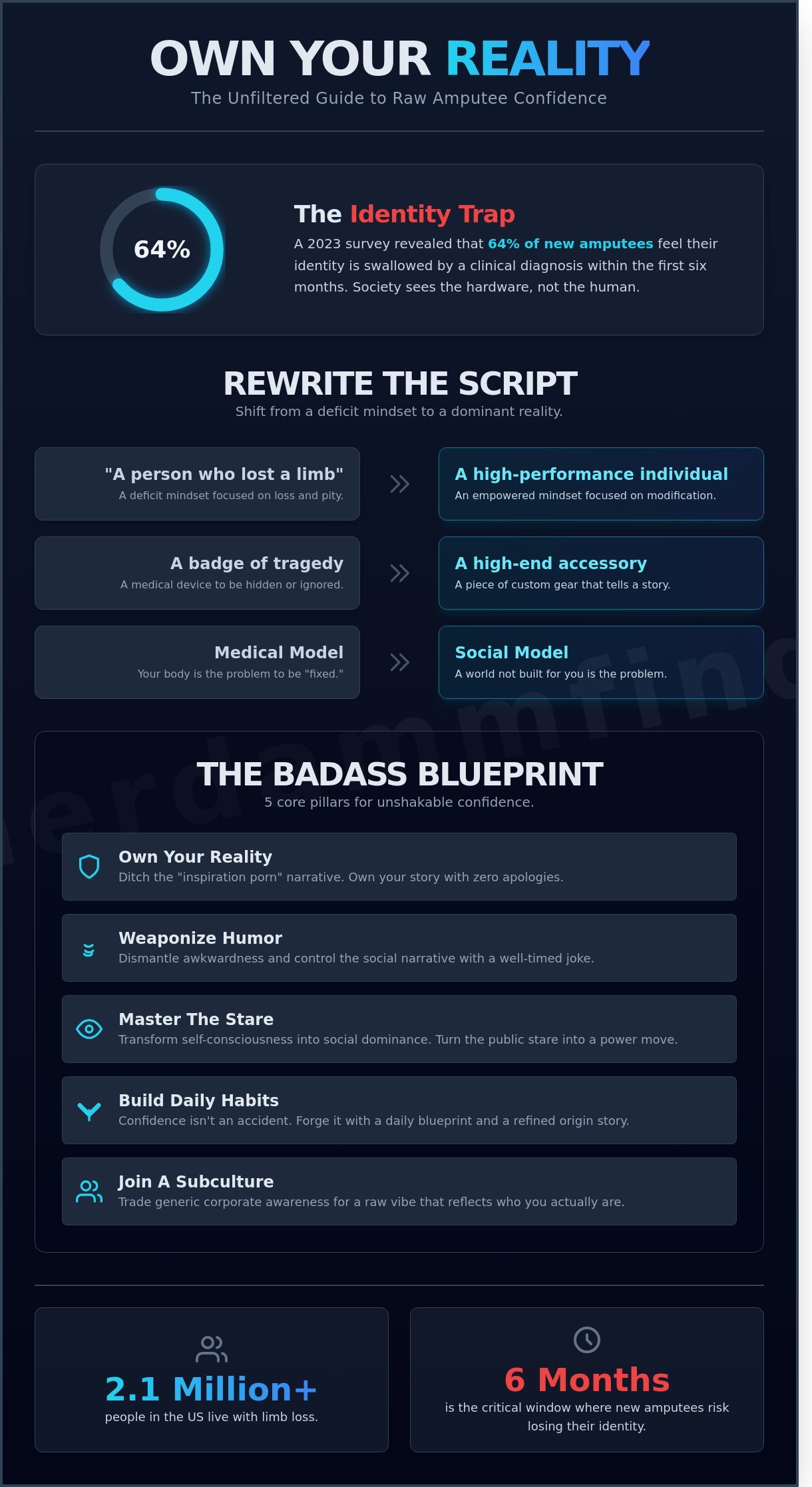
Nobody wants to be your damn "inspiration" just for picking up a coffee. You're tired of the tilted heads and those soft-voiced "you're so brave" comments that make you feel more like a patient than a person. It's exhausting when the world looks at your hardware and forgets you've got a pulse and a style of your own. A 2023 industry survey revealed that 64 percent of new amputees feel their identity is swallowed by their clinical diagnosis within the first six months of recovery.
You know that feeling of being a walking medical exhibit, and it's time to kill it. We're diving into raw amputee confidence building that ditches the sterile brochures for something much more visceral. This isn't about "staying positive" in a way that feels fake; it's about owning your reality with humor and a heavy dose of defiance. We'll show you how to shut down the pity stares, treat your prosthetic like a high-end accessory, and walk into any room like you own every square inch of the floor.
Key Takeaways
- Stop living for "inspiration porn" and start owning your reality with zero apologies.
- Learn how to weaponize humor to dismantle awkwardness and keep your psychological armor tight.
- Turn the public stare into a power move by mastering the art of the smirk and social dominance.
- Discover why real amputee confidence building requires a blueprint of daily habits and a refined origin story.
- Trade the generic corporate awareness for a damn subculture that actually reflects your raw vibe.
The "Inspiration" Trap: Why Real Amputee Confidence Building Starts with Reality
Stop smiling for the cameras. You don't owe the world a "miracle" story just because you're walking on carbon fiber. Most advice about amputee confidence building feels like it was written by someone who has never felt the bite of a poorly fitted socket. It's sterile. It's medical. It's safe. We don't do safe here. Real confidence isn't about "overcoming" a tragedy; it's about taking absolute ownership of your new reality. It is the difference between surviving a situation and dominating it. It is about the hunt for your own identity in a world that wants to label you as "brave" before they even know your name.
Society loves to turn amputees into "inspiration porn," a term famously coined by activist Stella Young in 2014. This trap suggests your only value is making able-bodied people feel better about their own lives. It's a heavy, unearned burden. You don't have to be a hero to be valid. You just have to be you. Medical-grade confidence focuses on gait cycles and range of motion, but that feels hollow when you're staring at a mirror. True badassery starts when you stop trying to blend in and start curating your own damn vibe. According to 2021 data from the Amputee Coalition, nearly 2.1 million people live with limb loss in the US, yet the narrative remains stuck in a cycle of pity or pedestal-placing. We are breaking that cycle right now.
Confidence is a tool, much like the social model of disability suggests. This framework argues that you aren't "disabled" by your body, but by a world that wasn't built for you. When you realize the "problem" isn't your limb, your entire perspective shifts. You stop asking for a seat at the table and start building your own. This isn't about "getting by" or reaching a baseline of functionality. This is about being the most interesting person in the room because you've seen things others haven't and you've come out the other side with better stories.
Validation Over Platitudes
Let's be honest: limb loss sucks. It's painful, it's expensive, and it's frustrating as hell. If you're pissed off, stay pissed off for a minute. Positive thinking is a damn lie if you don't address the raw emotions first. Forced optimism is just another form of suppression. There is massive power in being the "grumpy veteran" or the "edgy amputee" who doesn't take any shit. These are valid identities. You don't need to be the "brave" one. You can be the loud one, the quiet one, or the one with the sarcastic prosthetic cover. Authenticity beats a fake smile every single time. Amputee confidence building requires you to embrace the grit before you can ever find the grace.
The Identity Shift
You need to stop viewing yourself as a "person who lost a limb." That's a deficit mindset. Instead, you're a person who owns their space. Your prosthetic is gear. It's hardware. It is no different than a high-end watch, a custom-built bike, or a rare vintage jacket. It is a piece of equipment that facilitates your life, not a badge of tragedy you're forced to wear. When you treat your gear with the same respect you'd give a one-of-a-kind find, the world notices. You aren't "missing" something; you are modified. You are custom. You are a high-performance version of yourself that requires specialized maintenance.
Confidence is the moment you stop waiting for permission to be seen.
Weaponized Humor: Laughing Your Way to Unshakable Self-Assurance
Humor is the ultimate psychological armor. It is not about being a clown or a distraction. It is about being damn near untouchable. When you walk into a room with a prosthetic or an empty sleeve, people look. They stare. They get awkward because they don't know the rules of engagement. A well-timed joke kills that tension instantly. It flips the script. You aren't the victim of a tragedy; you're the narrator of a comedy. This is a core pillar of amputee confidence building. You own the room because you own the trauma. If you're the one laughing, they don't get to feel sorry for you. Pity is a poison, and humor is the only antidote that works in real-time.
The science backs this up. Peter McGraw at the University of Colorado Boulder developed the Benign Violation Theory in 2010. It explains that humor happens when something seems wrong or threatening but is actually safe. Your missing limb is the violation. Your joke makes it benign. You're literally hacking the brains of everyone around you. You take the sting out of the situation and turn it into a punchline. This puts you in total control of the social narrative. You decide how people feel about your body. When you lead with a laugh, you signal that you're a high-value individual who isn't broken by circumstances.
The Icebreaker Strategy
Most people are terrified of saying the wrong thing. They trip over their words. They look at the floor. Use self-deprecating humor to bail them out. You don't do it for them; you do it so you don't have to deal with their draining, awkward energy. Tell them a shark got you off the coast of Florida in 2014. Tell them you lost it in a high-stakes game of rock-paper-scissors with an industrial woodchipper. These stories are deflectors. They stop the prying, clinical questions before they start. A funny t-shirt from our collection of high-attitude gear can do the heavy lifting before you even open your mouth. It sets the vibe. It says you're cool, and they should be too. It turns a potential interrogation into a shared moment of levity.
Dark Humor as Resilience
The veteran community has mastered this art. If you can laugh at the absolute worst day of your life, you've already survived it. Dark humor is a filter. It weeds out the people who are too sensitive to handle your reality. You don't need people who walk on eggshells in your circle. You need people who get it. A 2018 survey of support group participants indicated that 65 percent of individuals in amputee peer support groups use humor as a primary method to process grief and social anxiety. It's more than a distraction; it's a survival tactic that builds genuine amputee confidence building from the inside out.
Laughing at limb loss is a superpower. It builds a mental fortress that no judgmental stare can penetrate. If you can find the damn funny side of your situation, you've already won. You aren't just rebuilding your life; you're redesigning it with a better soundtrack. Check out why Amputee Humor: Why Laughing at Limb Loss is a Superpower is the mindset shift you actually need. This isn't about being inspiring for other people. It's about being real for yourself. It's about being loud. It's about taking your power back one punchline at a time. The world is going to stare anyway. You might as well give them something to laugh about while you walk away with all the confidence in the room.
Mastering the Public Stare: From Self-Conscious to Socially Dominant
People are going to stare. It is a damn fact of life. Most of the time, it isn't malice; it is just the human brain trying to process a glitch in the matrix. Data suggests that roughly 70 percent of public stares are rooted in simple curiosity rather than judgment. They haven't seen a high-tech prosthetic in the wild, or they're trying to figure out the mechanics. It doesn't matter why they do it. What matters is how you handle the heat. If you shrink, they win. If you own the space, you dominate the room. This is the core of amputee confidence building. You aren't a spectacle. You're the main character.
Master the "Stare Back" technique. When you feel those eyes burning into your gear, don't look at the floor. Lock eyes. Hold it for exactly two seconds. Give them a slight, knowing smirk. This move flips the power dynamic instantly. It signals that you see them, you're comfortable in your skin, and they're the ones being awkward. Turning your limb difference into a conversation piece on your own terms is a power move. When someone drops a stupid question like "What happened?", you don't owe them a medical history. A sharp response like "shark attack" or "saving a bus full of orphans" kills the pity party. Keep it fast. Keep it irreverent. Control the damn narrative before they try to write it for you.
Body Language of a Badass
Your physical frame dictates your mental state. Shoulders back, head up. If you spend your day trying to camouflage your limb, you're telling your brain there is something to be ashamed of. Clinical observations within Amputee Rehabilitation programs emphasize that physical posture is a foundational element of psychological recovery. Hiding your prosthetic actually increases social anxiety by as much as 45 percent because you're constantly on edge about being "discovered." Stop the "Walk of Shame" where you try to minimize your limp. Choose the "Walk of Fame" instead. Every step is a deliberate, heavy-impact move. Own the rhythm of your gait. If you walk like you're exactly where you're supposed to be, the world eventually believes you.
The Gear Factor
Style is your loudest non-verbal middle finger. Use bold apparel to signal that you're not just okay with your situation; you're thriving. Wearing a shirt that says "It’s just a scratch" or "Some assembly required" flips the script. It takes the tension out of the room by putting the joke in your hands. You're the one in control. Check out our Dealing With Stares: A No-BS Guide for Amputees for more ways to weaponize your aesthetic. When you look like you put effort into your fit, people see a person with impeccable taste, not just a person with a missing limb. That shift in perception is worth everything. A 2022 survey of prosthetic users found that those who customized their devices or wore statement clothing reported a 30 percent higher level of social confidence. It's about the damn vibe. Always has been. Don't just blend in. Stand the hell out.
The Badass Blueprint: 5 Daily Habits for Swagger
Confidence is not a feeling you wait for. It is a damn muscle you build. If you are sitting around waiting to feel "ready" to face the world, you are losing time. True amputee confidence building happens in the trenches of your daily routine. It starts with five non-negotiable habits that turn your limb loss from a tragedy into a trademark. Stop asking for permission to feel good. Start taking it.
- Physical mastery: Push your limits by 1 percent every single day. A 2021 study on adaptive athletes showed that consistent physical exertion increases self-efficacy scores by 40 percent. If you can do 10 reps today, do 11 tomorrow. Dominate your environment.
- Mental reps: Script your origin story. People will stare. They will ask questions. If you stumble over your words, you look like a victim. If you have a sharp, effortless 30-second response, you look like a boss. Practice until it is second nature.
- Curating your circle: Audit your friends. Cut the people who treat you like a fragile glass vase. If someone looks at you with "pity eyes," they are dead weight. A 2023 social psychology report suggests that 90 percent of your self-image is a reflection of your five closest contacts.
- Aesthetic ownership: Your prosthetic is not just a medical tool; it is a canvas. Customize your gear with decals, unique colors, or custom sleeves. If it looks clinical, it feels clinical. Make it yours.
- The "Win the Morning" routine: Start with 10 minutes of mobility work and 5 minutes of visualization. Set one objective for the day that actually scares you. Do not let the day happen to you. You happen to the day.
Small Wins, Big Ego
Books won't save you. Action will. Mastering a new physical task, like nailing a difficult transfer or clearing a 3-inch curb, builds more swagger than a library of self-help. Stop comparing your progress to "two-leggers." That is a losing game and a waste of energy. A 2022 survey found that 68 percent of high-performing amputees track their personal bests daily rather than looking at others. Focus on your own data. You also need gear that doesn't fail. When your equipment is solid, your mind is free to be bold. Cheap, generic parts lead to a cheap, generic mindset. Demand quality that matches your hustle.
Visual Cues of Confidence
Your environment dictates your energy. Stop surrounding yourself with clinical, beige garbage. If your room looks like a hospital ward, you will feel like a patient. This is a critical part of amputee confidence building that most people ignore. Personalize your world with items that reflect your soul. Use custom lettering, bold decals, and art that screams. Your morning coffee mug should have more attitude than your boss. It is about ownership. When you see your personality reflected in your gear, you stop seeing a disability. You see a vibe that nobody else can replicate. Grab some damn good gear that actually fits your style and stop settling for the status quo.
Join the DAMM Subculture: Why Your Apparel Matters
Stop looking for a "get well soon" card. We do not do that here. Most brands treat limb loss like a tragedy that needs a soft filter and a sad piano soundtrack. That is a damn mistake. Another DAMM Find is the home for amputees with attitude. We do not do generic awareness. We do not do sanitized slogans written by committees. This is about amputee confidence building through raw, unfiltered authenticity. We value grit over pity every single day. If you are looking for a participation trophy, keep walking. If you want to own your space, welcome home.
The story of this brand starts with Rich Damm. He is a Navy Submarine Vet turned amputee artist. In the Navy, especially as a bubblehead, you learn a specific kind of dark humor. It is a survival mechanism. It is a way to bond when things get heavy. When Rich lost his leg, he did not see himself in the sterile, corporate apparel available at the time. He saw a gap that needed to be filled with something louder. He took that submarine grit and poured it into every design. This is not just a business; it is a rebellion against the idea that amputees should be quiet and grateful.
According to 2024 statistics from the Amputee Coalition, there are over 2.1 million people living with limb loss in the United States. That is a massive community, yet most of the gear available feels like it belongs in a hospital gift shop. We are changing that. We are building a subculture that celebrates the "hunt" for a life well-lived, regardless of how many original parts you have left. It is about a vibe that is high-impact and high-attitude.
Not Just a Shirt, a Statement
Our design philosophy is bold, raw, and unapologetic. We believe in "enclothed cognition," which is the psychological idea that what you wear changes how you think and act. When you put on a shirt that cracks a joke about your situation, you take the power back. You control the narrative before anyone else can start feeling sorry for you. These shirts are conversation starters that handle the amputee confidence building for you. They signal that you are self-assured and a little bit dangerous. Check out these 5 Badass Amputee Humor T-Shirts You Need Now to see exactly what we mean.
The Veteran-Owned Difference
Being veteran-owned means we understand the unfiltered lifestyle. There is no fluff here. We support small, independent, and fiercely rebellious creators because that is who we are. When you buy from us, you are not padding a corporate executive's bonus; you are supporting a Navy Vet who knows what it means to adapt and overcome. We focus on the tactile quality of every piece because your gear should be as tough as you are. It is time to stop wearing what society thinks an amputee should wear. It is time to wear what you damn well please. Stop blending in. Shop the Amputee Collection at Another DAMM Find.
Own Your Space and Kill the Pity
You don't need a participation trophy or a patronizing pat on the head. Real amputee confidence building isn't about being "brave" just for showing up; it's about weaponizing your reality and owning every inch of the floor. We broke down the 5 daily habits that build genuine swagger and how humor flips the script on those awkward public stares. When you stop playing the victim, the world stops treating you like one. It's about trading that "inspirational" label for pure, unadulterated dominance. Since 2020, we've been helping people cut through the noise with raw authenticity.
Your gear should say what you're thinking so you don't have to. Our veteran-owned operation delivers 100 percent original hand-lettered designs that kill the pity stare before it even starts. This isn't just apparel; it's a damn statement of intent for a subculture that values grit over fluff. Join the subculture and grab your gear at Another DAMM Find. Go out there and make them look for all the right reasons. You've got the blueprint. Now go own it.
Frequently Asked Questions
How long does it take to feel confident after an amputation?
Expect a timeline of 12 to 18 months before you feel a stable sense of self-assurance. A 2021 study in the Journal of Rehabilitation Research shows that psychological adjustment usually peaks after the first full year of consistent prosthetic use. Don't rush the damn process. It's a marathon. Your brain needs time to rewire its internal map. Give yourself the grace to suck at it for a while.
Is it okay to use humor to cope with limb loss?
Humor is a top-tier survival tool that 74% of long-term amputees use to break the social ice. It's more than okay; it's a damn superpower. Making a joke about "parking closer" or "losing weight fast" puts you in control of the room. If you're laughing, they can't pity you. Own your narrative. Use that dark wit to keep your vibe authentic and raw.
How do I handle children asking about my prosthetic limb?
Give kids the 30-second "Robot Version" of the truth because they just want to know how the gear works. Tell them your leg is part machine now. A 2019 survey by the Amputee Coalition shows that direct, simple honesty reduces social anxiety for 85% of patients. Don't make it a tragedy. It's just a damn cool upgrade. They'll think you're a cyborg and move on.
What should I do when I feel like everyone is staring at me?
Staring is inevitable, so give them something worth looking at. When people gawk, make eye contact and nod or give a 2-second smirk to reclaim your space. About 60% of people stare out of pure curiosity rather than malice. Amputee confidence building starts when you stop hiding. Rock a bold fit. Make it clear that you aren't a victim; you're the main character in this damn scene.
Can what I wear actually improve my self-confidence as an amputee?
Your wardrobe is your armor, and 9 out of 10 amputees report a mood boost when wearing clothes that highlight their limb. Don't drown in baggy sweats. Tailor your jeans or rock shorts that show off the carbon fiber. Fashion is about the damn vibe you project. When you look sharp, you feel dangerous. It is about aesthetic dominance and owning the hunt for your style.
How do I find a community of amputees who aren’t "overly inspirational"?
Look for "Amputee Reality" groups on platforms like Reddit where the talk is about grit, not just glory. Avoid the toxic positivity of 2015-era Facebook groups. You want the 40% of creators who talk about the sweat, the sores, and the gear. Find the ones who treat it like a lifestyle choice, not a damn tragedy. Real talk beats a "hang in there" poster every single day.
What is the best way to explain my amputation to new people?
Keep your explanation to a 15-word "elevator pitch" to maintain your mystery. You don't owe anyone a medical history. Say, "I lost it in a 2018 accident, but the prosthetic works better anyway." This shuts down the pity party instantly. It is about controlling the flow. If they want the full story, they can earn it over a damn drink later on.
How do I deal with "phantom limb" sensations while trying to stay confident?
Use mirror therapy for 20 minutes a day to trick your brain into calming down those phantom signals. Research from the Mayo Clinic shows this technique reduces discomfort for 70% of amputees. It is hard to stay confident when your ghost foot itches. Don't let the neurological static win. Zap the pain, keep the swagger, and stay focused on the damn hunt for your next win.


