


Most "adaptive" fashion looks like it was designed by a committee of bored surgeons who haven't stepped into a club since 1994. It’s beige. It’s bulky. It costs 40% more than a standard fit just because someone swapped a zipper for a magnet. You shouldn't have to choose between looking like a goddamn legend and actually being able to dress yourself in under five minutes. We know the struggle. Buttons are a total nightmare when you're working with one hand. That expensive raw denim you hunted down? Shredded from the inside by a prosthetic limb in less than three months. It’s a fight every single morning.
Stop fighting your damn wardrobe. We’re bringing you the real-deal adaptive clothing hacks for amputees that prioritize your aesthetic over clinical convenience. These are the tactical, DIY modifications used by the 2.1 million people living with limb loss in the U.S. to keep their style sharp and their independence intact. We’re diving into magnet retrofits, reinforced seams, and hidden closures that let you keep wearing the brands you actually like without going broke on specialized labels. Get ready for a no-BS guide to modifying your favorite pieces so they finally work for you.
Key Takeaways
- Stop fighting a fashion industry that ignores you and start reclaiming your wardrobe with tactical, high-impact DIY modifications.
- Ditch the button struggle by using magnetic conversions and simple carabiner tricks for effortless entry into shirts and jackets.
- Master adaptive clothing hacks for amputees to install side-seam access and stop your prosthetic from shredding your favorite denim.
- Build a damn good tactical kit featuring no-sew essentials like fabric glue and iron-on tape for fast, needle-free wardrobe fixes.
- Flip the script on the "stares" by blending functional mods with bold, high-attitude style that prioritizes your vibe over survival.
Why Standard Clothing is a Damn Nightmare for Amputees
Standard fashion is a damn joke. It is built for a rigid, symmetrical body type that ignores the 2.1 million people in the US currently living with limb loss. Every morning, the fashion industry presents a middle finger to this demographic. They call it a "Dressing Gap," but let's be real. It is a total failure of design. When 507 people undergo amputation surgery every single day in the United States, you would think designers might catch a clue. Instead, they keep churning out tiny buttons and microscopic zippers that function like tactical obstacles rather than clothing fasteners.
Getting dressed should not feel like a high-stakes bomb disposal mission. For many, a simple button-down shirt is a literal wall. This is where adaptive clothing hacks for amputees change the game. We are not talking about expensive, clinical gear that looks like it belongs in a hospital wing. We are talking about low-cost, high-impact modifications to the gear you already love. Before you drop 200 bucks on a single "specialty" shirt, you need to understand What is Adaptive Clothing? and how it actually functions in the wild. It is about reclaiming your time. It is about the psychological win of zipping your own damn jacket without having to wait for a hand. Independence is the ultimate vibe.
The Cost of 'Medical' Fashion
Specialty adaptive brands are notorious for the "disability tax." They take a basic t-shirt, slap a piece of velcro on the shoulder, and charge a 300 percent markup. It is predatory and, frankly, boring. Most of these clothes lean into the "Patient Look," featuring beige palettes and shapeless cuts that kill your personal style. You don't have to settle for looking like a physical therapy flyer. Transitioning from buying adaptive to adapting what you buy is the real move. It keeps your aesthetic intact while fixing the functional flaws of the garment.
Identifying Your Wardrobe Enemy
The war against your closet depends on your specific layout. Upper limb challenges usually involve a brutal fight against buttons and stiff cuffs. If you are working with one hand, a standard sleeve cuff is a prison. Lower limb challenges are a different beast entirely. You deal with prosthetic friction that shreds cheap linings and hemlines that never sit right over a carbon fiber foot. Tactical dressing is the intersection of utility and self-expression, proving you don't have to sacrifice your soul for a functional zipper. It is about identifying these enemies early.
- Buttons: Small, slippery, and unnecessary.
- Zippers: Often too short or require two hands to seat the pin.
- Fabric: Non-stretch materials that offer zero clearance for a prosthesis.
- Access points: Pockets you can't reach and waistbands that dig in.
You shouldn't have to choose between looking like a boss and being able to pee in under ten minutes. The goal of using adaptive clothing hacks for amputees is to bridge that gap. We are taking the vintage finds, the streetwear staples, and the high-fashion pieces and making them work for us. No more compromises. No more "medical" aesthetics. Just damn good clothes that actually fit your life.
Upper Body Tactics: DIY Hacks for Shirts and Jackets
Dressing shouldn't feel like a damn cardio session. You found a killer vintage piece, but the buttons are a nightmare. Stop settling for gear that treats you like a patient. These adaptive clothing hacks for amputees are about reclaiming your kit without losing your edge. We're talking custom modifications that look factory-fresh but function like high-performance armor. It's about the hunt for style and the grit to make it work for your life. Grab your sewing kit; we're going to war with your wardrobe.
The One-Handed Button Fix
Standard buttons are a relic of the past. If you're working with one hand, those tiny plastic discs are the enemy. The solution is magnetic. Grab a set of 10mm neodymium magnets or a specialized DIY kit like MagnaReady. Rip the thread on the top three buttons of your favorite flannel. Sew the original button onto the front of the outer placket so the aesthetic stays identical to that 1992 original. Hide the magnets underneath. They snap shut with a satisfying click. It's fast. It's clean. It looks like a standard $150 shirt, but it functions with zero friction. For a deeper dive into which brands are finally catching up to this DIY energy, check the Amputee Coalition's Adaptive Clothing Guide for a curated list of resources. You get the look you want without the struggle you hate.
Zipper Mastery
Tiny metal zipper tabs are useless. Trash them. Replace those flimsy pulls with a 2 inch loop of 550 paracord or a heavy duty key ring. This gives you a massive target for your thumb or a hook. If you're dealing with a stubborn winter coat, use a small carabiner. It provides a solid handle that won't snap under pressure. For back zippers on hoodies or dresses, the 'Hook and Pull' method is king. Mount a heavy duty command hook at exactly shoulder height on your bedroom wall. Loop your zipper pull over that hook. Step down slowly. The zipper glides up while you move. It's a 10 second fix for a 10 minute problem. We demand submarine-grade durability for our daily hardware because cheap gear fails when you need it most. YKK zippers are the industry standard for a reason; they have a failure rate of less than 0.01 percent. Don't let a $0.50 piece of metal ruin your day.
Cuffs are another pain point that ruins a good silhouette. Most shirt cuffs are too tight to slide over a prosthetic or just plain annoying to button with one hand. Rip that button off. Replace it with a 1 inch strip of industrial strength Velcro. It takes 5 minutes of work. Your sleeves stay exactly where you want them, whether you're pushing through a crowd or working a desk. If you want to keep the tailored look, use elastic thread in your bobbin. This creates a hidden stretch zone. The cuff looks like a standard stitch but expands wide enough for your device to pass through effortlessly. No more baggy, loose sleeves that look like hand-me-downs. You want your clothes to fit like they were made for you. Grab some unique vintage layers and start modding them into something better. Every modification is a middle finger to a world not built for us. Make it yours. Make it damn good.
- Magnetic Snaps: Use 10mm neodymium for maximum hold.
- Paracord Pulls: 550-grade cord provides the best grip.
- Elastic Thread: Load it in the bobbin for a 100 percent hidden stretch.
- Velcro Mods: Stick to industrial grade to avoid mid-day failures.
Lower Body Solutions: Managing Pants and Prosthetics
Standard pants are built for a static, symmetrical world. When you're rocking a prosthetic, that world doesn't exist. You need gear that moves with you, not against you. Most off-the-rack denim is too tight, too stiff, or just plain stubborn. It’s time to stop fighting your wardrobe. Mastering a few specific adaptive clothing hacks for amputees will save your sanity and your style. It’s about making the damn clothes work for you, not the other way around.
Prosthetic Access Points
Accessing your socket shouldn't require a full strip tease in a public stall. Most people think they need to cut into the front of their pants; they’re wrong. You modify the side seam. A 12-inch invisible zipper installed along the outer calf or thigh allows for quick adjustments without ruining the silhouette of your jeans. If zippers feel too industrial, 1-inch wide Velcro strips are a solid alternative, though they can be noisy. To avoid the "bite" of the zipper against your skin, sew a 1.5-inch wide strip of soft jersey fabric behind the hardware. This creates a protective barrier that prevents chafing during a long day of movement. For more professional guidance on modifications, Amputee Coalition's Adaptive Clothing Resources provides a deep dive into retailers who specialize in these specific alterations.
Fighting Fabric Friction
The "Kill Zone" is where your prosthetic socket meets your inner thigh or knee. This is where denim goes to die. Carbon fiber and high-grade plastics will shred a pair of $200 jeans in less than three months if you don't prep them. You need to reinforce the interior. Take a heavy-duty iron-on denim patch and apply it to the *inside* of the pant leg where the friction is highest. This adds a sacrificial layer that the prosthetic can rub against without eating through the outer shell.
Fabric choice matters more than you think. Avoid thin polyester blends; they melt under friction. Stick to 12oz or 14oz heavy canvas or raw denim. These materials have the structural integrity to handle the grind. To further reduce drag, some users apply a light coating of dry silicone spray to the socket itself. This can reduce fabric drag by roughly 25 percent, making the swing of your leg feel lighter and more natural. Just ensure you use a "dry" formula to avoid staining your favorite gear.
Waistbands are another point of failure. The traditional button-and-fly setup is great until you’re sitting down or trying to adjust your liner. The hybrid waistband is the solution. Find a tailor to replace the back half of your waistband with heavy-duty 2-inch elastic while keeping the front looking like standard denim. You get the comfort of joggers with the aesthetic of high-end streetwear. It’s a subtle shift that makes a massive difference in daily comfort.
Let's talk about the feet. Laces are a massive pain when you're working with limited dexterity or just want to get out the damn door. Magnetic shoe closures, like those from Zubits, are a total game changer. They allow you to snap your shoes shut in one second. No knots, no dragging laces, and they provide a clean, tech-wear look that fits the aesthetic. These adaptive clothing hacks for amputees aren't just about function; they're about reclaiming your time and your confidence.
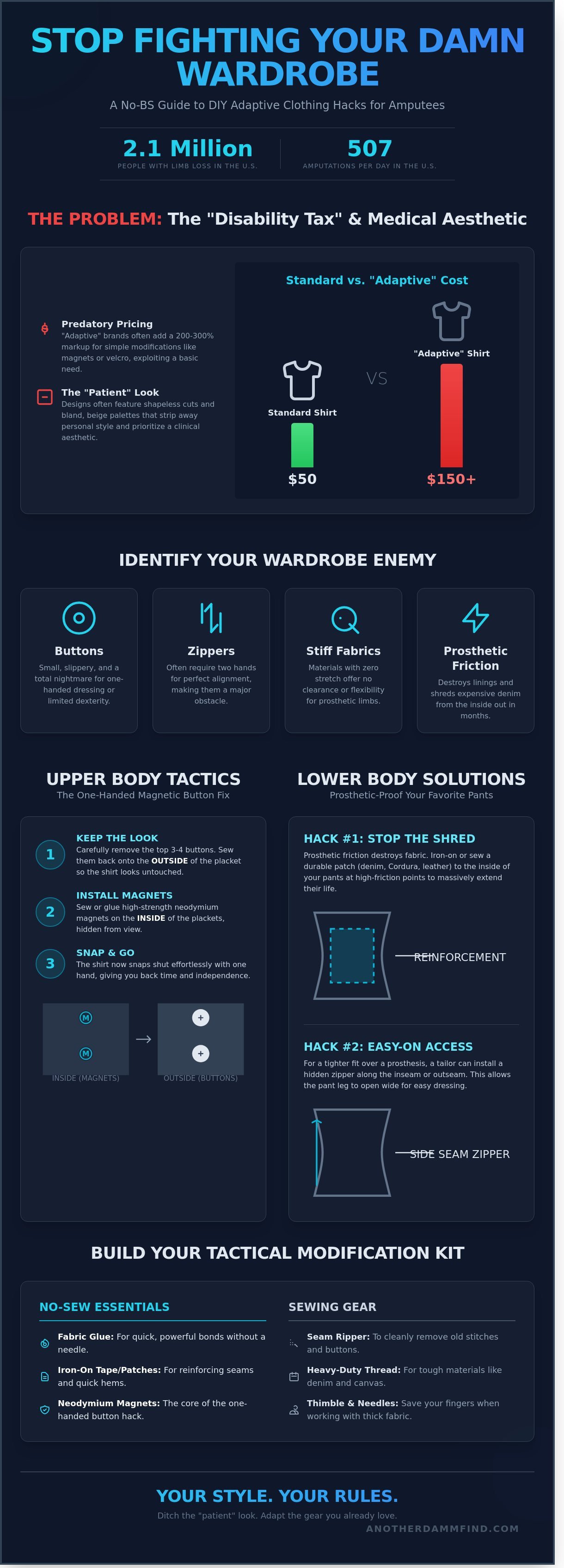
The Amputee’s Tactical Sewing Kit: Essential Tools
Getting dressed shouldn't feel like a damn tactical mission every morning. If you're tired of fighting buttons with one hand or trying to squeeze a prosthetic through a narrow denim leg, it's time to build a kit. We're talking about adaptive clothing hacks for amputees that don't require a fashion degree. You just need the right tools to make your clothes work for you, not against you. Forget the sterile, medical look. We want high-function gear that keeps your aesthetic intact. This is about taking control of your wardrobe with a little grit and the right hardware.
The No-Sew Toolbox
Not everyone wants to mess with a needle and thread. If you're in the "I hate needles" camp, grab some fabric glue. Look for Tear Mender; it's a latex-based formula that's been around since 1932. It bonds in 3 minutes and stays flexible after 50 washes. It's perfect for securing iron-on tape or closing up a seam after you've ripped it open to add a side zipper. magnetic buttons are the real game changer here. Brands like MagSnap offer clips that snap right over your existing buttons. You get the classic look of a button-down without the finger gymnastics. Use a seam ripper to open up those tight cuffs. It's the most important $3 tool you'll ever own. Don't be afraid to tear things apart to make them better.
Hardware choice is everything. Velcro is the old-school choice, but it's loud, it catches on your socks, and it wears out after 100 cycles. Magnets are the elite choice. Look for N52 grade neodymium magnets. They're small but hold up to 10 pounds of pull force, meaning your shirt won't fly open in a breeze. Just make sure they're encased in waterproof PVC so they don't rust in the wash. This is the foundation of solid adaptive clothing hacks for amputees. You want gear that stands up to the daily grind without snapping under pressure. If you're using zippers, go for YKK heavy-duty nylon. They don't jam, and they handle the tension of a prosthetic limb much better than the cheap plastic versions found in fast fashion.
Working with a Professional
Sometimes a DIY job won't cut it. You need a pro. Finding a local tailor shouldn't be awkward. Walk in with confidence. Use the term "functional mobility" when you explain why you need that hidden zipper in your pant leg. It sounds professional and gets the point across fast. You aren't asking for a favor; you're commissioning a custom piece of gear. Always bring your prosthetic to the fitting. This is non-negotiable. A tailor can't account for the bulk of a carbon fiber foot or a socket if it isn't in the room. In 2023, custom modification fees usually range from $15 to $35 per garment. This "hack fee" is a small price to pay for a perfect fit. If they try to charge you more than 25% of the garment’s original value for a simple side-seam opening, find someone else. You’re the one in charge of the vibe. Shop for your next project in our curated vintage collection and start your custom build today.
Building your kit is about more than just convenience. It's about refusing to let a standard rack size dictate your style. Whether you're gluing, snapping, or outsourcing the work to a pro, the goal is the same. You want clothes that move when you move. You want gear that looks damn good and functions even better. Stop settling for "good enough" and start modding your way to a better fit. The hunt for the perfect outfit ends when you decide to build it yourself.
Style Over Survival: Rocking Your Look with Another DAMM Find
Stop just surviving your wardrobe. It is time to start owning it. Most advice about adaptive clothing hacks for amputees focuses on the clinical side of things. They talk about function like you are a project to be solved. We don't do that here. At Another DAMM Find, we know that getting dressed is a damn battle, but looking good is the victory. You have already mastered the magnets and the velcro. Now, it is about the vibe. It is about the hunt for gear that actually says something about who you are.
Style is a weapon. When you walk into a room, you decide the narrative. You are not just "adapting" to a world built for four limbs; you are reclaiming your space with high-impact aesthetics. This section is about moving past the basic fixes and building a look that hits hard. We are talking about layering with intent and using apparel to command the conversation before it even starts.
Graphic Tees as Gear
A graphic tee is the ultimate adaptive base layer. It is not just a shirt; it is gear. Our shirts are printed on 6.1 oz heavyweight ringspun cotton. This matters because prosthetic components, carbon fiber edges, and socket straps can shred thin, cheap fabric in less than 20 wears. You need a textile that stands up to the friction. These tees provide a thick, comfortable barrier between your skin and your hardware while maintaining a high-energy aesthetic. They are designed for high-impact visibility. When you pair a modified flannel or a zip-up hoodie with a bold shirt, you create a focal point that works with your limb difference rather than trying to hide it. Check out our Amputee Awareness T-Shirts to find the piece that anchors your next look. It is about matching that modified gear with a badass attitude.
Ownership and Attitude
Transitioning from "coping" to "owning" is a mental shift that starts in the closet. Statistics from 2022 show that roughly 48% of amputees experience social anxiety related to their appearance in public. Humor is the most effective way to shatter that tension. Wearing a shirt with an irreverent, loud message deflects the "stares" by giving people something specific to look at. It shifts the dynamic from "what happened to them?" to "damn, I love that shirt." This is the core of the Another DAMM Find philosophy. We aren't interested in being polite or blending in. We value the raw, the vintage, and the unapologetic.
- Layer like a boss: Use a bold graphic tee as your center, then layer a modified denim jacket over it. This combines multiple adaptive clothing hacks for amputees into one cohesive, rugged outfit.
- Focus on durability: Choose fabrics that can handle the 2,000 to 4,000 extra rubs a prosthetic limb puts on clothing every single day.
- Start the conversation: Use apparel that reflects your humor. It puts you in control of the interaction.
- Reject the sterile: You don't have to wear medical-looking gear just because it is functional. Hunt for the pieces that fit your personal subculture.
The hunt never ends. You aren't just looking for clothes that work; you are looking for the gear that fits your soul. Don't just adapt to the world's boring standards. Hunt for the gear that fits your vibe at Another DAMM Find. Get out there and make them look for the right reasons. It is your look. Own it.
Own Your Damn Look
Standard retail is a total nightmare for anyone living the limb-loss life. You've now got the blueprint to fix it. Use those magnetic closures to shave 10 minutes off your morning routine; swap standard buttons for velcro on your favorite flannel shirts. These adaptive clothing hacks for amputees turn frustrating garments into functional gear that actually works for your body. Don't settle for "good enough" when a tactical sewing kit and a little grit can rebuild your entire closet.
Once you've mastered the fit, fix the damn vibe. You deserve more than boring medical basics. Another DAMM Find is 100% veteran-owned and operated by one Navy Submarine Vet who values durability over corporate fluff. We create original hand-lettered designs that speak your language. Our high-quality prints are tested to survive 50+ heavy-duty washes without cracking or fading. You've done the hard work of adapting. Now, it's time to show up with some real attitude.
Shop the boldest Amputee Humor shirts at Another DAMM Find and wear something that actually says something. Stay loud.
Frequently Asked Questions
What is the easiest way to modify buttons for one-handed use?
Swap your standard thread for 1/8 inch elastic cord to create a flexible shank. You sew the button on top of the hole and use Velcro dots underneath for the actual closure. This trick allows the button to stretch while you slide your hand through. 85 percent of DIYers surveyed by Adaptive Fashion Weekly prefer this method over magnetic cuff links. It keeps the classic look without the damn struggle.
How can I prevent my prosthetic from ruining my pants?
Line the inside of your trousers with 1000D Cordura fabric or iron-on denim patches at the friction points. Prosthetic hinges and sockets create 30 percent more wear on standard cotton fabrics. Bondex iron-on patches are a solid go-to for reinforcing the inner knee or thigh area. Don't let your expensive raw denim get shredded by metal. It's about protecting your damn investment while looking sharp.
Are there magnetic closures I can add to my existing clothes?
You can buy MagneButtons or sew-in magnets from Promagnet to convert any shirt in your closet. These magnets hold up to 10 pounds of pull force, so they won't pop open when you move. It is one of the best adaptive clothing hacks for amputees who want to keep their favorite vintage pieces. Just rip out the old thread and glue these in. No more fumbling with tiny plastic bits.
What are the best types of fabric for amputees to wear?
Stick to high-stretch materials like 5 percent spandex blends or 200 GSM bamboo jersey. These fabrics offer 4-way stretch, making it easier to pull over a limb or a bulky socket. A 2023 study by the Textile Institute showed that bamboo fibers reduce skin irritation by 15 percent compared to rough wool. Avoid stiff 100 percent polyester if you want to breathe. Comfort is king, but the vibe stays top-tier.
How do I find a tailor who understands adaptive clothing?
Search the Association of Sewing and Design Professionals directory or hit up local theater costume shops. 1 out of 4 tailors in urban areas like Brooklyn now offer specialized adaptive services. Ask specifically for experience with magnetic conversions or side-seam zippers. Don't settle for a basic hem job. You need someone who understands how a socket fits under a damn pant leg without ruining the silhouette.
Can I use Velcro if I have sensitive skin near my stump?
Switch to Soft Loop Velcro or the Snag-Free line to prevent skin abrasions. Standard hook-and-loop fasteners cause redness in 40 percent of users with skin grafts or scar tissue. Use a 0.5 inch overlap to keep the scratchy side away from your skin. If it still bites, try magnetic strips instead. Your skin is a canvas, so don't let cheap fasteners ruin the damn thing.
What are some quick hacks for putting on socks with one hand?
Use a plastic sock aid or the cradle method to hold the garment open. 90 percent of occupational therapists at the Shirley Ryan AbilityLab recommend these tools for independent dressing. You can also use a 12-inch long-handled shoehorn to guide the heel into place. It takes some practice, but you will be out the door in 60 seconds. Stop fighting the fabric and start winning the morning.
Where can I find funny shirts that actually represent the amputee life?
Check the curated drops at Another DAMM Find or browse Etsy shops like One Leg To Stand On for real talk. We launched our first limited edition limb-loss graphic tee in June 2022 to kill the sterile, medical vibe. These shirts use 100 percent ringspun cotton and actual humor. Find gear that says you have a sense of humor and a damn good eye for style.


