


Why does every "premium" tee you buy end up looking like a sad, stretched-out sack after three washes? You know the vibe. The collar is wavy. The hem is reaching for your knees. The whole thing has the structural integrity of a wet paper towel. It’s a total scam. Most brands sell you on "softness" while hiding the fact that their cheap threads have zero memory. If you are done with the dreaded bacon neck, you need to find t-shirt fabric that doesn't stretch out before you waste another dime.
We feel the pain. You want a shirt that actually fits the same way on Tuesday as it did on Sunday. You want real weight and a collar that stays put. This is your no-BS guide to finding a forever tee. We are going to break down the science of GSM, the secret recovery powers of specific fiber blends, and how to spot a high-quality print surface that actually holds its ground. No more disposable fashion. Just raw quality that keeps its shape wash after wash.
Key Takeaways
- Stop falling for "soft" marketing and start checking for fabric memory to kill the dreaded bacon neck before it starts.
- Learn why ring-spun and combed cotton are the heavy hitters when you're hunting for t-shirt fabric that doesn't stretch out.
- Discover the "Snap-Back" secret where a tiny percentage of spandex provides the structural backbone your shirt needs to stay sharp.
- Master the cold-water wash and the inside-out rule to protect your fibers and keep your graphics from fading into obscurity.
- Understand why high-GSM is the only metric that matters for a heavy-duty tee that actually survives the heat of the dryer.
Why Your Favorite T-Shirt Turned Into a Damn Sack
You bought it because it looked crisp on the rack. Three washes later, it looks like a hand-me-down from a giant. That is the "Bacon Neck" special. Your collar is wavy. Your hem is dragging. The whole thing has lost its soul. This isn't an accident. It is a failure of materials. When you are hunting for t-shirt fabric that doesn't stretch out, you are fighting against a system designed to make you rebuy the same basic crap every six months. Cheap brands love a shirt that dies young. It keeps their margins high and your closet full of rags. Finding t-shirt fabric that doesn't stretch out is the difference between a wardrobe staple and a floor cloth.
Big-box retailers aren't selling you a "forever" piece. They are selling you a subscription to mediocrity. They use short-staple cotton because it is cheap. These short fibers pull apart easily. They pill. They lose shape. Every time your shirt turns into a sack, that is more money you are tossing into the corporate furnace. Real structural integrity isn't just about looking good for a selfie. It is about not being a sucker for planned obsolescence. If the fabric can't hold a line, it can't hold your respect.
What is Fabric Recovery?
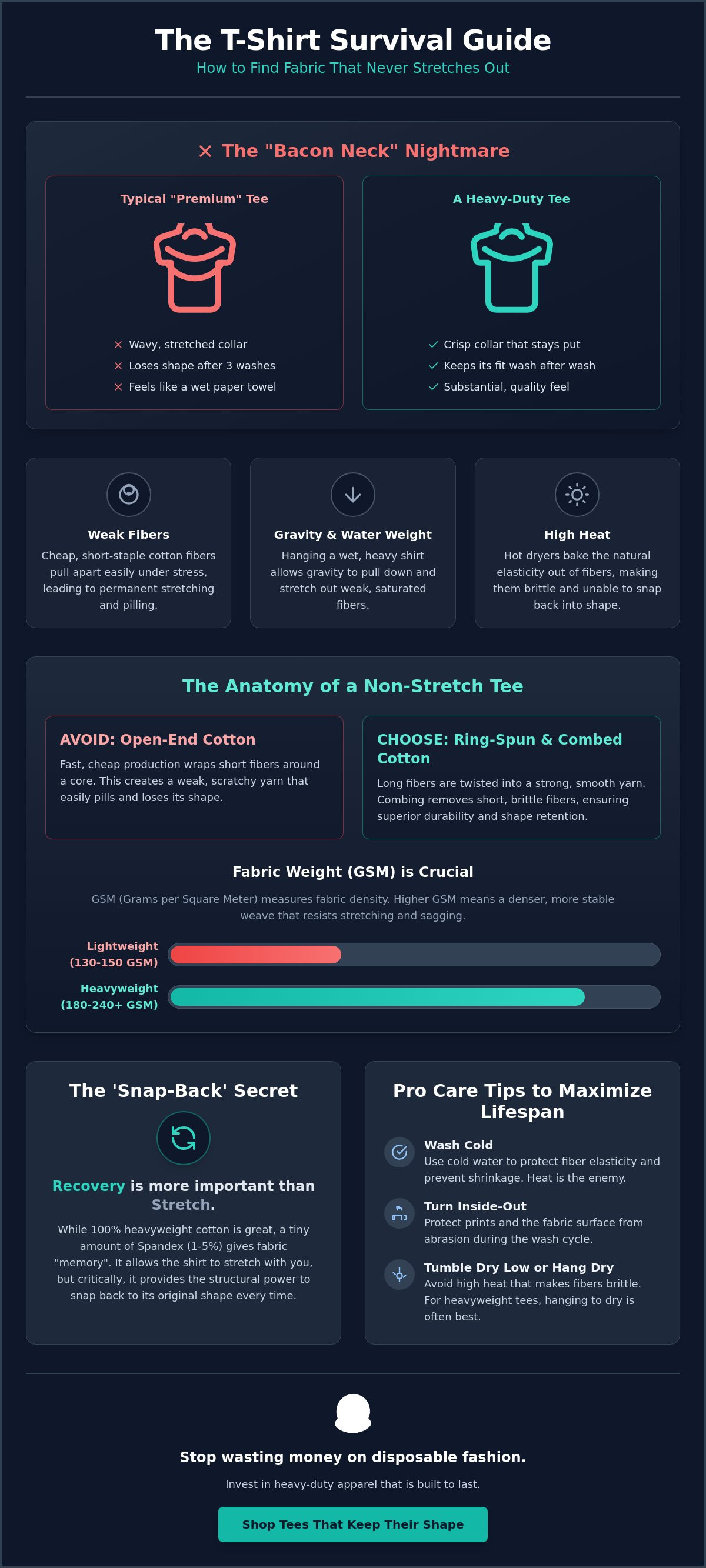
People talk about "stretch" like it is the goal. It isn't. Stretch is just pulling. Recovery is what actually matters. If a fabric stretches but doesn't snap back, you are wearing a tent. Fabric recovery is the 'snap-back' factor that prevents sagging. It is a core part of textile performance and dimensional stability. 100% cotton is great for breathability, but without the right weave or a tiny bit of help, it has the memory of a goldfish. It goes out, and it stays out. You need fibers that remember where they belong.
The Role of Gravity and Heat
Gravity is a hater. When you hang a cheap, wet shirt, the weight of the water pulls those weak fibers down. It gets longer. It gets wider. It loses the plot. Then you throw it in a high-heat dryer. You think you are shrinking it back to size? Wrong. You are baking the elasticity out of the fibers. High heat makes fibers brittle. Once that internal structure snaps, it is game over. Even if a label says "pre-shrunk," it doesn't mean it is "pre-stretched." It can still grow into a baggy mess if the quality isn't there.
- Vertical Tension: Hanging shirts while wet is a death sentence for cheap cotton.
- Fiber Brittle-ness: High heat destroys the "snap" in your shirt's DNA.
- The Pre-Shrunk Lie: Shrinking doesn't stop a shirt from widening over time.
The Best Fabrics for Shape Retention: Cotton, Blends, and Heavyweight Heat
Forget the marketing fluff. Most people think "100% cotton" is a badge of honor. Usually, it's just a warning sign. Unless that cotton is ring-spun and combed, it is just raw material waiting to fail. If you want t-shirt fabric that doesn't stretch out, you have to look at the architecture of the yarn itself. Cheap shirts use "open-end" cotton. It is produced by wrapping fibers around a core. It’s fast, it’s cheap, and it’s garbage. It feels scratchy and loses its structural integrity the moment it hits water. You deserve better than a shirt that feels like sandpaper and fits like a trash bag.
Ring-Spun vs. Open-End Cotton
Ring-spun cotton is the gold standard for a reason. The process involves continuously twisting and thinning the cotton strands. This creates a yarn that is significantly stronger and smoother. It’s the difference between a high-tension cable and a ball of lint. Combed cotton takes it a step further by literally brushing out the short, brittle fibers that cause pilling and stretching. By keeping only the long, resilient strands, you get a fabric that stays soft but refuses to sag. It holds its shape because the fibers are physically locked together through superior tension.
Understanding Fabric Weight (GSM)
GSM stands for Grams per Square Meter. It is the only stat that matters when you are tired of wearing tissue paper. Lightweight shirts (130-150 GSM) are fine for a gym session, but they are useless for long-term wear. They have no backbone. You want the heavyweight heat. We are talking 180 to 240 GSM. This isn't just about being thick or hot. It is about weave density. A dense, heavyweight weave provides a stable canvas for bold graphics and ensures the neck doesn't turn into a ruffled mess. If you want gear that actually survives your lifestyle, browse the heavy-duty collections at Another DAMM Find.
Then there are the blends. Tri-blends are the secret weapon of the "forever" fit. By mixing cotton for comfort, polyester for durability, and rayon for drape, you create a fabric that mimics the science of shape memory. These materials are engineered to snap back to their original silhouette regardless of how much you pull at them. Polyester acts as the internal skeleton of the shirt. It doesn't absorb water like cotton does, which means it won't get heavy and stretch out when you sweat or get caught in the rain. It is about building a shirt that fights back against gravity every single day.
- Ring-Spun Cotton: Superior twist for high-tension durability.
- Combed Cotton: Zero short fibers means zero pilling and zero sagging.
- Heavyweight (200+ GSM): The structural backbone of a high-quality tee.
- Tri-Blends: Engineered for ultimate recovery and a consistent fit.
The 'Snap-Back' Secret: Why Recovery Matters More Than Stretch
Stop falling for the "100% natural" marketing trap. It is a scam for people who like looking like a melted candle by 4:00 PM. If you want t-shirt fabric that doesn't stretch out, you need to understand that stretch is cheap. Recovery is expensive. Stretch is just the ability of a fiber to pull apart. Recovery is the ability of that fiber to return to its original length after you have spent the day moving, sweating, and living. Without it, you are just wearing a countdown to a rag. Pure cotton is a romantic lie; it is comfortable until it settles into a permanent sag.
The Spandex/Elastane Factor
Cotton is a lazy fiber. It likes to stay where you put it. Once it is stretched, it is done. That is why the 5% rule is your best friend. A tiny hit of Spandex or Elastane acts like an internal rubber band. It provides the "snap" that keeps your collar tight and your hem straight. A 95/5 blend is the sweet spot. It keeps the vibe of a classic tee but adds the structural memory of a high-end technical garment. This blend ensures that the shirt moves with you instead of just growing on you throughout the day.
Do not listen to the polyester haters. Polyester is the backbone of any shirt that actually keeps its shape. It does not absorb moisture like cotton, meaning it does not get heavy and sag when the humidity hits. It is the invisible skeleton that keeps the whole operation from collapsing. When mixed with ring-spun cotton, polyester provides the tension required to survive a thousand wash cycles without losing the plot.
Side-Seams: The Architect of the Tee
Look at the sides of your shirt. If there are no seams, you are wearing a tube. Tubular shirts are the fast-food of fashion. They are cheap to make because there is less cutting and sewing involved. But because they lack a frame, they torque. They twist. One wash and the side of your shirt is suddenly sitting across your stomach. Side-seams provide a physical boundary. They act like a chassis for the fabric, ensuring the shirt stays aligned and prevents horizontal expansion. It is the difference between a tailored look and a sack of potatoes.
Next time you are checking out gear, do the 3-second pull test. Grab a handful of the fabric. Pull it hard. Let go. If it doesn't snap back instantly to its original silhouette, it is garbage. You want gear that fights back. Whether you are rocking our amputee humor t-shirts or a heavy basic, the construction is what keeps you looking sharp instead of sloppy. High-quality construction means instant recovery, every single time.
- The 5% Rule: Synthetic blends provide the "snap" cotton lacks.
- Polyester Backbone: Provides tension and moisture resistance.
- Side-Seam Stability: Prevents the "twist" and holds the horizontal line.
- 3-Second Test: If it doesn't snap back, put it back on the rack.
How to Stop Stretching Out Your Shirts (And Your Wallet)
You did the work. You found the right gear. Now don't blow it by treating your threads like a pair of disposable gym socks. Even the most resilient t-shirt fabric that doesn't stretch out has a breaking point. If you treat your clothes like garbage, they will look like garbage. It’s a simple equation. Most people kill their favorite shirts in the laundry room before they even get a chance to wear them out. Heat is the ultimate soul-crusher for high-quality fibers. It cooks the internal structure until the "snap-back" we talked about earlier completely evaporates.
High heat belongs on a pizza, not on your back. When you blast your tees with hot water and a high-temp dryer cycle, you are essentially melting the elasticity. Cold water is non-negotiable. It keeps the fibers tight and the colors from bleeding into a muddy mess. Beyond the temperature, think about the mechanical stress. Your washing machine is a cage match. Every minute your shirt spends tumbling is a minute the fibers are being pulled, twisted, and stressed. Use a short cycle. Your shirt isn't a mud-caked rug. A quick, cold wash is all it takes to keep the shape locked in and the vibe fresh.
Washing for Longevity
Harsh detergents are another silent killer. They break down the organic bonds in high-end cotton, making the fabric brittle and prone to sagging. Stick to mild soaps. And for the love of everything holy, flip your shirt inside-out. This protects the surface fibers from pilling and keeps your graphics from cracking under pressure. If you are serious about keeping your gear in peak condition, check out our guide on how to wash graphic tees without ruining the damn art. It’s the difference between a shirt that lasts five years and one that lasts five weeks.
The Hanger Crime
Stop hanging your heavy tees on those skinny wire hangers you got from the dry cleaners. It’s a literal crime against your wardrobe. Gravity never sleeps. When you hang a heavyweight shirt, the weight of the fabric pulls the shoulder seams out of alignment, creating those weird "shoulder nipples" that make you look like an alien. It ruins the silhouette permanently. The "Fold and Stack" method is the only way to maintain shoulder integrity. Lay it flat. Fold the sleeves in. Stack them up in a drawer. This keeps the vertical tension at zero and ensures the shirt fits exactly the same way every time you pull it on.
If you absolutely must hang them, use wide-shoulder hangers that actually support the weight of the fabric. But honestly? Just fold them. It takes ten seconds and saves you from having to replace your favorite gear. If you want gear that actually stands up to real life, grab some of our heavyweight graphic tees and treat them with some respect. You buy quality to avoid the cycle of disposable fashion, so don't let a lazy laundry routine ruin the investment.
- Cold Water Only: Preserve fiber memory by avoiding the heat trap.
- Inside-Out Rule: Protect the art and the surface texture from machine agitation.
- Short Cycles: Less time in the wash means less mechanical stretching.
- Fold and Stack: Kill the "shoulder nipples" and keep the silhouette sharp.
Why Another DAMM Find Apparel Stays Sharp
You have the data. You know the science. Now you just need gear that actually respects those rules. We don't do the "fast fashion" dance here. At Another DAMM Find, we are obsessed with the intersection of raw, hand-lettered art and textile engineering. Most printers grab the cheapest blank they can find to maximize their cut. We do the opposite. If we are putting a Rich Damm original on a shirt, that canvas better be built to last. We prioritize high-GSM, heavyweight fabrics because we know you are going to actually live in this stuff. You need t-shirt fabric that doesn't stretch out while you are working, riding, or just dealing with the daily grind.
Our commitment to quality is personal. When we design our amputee humor t-shirts, we choose specific blends that offer maximum recovery. If you are missing a limb, the way a shirt drapes and holds its shape matters even more. You don't want a sleeve sagging or a hem twisting when you are just trying to get through your day. We use the "Snap-Back" tech we discussed earlier to ensure our shirts fit the same way on the hundredth wear as they did on the first. It is about dignity. It is about durability. It is about refusing to settle for corporate rags.
Designed by a Submarine Veteran
Life in the "Silent Service" doesn't have room for fragile equipment. When you are on a boat, everything has to work. Every time. That mindset is baked into our brand. Our navy submarine service inspired apparel is built for badasses who value gear that survives. Rich Damm spent years in that high-pressure environment, and he brought that "no-fail" attitude to the design table. Quality isn't a marketing buzzword for us. It is a requirement. If a shirt can't handle a real dryer or a long day, it doesn't get our name on it.
The Another DAMM Find Guarantee
We are a fiercely independent shop. We hate generic, sterile e-commerce as much as you do. Our hand-lettering is raw and intentional, and it deserves a high-quality print surface that doesn't warp. When you buy from us, you are joining a subculture that values authenticity over mainstream approval. Read the Another DAMM Find story to see the grit behind the graphics. We provide t-shirt fabric that doesn't stretch out because we actually give a damn about what you wear.
- Heavyweight Performance: 200+ GSM fabrics that refuse to surrender to gravity.
- Veteran Tested: Submarine-grade durability for everyday life.
- Artistic Integrity: Stable canvases that keep our hand-lettering looking sharp.
- No-BS Philosophy: Real quality for real people. No corporate fluff.
Stop Settling for Disposable Rags
You now have the blueprint. You know that "soft" is often just code for "weak" and that 100% cotton without a plan is a recipe for a bacon-neck disaster. Real quality isn't found in a bargain bin. It is found in high-GSM weights, ring-spun fibers, and the specific t-shirt fabric that doesn't stretch out no matter how hard you live. Don't let gravity and high-heat dryers win the war against your wardrobe. Fold your tees, wash them cold, and demand more from the brands you support. You've spent enough money on shirts that surrender after three washes.
At Another DAMM Find, we don't do corporate fluff. We are veteran-owned and operated, building gear that handles the grind. Every piece features original hand-lettered designs printed on the heavyweight, durable fabrics we have been talking about. You deserve a shirt that fits as well on wash fifty as it did on day one. It is time to ditch the sacks and upgrade your rotation with something that actually has a backbone. Shop high-quality, badass apparel at Another DAMM Find and wear something that stays sharp. You've earned the right to look good without the sag.
Frequently Asked Questions
Does 100% cotton always stretch out over time?
100% cotton doesn't have to be a death sentence for your style, but cheap, open-end versions will absolutely fail you. High-quality ring-spun cotton with long-staple fibers holds its ground much longer because the structure is physically tighter. Without a synthetic "snap-back" fiber, even the best cotton eventually relaxes under the weight of gravity and sweat. It’s about the fiber length and the weave density, not just the label on the neck.
What is the best fabric blend for a t-shirt that keeps its shape?
A 95/5 blend of combed cotton and spandex is the undisputed king of shape retention. You get the breathability of a classic tee with the mechanical memory of a rubber band. This specific mix creates t-shirt fabric that doesn't stretch out because the synthetic fibers pull the cotton back into place after every move. Tri-blends with polyester and rayon also work wonders, providing a durable skeleton that refuses to sag or bag out.
How can I fix a t-shirt collar that has already stretched out?
You can sometimes revive a "bacon neck" collar by dipping just the neckline in ice water and flat-drying it. The cold shock can temporarily tighten the fibers, but it isn't a permanent miracle. Another move is a quick hot-water soak on the ribbing followed by a localized blast of heat from a hairdryer. If the fibers are snapped, it's over. Next time, buy a shirt with a reinforced, high-GSM collar to avoid the mess entirely.
Is heavyweight cotton better than lightweight for preventing bagginess?
Heavyweight cotton is objectively superior for maintaining a sharp silhouette. Lightweight fabrics are too thin to fight gravity, meaning they settle into every pull and tug permanently. A heavier weave, usually 6oz or higher, acts like a frame for your body. It doesn't just hang; it holds. This density prevents the fabric from becoming a baggy sack after a long day of wear or a heavy wash cycle in a machine.
What does GSM mean and why does it matter for shirt quality?
GSM stands for Grams per Square Meter, and it is the only metric that tells you if you're buying a rag or a real shirt. It measures the density and weight of the fabric. Higher GSM usually means a tighter weave and more durable threads. Low GSM shirts feel soft because they're thin, but they have zero structural integrity. If you want gear that lasts, look for a GSM between 180 and 240 for that premium feel.
Can putting a shirt in the dryer actually help it regain its shape?
The dryer provides a temporary "shrink" that makes a shirt feel tight again, but it’s a short-term fix with a high price. That heat is actually cooking the fibers and snapping the elasticity that provides the "snap-back" factor. Every time you blast it to fix the sag, you're making the next sag even worse. It’s a vicious cycle of fiber destruction. Air drying is the only way to preserve the actual memory of the fabric.
Why do my shirts always twist to one side after washing?
Your shirts twist because they were built as a cheap tube rather than being cut and sewn with side seams. This is called "torque," and it happens when the knit of the fabric pulls in one direction during the wash. Without side seams to act as an anchor, the whole shirt rotates around your torso. It’s a hallmark of fast-fashion garbage. Always look for side-seam construction to keep your graphics centered and your fit straight.
Are expensive t-shirts actually made of better fabric?
Price doesn't always equal quality, but you usually get what you pay for when it comes to technical specs like ring-spun yarn and high-recovery blends. A cheap shirt is almost guaranteed to be open-end cotton that will turn into a sack. Premium gear costs more because it uses combed cotton, reinforced stitching, and t-shirt fabric that doesn't stretch out. You're paying for the engineering that keeps the shirt out of the landfill after three months.


