


being called "brave" just for showing up at the grocery store is a special kind of hell!! it’s that patronizing tilt of the head. the uninvited stares. the heavy, awkward silence when someone finally notices the chair or the missing limb. you aren't a walking tragedy or a motivational poster for some stranger’s facebook feed. using humor to talk about disability isn't just a coping mechanism; it’s a tactical dominance strategy for the bold. it’s about taking the mic back from a society that wants you to be either invisible or "inspirational."
we get it. the "inspiration porn" is exhausting and the pity is toxic. you want to exist without being a lesson in resilience. this guide is about flipping the script. you'll learn how to wield humor like a weapon to reclaim your identity, shut down the "brave" comments, and find a community that actually gets the dark side. we're diving into how to own your narrative through sharp wit and the kind of apparel that starts the right conversations.. it's time to stop being the subject and start being the one in control.
Key Takeaways
- stop being the tragic side character in someone else's story. learn how humor flips the script and puts you back in the driver's seat of your own life.
- master the "elephant in the room" technique. addressing your limb difference first kills the awkwardness before it has a chance to breathe.
- discover how using humor to talk about disability lets you opt-out of the "inspiration porn" trap and those patronizing "brave" comments.
- learn the two-step tactical response for handling hushed tones and wide-eyed stares with zero apology and maximum impact.
- leverage Amputee Awareness T-Shirts and graphic tees as 24/7 icebreakers that tell the world exactly how to approach you.
Reclaiming the Narrative: Why Disability Humor is a Power Move
Stop letting people look at you like a cracked porcelain doll. When you're living with a limb difference, society usually hands you a script written in "pity" and "tragedy." It's exhausting. Reclaiming the narrative means burning that script and scattering the ashes. Using humor to talk about disability isn't a way to hide from the reality of your situation. It's a way to hunt. You're taking the agency back. You're deciding that your body isn't a problem to be solved by strangers, but a story you're telling on your own terms. This is the "Damn Narrative." It belongs to you, and it's high time you started acting like the lead character.
The psychological shift here is massive. You move from being the "subject" of the room's tension to being the "author" of the vibe. Humor is the fastest way to bridge the gap between being perceived as "different" and being recognized as "human." Most people don't know how to act around a missing limb. They freeze. They use that hushed, "funeral" voice. A sharp, well-timed joke thaws the room instantly. It signals that you're still here, you're still you, and you're probably funnier than they are. You take the heavy burden of their discomfort and toss it in the trash where it belongs.
The Difference Between Laughing With and Laughing At
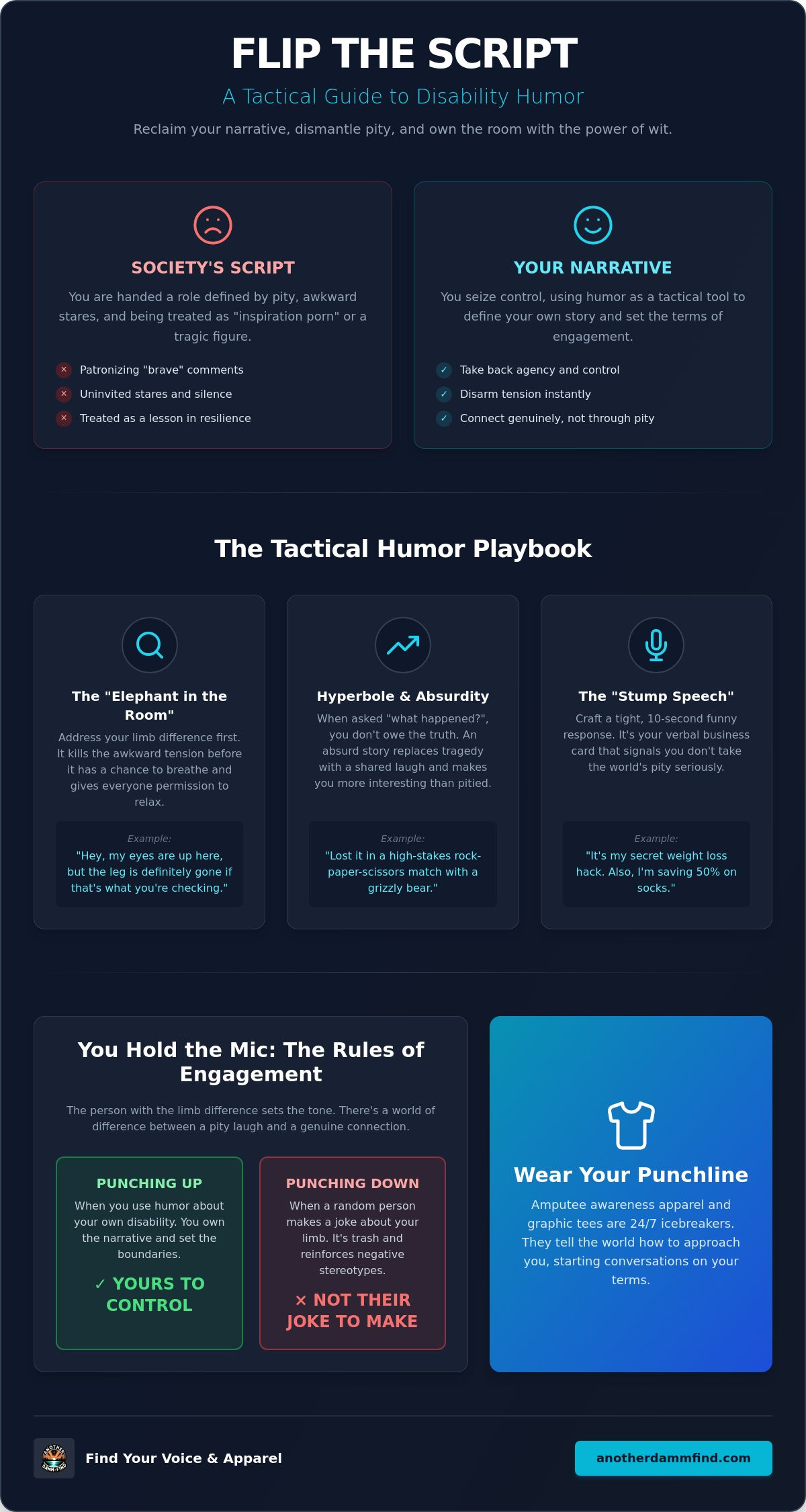
The person holding the mic, or the missing limb, sets the rules for the engagement. There is a world of difference between a pity laugh and a genuine connection. A pity laugh feels like a patronizing pat on the head; a genuine connection feels like a high-five. You can use amputee humor to establish hard boundaries before some random person in the checkout line tries to turn your existence into a "teaching moment." It’s about dominance. When you control the joke, you control the room. This is vital because the historical depiction of disability in the media has spent decades making us the punchline or the tragic victim. We're done being the "super-crip" or the villain. We're just people with better jokes.
The Veteran Perspective on Dark Humor
Submarine veterans and amputees often share a very specific, jagged frequency. It’s called gallows humor. In the service, especially in the cramped, high-pressure world of subs, we used dark jokes to process the absolute chaos of the job. It's raw. It's honest. It's intentionally cynical. This "Submarine Slang" approach to using humor to talk about disability doesn't sugarcoat the struggle. It acknowledges the trauma and then laughs directly in its face. If you can joke about being trapped in a metal tube miles under the ocean, you can definitely joke about a missing leg. It’s about grit. It’s about staying human when the world tries to treat you like a statistic or an inspiration poster.
The Anatomy of a Badass Limb Difference Joke
You have the license. It’s your body. You set the rules. In the comedy world, we talk about "punching up" versus "punching down." When some random person makes a joke about your limb, they’re punching down. It’s trash. But when you’re using humor to talk about disability, you’re punching exactly where you want. You own the narrative. You’re the authority. You decide which parts of your story are public property and which ones are off-limits.
The "Elephant in the Room" technique is your best friend. People are going to stare!! Their brains are short-circuiting trying to figure out if it’s okay to look. Kill that tension immediately. "Hey, my eyes are up here, but the leg is definitely gone if that’s what you’re checking." Boom. Tension dead. You’ve just signaled that you aren't a victim and you aren't fragile. You’ve given them permission to breathe. When you start using humor to talk about disability, you’re not just making jokes. You’re setting the terms of engagement.
Hyperbole is another tactical win. If someone asks "what happened," you don't owe them the medical truth. Make it ridiculous. Tell them you lost it in a high-stakes rock-paper-scissors match with a grizzly bear. Or that you’re part of a secret cyborg program that’s still in beta. When the story is that absurd, the "tragedy" disappears. It’s replaced by a shared laugh. It makes you the most interesting person in the room rather than the most pitied.
Craft a "Stump Speech." This is your 10-second funny response for the curious. Keep it tight. Keep it irreverent. It’s a verbal business card that says you don't take the world’s pity seriously. Maybe it’s a line about how you’re "saving 50% on socks." Maybe it’s about your "weight loss hack." Whatever it is, make it yours.
Timing and Social Awareness
Reading the room is a skill. Sometimes a dark joke is a bridge; sometimes it’s a wall. If someone is genuinely trying to help, a smirk and a light comment work better than a scorched-earth roast. You want to transition from the joke to a real conversation without losing the vibe. If the "Too Soon" police show up, just give them a look. It’s your limb. It’s never too soon for you. You decide when the mourning period ends and the comedy set begins.
The Role of Visual Humor
Visual humor is the ultimate icebreaker for amputees. It does the heavy lifting before you even open your mouth. Use your prosthetic as a prop. Throw some "shark attack" decals on there or build a Lego sleeve. It turns a "medical device" into a conversation piece. Even better, throw on one of our Amputee Awareness T-Shirts to let your gear do the talking. Visual humor is the ultimate icebreaker because it screams your personality before you say a single word. It’s about being loud without saying a damn thing.
Dismantling the Inspiration Trap with Wit
Ever been told you're "inspirational" while you're just trying to buy a carton of eggs? It's a special kind of condescension. It’s a backhanded compliment that assumes your existence is a constant struggle, making the mundane seem miraculous. Using humor to talk about disability is the only sane way to dismantle this trap. You aren't a walking motivational poster. You're a person who needs groceries. A sharp comment about how "brave" you are for choosing the extra-pulpy orange juice usually shuts that noise down fast. It forces the other person to realize how ridiculous they’re being without you having to give a lecture.
This is the core of the Inspiration Porn problem. Society loves to use our bodies as props for their own emotional catharsis. They want to feel better about their own lives by looking at yours. Humor lets you opt-out of that contract. It’s a refusal to be the saint they want you to be. When you crack a joke about your limb, you’re telling them that you aren't here for their spiritual growth. You’re just here to live your life. It breaks the pedestal they’ve built for you and puts you back on solid ground.
Then comes the classic line: "I could never do what you do." It’s meant to be kind, but it’s actually isolating. It puts you in a category of "other" that can't be reached. Try hitting them with a smirk and a quick, "Well, the trial period ended and I couldn't find the cancel button." It’s raw. It’s honest. It reminds them that you’re navigating a reality, not performing a miracle. Using humor to talk about disability turns that pedestal into a level playing field where you’re the one holding the cards.
The "Stare-Back" Strategy
If they’re going to gawk, give them a show. When you catch someone burning a hole in your prosthetic with their eyes, lean in. Tell them it’ll grow back by Tuesday if the moon is full. Or mention you’re just molting and the new one is coming in chrome. Turning the awkwardness back on the observer is a power move. It makes the situation a shared win because you both get a laugh, but they get the message: I see you seeing me. It’s about making the stare as uncomfortable for them as it is for you.
Finding Your Tribe
You can’t do this alone in a vacuum of "polite" society. You need people who get the dark side. You need the ones who won't flinch when you make an "offensive" joke about your own body. Look for amputee support in New York or your local area that values grit over pity. Build a community based on shared wit rather than just shared trauma. It’s about finding the people who speak your frequency and won't try to "fix" your humor with a sad face.
Tactical Humor: How to Handle Common Social Scenarios
Social settings are a battlefield. You need a tactical plan. Most people are well-meaning but socially inept when they see a prosthetic. They get those wide, panicky eyes. They lower their voice like they’re in a library. This is your cue. Using humor to talk about disability is how you disarm the bomb before it goes off. You’re taking the tension out of their hands and throwing it out the window.
Follow the tactical sequence. First, detect the awkwardness. If you see the "hushed tone" coming, you’re already behind. Second, deploy the icebreaker. Use that quick, irreverent comment about your limb to break the glass. Third, normalize the situation immediately. Pivot to a topic that has nothing to do with your leg. "Yeah, it’s a prosthetic, but have you tried the tacos here?" Fourth, use the redirect if they get too intrusive. If they ask for your medical history, tell them it’s classified by the Department of Defense. Finally, reward the good interactions. If someone is chill, give them more of your real personality. They earned it.
You can set the tone early and skip the small talk by grabbing some Long Sleeve Graphic Tees that do the talking for you.
The First Date / New Job Scenario
Mention it early. Don't make it a "big reveal" like you're in a soap opera. Mentioning your limb with a smirk says you're cool with it. It tells them they should be too. This is also a vetting tool. If they can't handle a joke about your stump, they definitely can't handle your life. In professional settings, adopt the "One-Legged Man in an Ass-Kicking Contest" philosophy. It signals high energy and zero excuses. You aren't looking for accommodations; you're looking for results. It’s about competence, not charity.
Handling Kids vs. Handling Adults
Kids are the best audience you'll ever have. They want the truth. They don't want a tragedy. If a kid asks what happened, tell them you're a pirate or a cyborg. It makes the disability approachable and cool. It removes the fear. Adults are the real problem. They’ve been conditioned to be "polite," which usually just means "weird." By being as chill as the kids, you teach the adults how to act. Your delivery is the lesson. If you aren't bothered, they won't be either. Using humor to talk about disability with children ensures the next generation isn't as awkward as the current one.
Wear Your Punchline: Why Amputee Apparel is the Ultimate Icebreaker
Sometimes you don't have the energy to give the "Stump Speech" for the tenth time in a single afternoon. Sometimes you just want to exist without being a one-person education committee. This is where your gear takes over. A well-designed shirt functions as a 24/7 "Don’t Be Awkward" sign for the general public. It’s the ultimate shortcut for using humor to talk about disability because it sets the boundaries of the conversation before a word is even spoken. You’re letting the fabric handle the introduction so you can focus on whatever you actually went out to do. It shifts the energy from curiosity to character instantly.
The psychology of graphic tees as a conversation starter is simple. It gives people a safe script to follow. Instead of stumbling over a question about your leg, they can just comment on the shirt. It’s a bridge. When you wear amputee awareness t-shirts that actually have a pulse, you’re telling the world that you aren't a fragile object. You’re a person with a sense of humor that’s probably sharper than theirs. It does the heavy lifting of a joke before you even open your mouth. It’s a tactical advantage in a world that often wants to treat you like a victim.
Choosing the Right Level of Irreverence
Your mood isn't a monolith. Some days you want a subtle nod to your situation. Other days you want full-blown, scorched-earth sarcasm. Matching your shirt to your internal frequency is a form of self-care. "Amputee Awareness" doesn’t have to be clinical or boring. It doesn't have to look like something you’d find in a hospital gift shop. We use original lettering that makes a statement that looks as good as it hits. It’s about aesthetic impact meeting raw attitude. It’s about being loud without having to raise your voice. Using humor to talk about disability through your style is the most authentic way to own your space.
The Story Behind the Ink
The mission behind Another DAMM Find was built on the intersection of limb loss and veteran pride. It’s about that specific, jagged brand of Navy grit that doesn't know how to quit. We prioritize curated chaos over corporate-approved, sterile designs. We value the history of the struggle and the humor that gets us through it. This isn't about fitting in; it’s about standing out on your own terms. It’s a final call to stop apologizing for your existence. Stop worrying about making people comfortable. Start laughing at the absurdity of it all and wear your punchline like armor. If they can’t handle the joke, they aren't your people anyway.
Take Back the Damn Mic
You’re done being a prop for someone else’s emotional journey. We’ve covered how humor thaws the awkward social freeze and why the "inspiration trap" is a pedestal you never asked to climb. Using humor to talk about disability is your tactical advantage; it’s the fastest way to remind the world that you’re the author of your own story. You don't owe anyone a tragedy. You don't owe them a miracle. You just owe it to yourself to be raw, honest, and as irreverent as you want to be.
We’re here to help you stay loud. Another DAMM Find is veteran-owned and operated by a Navy Sub Vet who knows that grit and gallows humor are the only ways to survive the deep. We feature original hand-lettered designs by Rich Damm that don't do "polite" or "clinical." You deserve bold, high-quality apparel that actually represents the chaotic, beautiful reality of your life. It’s time to stop blending in and start making them look for the right reasons.
Check out our Amputee Awareness T-Shirts and start the damn conversation.
Go out there and be the most interesting person in the room. They’re already staring; you might as well give them something worth reading.
Frequently Asked Questions
Is it always inappropriate to joke about disability?
It’s never inappropriate when you’re the one owning the narrative. using humor to talk about disability is a power move that belongs strictly to the person living the experience. If a random stranger makes a joke at your expense, that’s trash. But when you hold the mic, you set the rules. It’s about agency, not just entertainment. You decide what's funny and what's off-limits.
How do I start using humor if I'm still struggling with my limb loss?
Start small and keep it within your inner circle. You don't have to be a stand-up comedian on day one of your recovery. Humor is a tool for processing trauma, so use it when it feels like a release rather than a performance. Find the people who won't flinch when you make a dark comment. That’s where the real healing happens, away from the "polite" eyes of the public.
What should I do if my joke makes someone cry instead of laugh?
Remind them that your life isn't a tragedy for them to mourn. If someone leaks tears because you cracked a joke about your stump, that’s their baggage, not yours. Tell them it’s okay to laugh. You’re the one living it and you’re laughing, so they should probably follow your lead. It’s about breaking their "pity" reflex and humanizing the situation.
Can non-disabled people joke about disability with me?
Only if they’ve earned the "all-access" pass through trust and shared history. Non-disabled people shouldn't lead with jokes, but they can follow your lead once you’ve established the vibe. It’s an invite-only club. If they don't get the grit of your situation, they don't get to make the punchline. You’re the gatekeeper of that humor, and you choose who gets in.
How do I handle people who tell me my humor is 'too dark'?
Tell them your survival isn't up for public debate. Some people are allergic to reality and prefer the sanitized, "inspirational" version of disability. If they think your humor is "too dark," it’s because they can’t handle the weight of your truth. using humor to talk about disability is for your mental health, not their approval. If it makes them uncomfortable, they can look away.
What are some good one-liners for when people ask what happened to my limb?
Go for the absolute absurd to highlight how intrusive the question is. Tell them you lost it in a high-stakes game of rock-paper-scissors with a grizzly bear. Or mention you’re part of a secret cyborg program that’s still in the beta phase. If they want a story, give them one that makes them realize they aren't entitled to your medical history.
Why does humor help with the psychological side of being an amputee?
It provides instant agency in a world that tries to make you a victim. Humor shifts the brain from "subject" to "author" of the vibe. It kills the "inspiration porn" energy and lets you exist as a human with a personality rather than a medical case file. It’s about psychological dominance over your own circumstances and refusing to be pitied.
How can I find funny amputee gifts that aren't generic garbage?
Stop looking at the big-box "inspirational" sites that sell toxic positivity. You want gear that has actual grit, like our Amputee Awareness T-Shirts or hand-lettered prints. Look for veteran-owned shops that value raw art over corporate-approved slogans. If it looks like it belongs in a hospital gift shop, it’s probably garbage. Demand something that actually represents your attitude.


