


most people think the navy submarine service is just some high-tech tom clancy fever dream. it isn't. it is 130 people trapped in a 360 foot pressurized tube, breathing recycled air and hoping the ocean stays on the outside. you have likely spent hours scrolling through dry government pages that read like a toaster manual. it is boring. it is sterile. it is a damn lie. you want the truth about the silent service without the recruitment office filter. no fluff. no jargon. just the raw reality.
we know the struggle. trying to figure out why an ssn is different from an ssbn feels like a bad math test. you are tired of the confusion. i spent 1,460 days underwater so you don't have to guess. i am going to give you the unfiltered truth about what it actually means to serve. we are going to break down the real culture, the weird traditions, and why the boomer life is a different beast than the fast attack grind. get ready for a crash course in the silent service that actually feels human.
Key Takeaways
- Get the raw, unfiltered truth about the navy submarine service and what it’s actually like to live in a windowless steel tube.
- Understand the damn reality of 18-hour days and the grit required to handle "hot-racking" in tight quarters.
- Decode the mission difference between the Fast Attack hunters and the silent, nuclear-armed "black holes" known as Boomers.
- Learn why earning your Dolphins is the ultimate rite of passage and how the grueling qualification process proves your worth.
- See how the high-stakes skills forged at the bottom of the ocean translate to a high-impact career in the civilian world.
What the Hell is the Navy Submarine Service?
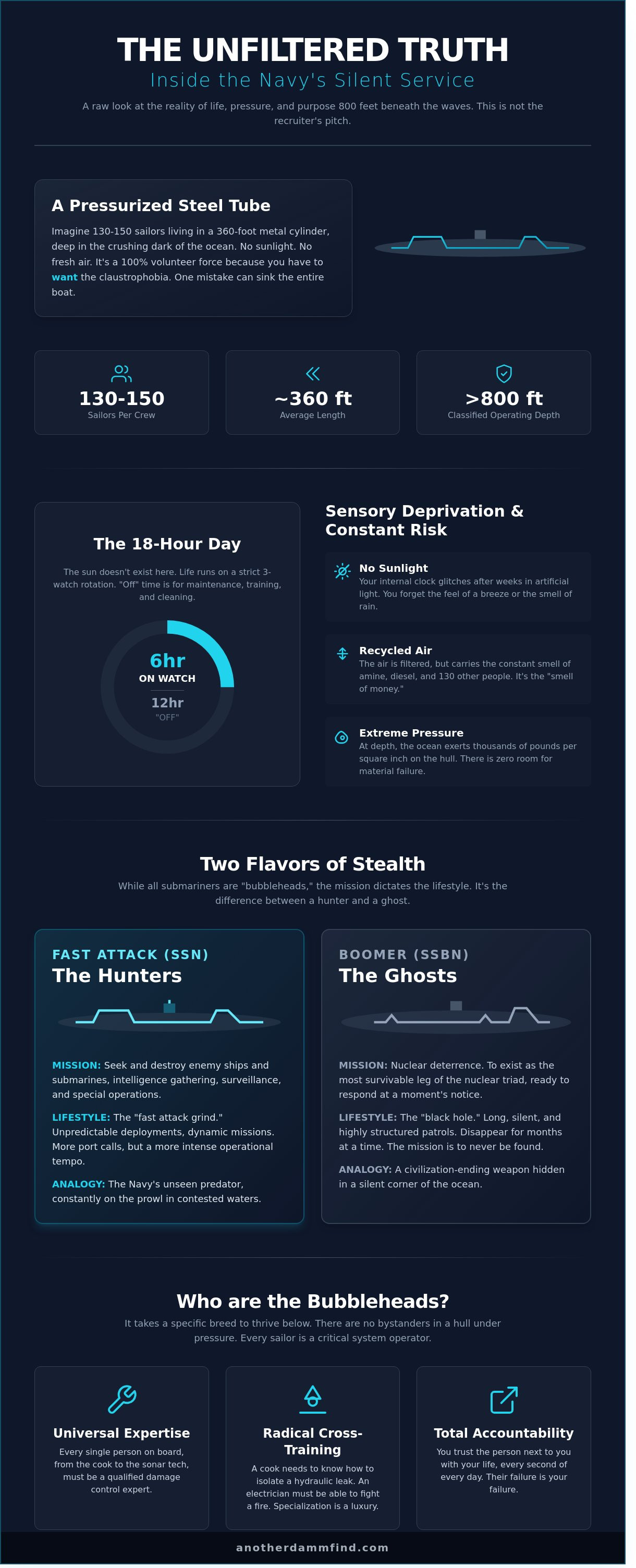
Imagine living in a pressurized steel pipe 800 feet under the damn ocean. No sunlight. No fresh air. Just you, 150 other sailors, and enough nuclear firepower to end a civilization. That is the navy submarine service. It is the elite, underwater arm of the U.S. Navy that operates in total secrecy. While the rest of the fleet is out there looking pretty on the horizon, the sub force is already behind enemy lines. They are the shadows. They are the ghosts.
The primary mission is simple but terrifying. It's about stealth, surveillance, and nuclear deterrence. Since the launch of the USS Nautilus in 1954, the goal has been to stay submerged and undetected for months at a time. They watch. They listen. They wait. It is the only branch in the military that is 100% volunteer. Nobody gets drafted into a submarine. You have to want the claustrophobia. You have to want the risk. It is the most demanding gig in the world because one mistake from one person can sink the entire boat.
The History of U.S. Navy Submarines is a wild ride from the 1775 Turtle to the modern Virginia class. We went from a wooden egg powered by a hand crank to $3.4 billion nuclear predators. These modern boats don't even need to refuel for their entire 33 year lifespan. They are engineering marvels designed for one thing: total dominance without ever being seen.
The Silent Service Philosophy
Stealth is the only currency that matters when you are 800 feet down. If the enemy hears a wrench drop, you're dead. This is the "Silent Service" for a reason. In modern global warfare, being unseen is the ultimate advantage. You can't hit what you can't find. The Silent Service is the Navy’s most lethal invisible asset. It provides a level of psychological pressure that surface ships just can't match. Every move is calculated to minimize the acoustic signature. It is a high-stakes game of hide and seek where the loser doesn't get a second chance.
Who are the Bubbleheads?
Submariners call themselves bubbleheads. It takes a specific, slightly crazy breed of sailor to thrive in the navy submarine service. You are looking for people who are hyper-intelligent but also comfortable living in a locker. There is no room for ego. The psychological profile of a volunteer submariner is someone who can handle extreme isolation and high-pressure environments without cracking. You don't get a window. You don't get a phone call home. You just get the mission.
- Universal Expertise: Every person on board must be a damage control expert.
- Cross-Training: A cook needs to know how to isolate a hydraulic leak.
- Total Accountability: There are no bystanders in a hull under pressure.
If a pipe bursts at a depth of 300 meters, the ocean is coming in at thousands of pounds per square inch. You don't wait for a specialist. You grab a wrench and fix it. This creates a bond that is tighter than any other unit in the military. You trust the person next to you with your life every single second of every single day. It is raw, it is intense, and it is the only way to survive the deep.
Life in the Tube: The Reality of Submarine Service
Living in a steel tube is a special kind of hell. It's a world defined by 18-hour days on a cycle that completely ignores the sun. You breathe the same air 130 other guys just exhaled. It's filtered, sure, but it smells like a damn mix of amine, diesel, and sweat. That's the gritty reality of the navy submarine service. No windows. No exits. Just 350 feet of high-pressure machinery and recycled oxygen. You lose track of Tuesday. You lose track of daylight. It's just you and the machine, thousands of feet below the waves where the pressure is enough to crush a soda can in seconds.
The sensory deprivation is real. After 60 days underwater, your internal clock starts to glitch. You forget what a breeze feels like. You forget the smell of rain. Everything is metallic, artificial, and cramped. It takes a specific type of person to handle that kind of isolation without cracking. You don't just work there; you exist in a state of constant, high-stakes alertness. It's raw. It's exhausting. It's the most intense environment you'll ever experience.
The Daily Grind Underwater
Forget the standard 24-hour clock. Subs run on a strict three-watch rotation system. You spend six hours on watch, then 12 hours off. But "off" doesn't mean sleep. Those 12 hours are packed with maintenance, training, and cleaning. You're babysitting a nuclear reactor while the rest of the world sleeps. The U.S. Navy Submarine Force Atlantic demands perfection because there's zero room for error. When the command calls for "darken ship" conditions, the red lights kick in to preserve night vision. It's eerie. It's quiet. It requires a mental toughness that most people can't fathom. You're operating a billion-dollar weapon in total darkness.
Shared Misery and Bonding
Space is a luxury you don't have. Enter hot-racking. This is the ultimate test of patience. Three sailors share two beds. When you get off watch at 0200, you're climbing into a bunk that's still warm from the guy who just left for his shift. It's intimate in a way that would freak out a civilian. But this shared misery creates a brotherhood that's unbreakable. You know every quirk of the guys around you. You know who snores and who talks in their sleep. This environment is why submarine veterans have a different vibe than surface sailors. It's a quiet, cynical confidence. They've lived through the grind and come out the other side with a dark sense of humor that acts as a survival mechanism.
- The Food: It's the best in the Navy. Steak, lobster, and fresh bread. It's a bribe to keep the crew from losing their minds.
- The Humor: If you can't laugh at the absurdity of living in a pipe, you won't last a week.
- The Vibe: Submariners don't need to brag. The dolphins on their chest say it all.
Joining the navy submarine service means trading your comfort for a level of expertise few will ever reach. It's about finding beauty in the chaos of a six-month deployment. If you're looking for that same level of authentic military-inspired gear to match your own rugged aesthetic, you know we've got the goods. Everything on a sub has a purpose. Every person has a role. There's no dead weight. You either adapt to the tube or the tube breaks you. It's that simple.
Fast Attacks vs. Boomers: Choosing Your Flavor of Stealth
Picking your boat in the navy submarine service isn't just a career choice. It's a damn personality test. You have two main paths, and they couldn't be more different if they tried. One is built for the kill. The other is built to prevent the end of the world by simply existing. It’s the difference between a street-fighting alley cat and a sleeping giant with a hair-trigger temper. You need to know which vibe fits your DNA before you sign your life away to the deep.
SSN: The Front Line Hunters
Fast Attacks are the aggressive middle finger of the fleet. If you're on a Los Angeles, Seawolf, or Virginia class boat, you're looking for trouble. The Los Angeles class was the backbone of the Cold War with 62 hulls commissioned between 1976 and 1996. These boats are smaller, faster, and louder in the mess decks. They hunt other subs. They shadow carrier strike groups. They do the intelligence and recon missions you'll never see on the news. Crew life is high-velocity chaos. You get more port calls than the Boomer guys. You might hit Subic Bay or Pearl Harbor for a few days of actual sunlight and decent food. It's a high-tempo lifestyle for sailors who can't stand sitting still. The hunt is everything. You're constantly maneuvering in 3D space to stay behind the enemy's baffles.
SSBN: The Strategic Deterrent
Then there are the Boomers. The Ohio class SSBN is a 560-foot monster designed to disappear. These boats carry the weight of the world. Specifically, they carry 20 Trident II D5 ballistic missiles. Their job is to be a "black hole" in the ocean. If a Boomer is doing its job right, nobody knows it exists for 90 days straight. There are no port calls. There is no hunting. There is only the mission of nuclear deterrence. To keep these boats at sea 70 percent of the time, the Navy uses a Blue and Gold crew system. One crew takes the boat out while the other trains or takes leave back home. It's a predictable schedule, which is rare in the navy submarine service. You trade the thrill of the hunt for the heavy responsibility of the nuclear triad. It's a quiet, intense brotherhood. Even after the patrol ends, that bond stays. Many former crew members find a home with the United States Submarine Veterans to keep that unique connection alive.
SSGN: The Special Ops Wildcard
Don't forget the SSGNs. These are the four oldest Ohio class hulls that got a massive makeover in 2002. The Navy ripped out the ballistic missiles and replaced them with 154 Tomahawk cruise missiles. They also added lockout chambers for Navy SEALs. These boats are the ultimate flex. They can park off a coast and dump a small army of special operators or a rain of precision strikes without ever being spotted. It's the perfect mix of Boomer stealth and Fast Attack aggression. Life on an SSGN is its own beast. You're dealing with special ops gear, dry deck shelters, and a mission set that changes by the hour. It’s the rarest seat in the house. Only four of these damn things exist, making it one of the most exclusive assignments in the entire fleet.
- Mission Length: Fast Attacks vary from weeks to 6-month deployments; Boomers stick to 70-90 day rotations.
- Port Calls: SSNs hit foreign ports frequently; SSBNs almost never see a pier between departure and return.
- Crew System: SSNs have one crew; SSBNs and SSGNs swap between Blue and Gold crews every few months.
- Primary Weaponry: SSNs use Mark 48 torpedoes; SSBNs carry nuclear Tridents; SSGNs carry 154 Tomahawks.
Earning Your Dolphins: The Brotherhood of the Deep
The navy submarine service isn't a job; it's a damn cult. You don't just walk onto a boat and get a seat at the table. You start as a ghost. A nobody. In submarine terms, you're a "non-qual" or a "puke." Until those silver or gold dolphins are pinned to your chest, you're a liability taking up oxygen. The process of earning your dolphins is a brutal, sleep-deprived rite of passage that separates the tourists from the professionals. It's about trust. When the hull starts groaning at 800 feet, every man on that boat needs to know you can save their life without thinking twice.
The Qualification Gauntlet
The "Qual Card" is a thick stack of papers that becomes your entire world for 10 to 12 months. It's a map of the ship's soul. You have to learn every damn valve, pipe, and switch. We're talking 100-plus signatures from subject matter experts who don't have time for your mistakes. You crawl through the bilges. You trace the high-pressure air lines until your hands are black with grease. It culminates in "The Board." This is a three to four-hour interrogation by senior sailors who will grill you until you break. If you pass, the pinning ceremony is raw. Traditionally, those pins are "tacked on," meaning your brothers punch the pins directly into your chest. It's painful. It's glorious. It's the moment you finally belong.
Submarine Slang and Lore
Life under the waves has its own language. If you're a civilian, you're a "skimmer" or a "target." When the boat does "angles and dangles," the pilot is pushing the sub through steep 25-degree climbs and dives to test the stowage. It's a chaotic mess of sliding plates and hanging on for dear life. Then there's "field day," which is just a fancy term for spending six hours scrubbing the deck with a toothbrush because the Captain saw a speck of dust. It's a grind, but it builds the grit that the navy submarine service is famous for.
- Gold vs. Silver: Officers wear Gold Dolphins; Enlisted wear Silver. The metal is different, but the sweat is the same.
- The Jolly Roger: This tradition dates back to 1914, started by the British HMS E9. Modern crews fly it after a successful mission to signal they're returning as hunters, not prey.
- Halfway Night: Usually occurring around day 45 or 90 of a deployment, this is a night of sanctioned chaos. Skits, bad food, and a temporary break from the crushing pressure of the mission.
The Dolphin pin is the most respected insignia in the Navy for a reason. It's not handed out for showing up; it's earned through a year of misery and mastery. It represents a level of technical expertise that 99 percent of the population couldn't handle. It's about being part of the 1 percent who live in a steel tube under the sea, waiting for a silent order that might never come. That kind of history is what we live for. If you appreciate the grit of vintage military culture, you need to check out our latest damn fine military finds before they disappear back into the deep.
The brotherhood is tight because the stakes are absolute. There's no back door on a submarine. You're in it together, or you're not in it at all. That's the damn truth of the deep.
Beyond the Hull: Why Submarine Veterans Never Truly Leave
You leave the hull. You don't leave the mindset. The deep sea changes you. It's a psychological rewrite that stays long after you've handed in your ID card. The navy submarine service produces a specific breed of human. You don't just clock out; you carry the weight of the ocean in your marrow. Transitioning back to the surface world is a legitimate trip. The noise. The sun. The people who complain about slow Wi-Fi. It's a culture shock that 27 percent of veterans struggle with in their first 12 months topside. But the skills you forged in the dark? They're pure gold. Sub vets are running over 40 percent of the nation's nuclear power plants for a reason. They handle pressure like nobody else on the planet. They don't panic. They perform. They take that nuclear-grade discipline into data centers and high-stakes engineering. It's a damn impressive transition.
The Veteran Identity
Once a bubblehead, always a bubblehead. It's a blood pact without the mess. You find your tribe in the wildest places. Whether you're in the docks of Groton or the concrete sprawl of New York, the connection is instant. In 2023, veteran-owned businesses contributed over $1 trillion to the U.S. economy. That's not a fluke. It's the result of people who "get it" supporting each other. We value the dark humor. We value the sacrifice. We know what it's like to live in a steel tube for 180 days straight. Supporting these businesses isn't just about commerce; it's about keeping the community alive. It's about acknowledging the shared history that civilians will never quite grasp. That's the vibe.
Gear for the Silent Service
Most Navy gear is generic garbage. It's mass-produced for the crowds. It's bland. It's sterile. It doesn't capture the actual grit of the silent service. You didn't serve on a floating city with 5,000 other people. You were part of an elite, invisible force. Another DAMM Find exists because the "off the shelf" stuff is a damn insult to your service. We curate apparel that actually reflects the reality. It's raw. It's bold. It's authentic. We hunt for the vintage cuts and the specific designs that signal you were there. You were under the ice. You were in the dark. You were doing the work that nobody else could. Don't settle for mall-kiosk trash that falls apart after two washes. It's time to wear your history with some actual attitude and style. Grab some damn good submarine gear here and show the world you never really left the boat. You're still part of the elite. Wear it like you mean it.
The transition is a mission of its own. It requires the same focus you used to navigate a 9,000-ton boat through a narrow strait. You use your tools. You rely on your brothers. You wear your pride on your sleeve because you earned it. The navy submarine service isn't just a chapter in a book; it's the foundation of everything that comes next. Stay sharp. Stay loud. Stay damn authentic.
Surface and Gear Up
The navy submarine service is a damn masterclass in grit. Since 1900, when the USS Holland first hit the water, this life has been about more than just oxygen levels and 18 hour rotations. It's the 800 foot dives. It's the silent brotherhood that sticks to your ribs long after you've processed out. You spent years in a pressurized steel tube. You earned those silver or gold dolphins through blood and sleep deprivation. Don't disrespect the hustle by wearing thin, faded shirts from a cheap base exchange that fall apart after two cycles in the wash. I started this shop because I'm a US Navy Submarine Vet who actually served in the tube. I was tired of the corporate fluff. Every piece features original hand-lettered designs and high-quality prints that won't quit on you. This is gear for the 1 percent who actually know what it's like to live without sunlight for 90 days straight. Grab something real. Check out our Submarine Veteran Apparel, made by a vet who actually served in the tube. You're part of the deep. Now look like it. Stay dangerous.
Frequently Asked Questions
How long do Navy submarines stay underwater at a time?
subs stay submerged for up to 90 days at a time, limited only by how much food the crew can carry. nuclear reactors generate their own oxygen and fresh water, so the boat stays down as long as the pantry is full. most crews spend 70 percent of their deployment underwater. it's a long damn time to live without seeing a single sunrise or breathing fresh air.
Do submarines have internet or Wi-Fi while deployed?
no, there is absolutely no wi-fi or internet access for the crew while the boat is submerged. maintaining stealth in the navy submarine service means zero electronic emissions that could tip off an enemy. sailors receive text-only emails through a system called sailor mail when the boat periodically reaches periscope depth. forget your social media feed; you're living in a total digital blackout for months.
What is the difference between a sub and a boat?
submarines are always called boats, never ships, regardless of their size. this tradition started in the early 1900s when the first subs were small enough to be carried on surface vessels. even a 18,750-ton ohio-class submarine is still a boat to the crew. if you use the word ship, you'll immediately mark yourself as an outsider who doesn't know the culture. it's a boat. period.
How deep can a U.S. Navy submarine actually go?
the exact maximum depth is classified, but the navy officially states they can go deeper than 800 feet. most experts estimate that seawolf-class submarines can reach depths of 1,600 to 2,000 feet before the hull fails. at those depths, the massive pressure causes the steel hull to compress by a measurable inch. it's a dangerous, high-stakes environment where every damn bolt has to hold.
Is it hard to get into the Navy submarine service?
joining the navy submarine service is a brutal process that only accepts volunteers with top-tier intelligence and psychological stability. applicants must score in the top 10 percent of the asvab and pass a rigorous screening for claustrophobia. only about 15,000 sailors out of the entire 340,000-person navy are qualified to wear the silver or gold dolphins. it's an elite, high-pressure club for the few who can handle it.
What happens if someone gets claustrophobic on a submarine?
if a sailor panics, they are typically reassigned to surface ships at the very next port visit. the navy uses a 48-hour pressure tank test during training to identify anyone who might crack under the stress of confined spaces. there is no room for a breakdown when you're 1,000 feet down. you either have the mental grit to stay calm or you're off the boat. no exceptions.
Why are submarine crews called "Bubbleheads"?
the term bubblehead is a slang title for submariners that refers to the pocket of air they live in while underwater. it's a badge of honor used to distinguish themselves from skimmers, which is what they call everyone else on the surface. this nickname has been part of the culture for decades. it reflects the pride of living in a pressurized steel bubble where the stakes are always damn high.
Do women serve on U.S. Navy submarines?
yes, women have been a permanent part of submarine crews since the navy lifted the ban in 2010. currently, over 600 women serve as officers and enlisted sailors on both ballistic missile and fast-attack boats. the navy is spending 450 million dollars to retrofit older vessels with separate berthing and head facilities. it's all about finding the best talent to man the most complex machines on earth.


