


Imagine living in a windowless steel tube for six months where you share a bunk with two other sailors and the air smells like diesel and old gym socks. You're probably staring at your phone right now, waiting for an email that might not hit your inbox for weeks. It's a high-stakes game of human Tetris where privacy is a total myth. We know you're tired of the military jargon and the constant worry about what's actually happening under the waves. It's a heavy weight to carry when you're trying to explain a parent's job to a confused kid.
We're dropping a veteran-owned, no-BS guide on life on a submarine facts for families that skips the sterile recruitment garbage. This is the raw truth. We're breaking down the 3.8 percent pay raise from January 2026, the reality of "hot racking," and how the current fleet of 49 attack subs actually operates. You'll get the real story on communication blackouts and the infamous submarine smell that ruins every piece of clothing. It's time to cut through the noise. You'll walk away with the facts you need to feel a real connection to the grind and a massive sense of pride in the crew.
Key Takeaways
- Decode the "Silent Service." See how a windowless city of steel operates under extreme pressure.
- Understand the brutal logistics of hot racking. Learn how sailors survive with zero personal space.
- Learn how the crew breathes using chemical candles. Find out why that specific "boat smell" never truly leaves.
- Stay sane during communication blackouts with these life on a submarine facts for families who only get 40 words at a time.
- Represent the deep. Grab submarine veteran hoodies and gear that feels as raw as the service itself.
The Silent Service: Why Life Under the Waves is Unlike Anything Else
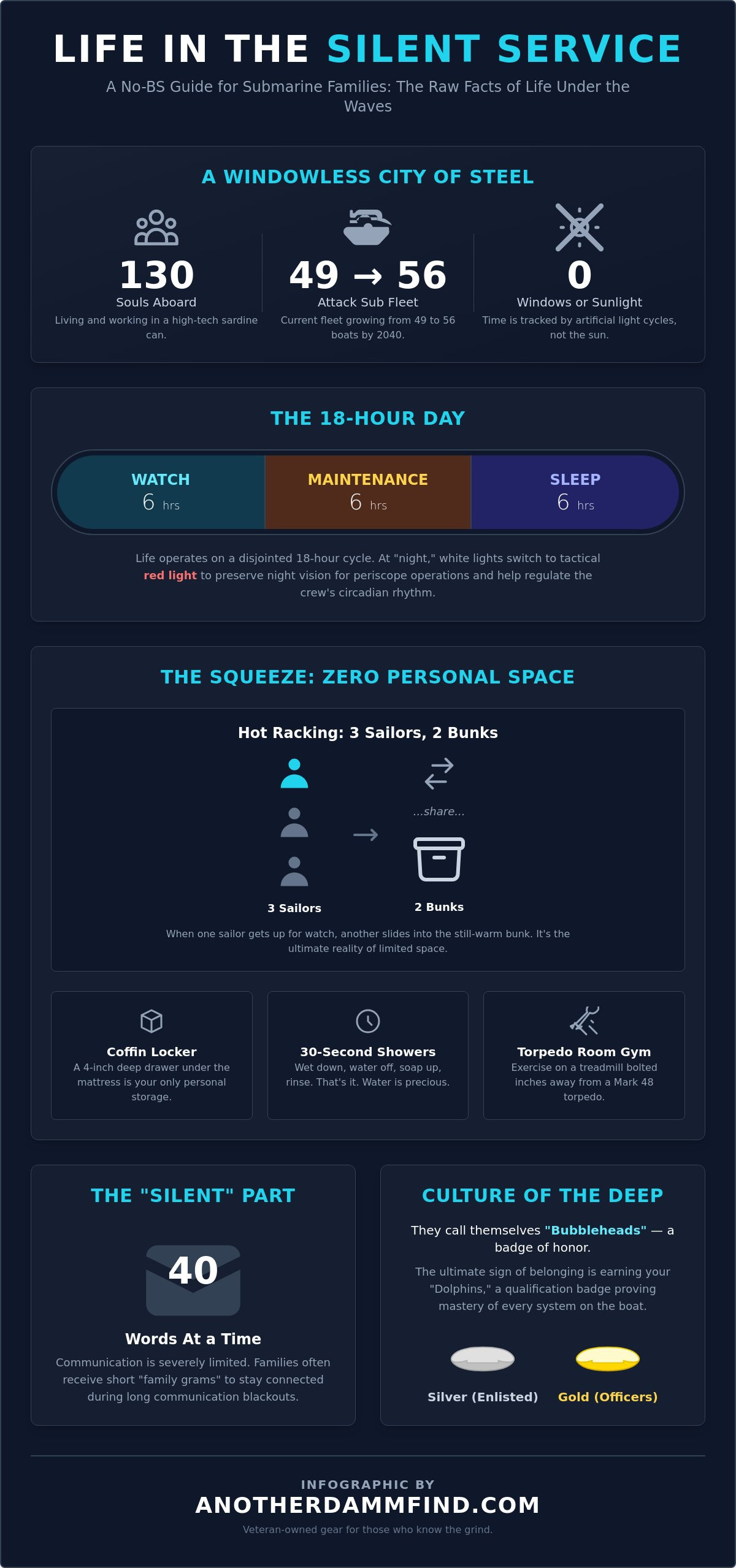
The "Silent Service" isn't some polished marketing slogan. It's a cold, hard reality for the people living it. When a boat slips beneath the waves, it disappears. No GPS pings for the family. No Instagram updates. Just a ghost ship carrying 130 souls through the dark. For families, this silence is the hardest part of the grind. It means trusting a massive Submarine and a crew of strangers with the life of someone you love. It’s a windowless city of high-pressure pipes and nuclear tech where privacy died decades ago.
By 2026, the fleet is hitting a new rhythm with 49 attack subs in the water. The Navy is dumping billions into the industrial base to reach 56 attack boats by 2040, but "bigger" is a relative term. Even on a modern Virginia-class boat, space is a luxury nobody can afford. These are the life on a submarine facts for families that rarely make it into the recruitment brochures. You’re living in a high-tech sardine can where every square inch is packed with gear, explosives, or people. It’s cramped. It’s loud. It’s home.
No Windows, No Sun, No Problem?
How do you track time when the sun is 800 feet above your head? You don't. The crew relies on artificial cycles to keep their brains from melting. At "night," the white overheads click off and the boat glows red. This red light is a tactical necessity to preserve night vision for the periscope, but it also helps the crew's circadian rhythm stay somewhat intact. Standard Time on a submarine typically follows an 18-hour day consisting of three six-hour blocks for watchstanding, maintenance, and sleep. It’s a disjointed, rhythmic chaos that makes the outside world feel like a distant dream.
The "Steel Tube" Community
Submariners call themselves "Bubbleheads." It’s a badge of honor. If you’re a family member, use the term. It shows you’re part of the inner circle. The bond in this steel tube is tighter than any other branch because your life literally depends on the guy next to you knowing how to fix a leak in total darkness. This connection is cemented when a sailor earns their "Dolphins." Whether they’re silver for enlisted or gold for officers, those fish mean you’ve mastered every system on the boat. It’s a brutal qualification process that turns rookies into brothers. If you want the full breakdown of this world, check out our navy submarine service guide. We don't do generic around here. We do real.
Hot Racking and Tiny Kitchens: The Logistics of Cramming 130 People in a Tube
Forget your king-sized mattress and that walk-in closet you take for granted. On a boat, personal space is a myth designed for people who live on land. We are talking about 130 people packed into a steel cylinder that is basically a high-pressure warehouse. These are the life on a submarine facts for families that actually matter when you are trying to picture where your sailor is sleeping. Most of the time, they aren't even sleeping in their "own" bed. It is a DAMM tight squeeze that defines the entire experience.
Welcome to hot racking. It is exactly as gross as it sounds. In a three-man rotation, two racks serve three sailors. When one guy gets up for watch, another guy slides into the warm spot. It is efficient. It is cramped. It is the reality of the grind. Life on a Nuclear Submarine means your entire existence fits into a "coffin locker." It is a drawer about four inches deep located right under the mattress. You want a laptop, three pairs of socks, and a picture of home? You better hope they are flat. There is zero room for fluff in this steel tube.
The Art of the Submarine Squeeze
Navigating the boat is a contact sport. Passageways are barely wide enough for one person, let alone two sailors trying to pass each other with heavy gear. You learn the "submarine tuck" real fast to avoid constant bruising. Showers are another nightmare. You get 30 seconds of water. Wet down, water off, soap up, rinse off. That is it. Anything more and you are stealing precious water from the supply. Even exercise is a puzzle. You will find a treadmill bolted to the floor in the torpedo room, literally inches away from a Mark 48 ADCAP. It is a surreal way to stay fit. If you want to rep this level of grit, our submarine veteran hoodies are built for those who know the struggle of the deep.
Feeding the Beast
If the living space is trash, the food is the absolute savior. Submariners eat better than anyone else in the Navy because if morale drops in a windowless tube, everyone is in trouble. Midrats, or midnight rations, are the holy grail for the night watch. It is usually leftovers or something greasy to keep the brain awake during the 18-hour cycle. Fresh produce lasts about twenty days if you are lucky. After that, it is a world of canned peaches and powdered milk. But Saturday night? That is pizza night. It is the closest thing to a religious experience you will find 800 feet down. The mess deck is the heart of it all. It is the dining room, the study hall, and the movie theater all rolled into one tiny, crowded space.
No Sun, No Air? Busting the Biggest Myths About Submarine Life
You can tell a sailor is home before they even drop their bags. It is the "boat smell." It is a visceral, oily, chemical cocktail of amine, diesel fuel, and recycled humanity that clings to every fiber of their uniform. You can wash a set of NWUs five times and that scent will still linger like a ghost. It is one of those life on a submarine facts for families that nobody warns you about. Your house will smell like a machine shop for a week. It is a DAMM permanent reminder of the grind they just left behind.
People always ask about claustrophobia. They think we are shivering in a dark corner. The truth? You are too busy to feel trapped. Between the 18-hour day cycles and the constant maintenance, the steel walls start to feel like a shield rather than a cage. You aren't "stuck" in a tube; you are operating a nuclear-powered predator. The only time it feels small is when the evaporators go down and the word "water rationing" hits the 1MC. Then, those 30-second showers we talked about earlier become a luxury you can't even afford.
Making Air and Water
We literally manufacture the environment. Through electrolysis, the boat uses electricity to split water molecules into hydrogen and oxygen so the crew can breathe. If the power goes out, we have "oxygen candles" that burn to release life-saving gas. A CO2 scrubber uses chemical reactions to strip poisonous carbon dioxide from the air, ensuring the crew doesn't suffocate in their own breath. The air inside is actually filtered to a higher standard than your local mall. It is clean, dry, and completely artificial. It is a science experiment that keeps 130 people alive in a place where humans shouldn't exist.
The Legend of the Mail Buoy
If your sailor tells you they are heading topside to check the "mail buoy" in the middle of the Atlantic, they are messin' with you. It is a prank as old as the 1940s. We tell the new guys to put on a life jacket and a harness to go fish for a floating mailbox that doesn't exist. It is a rite of passage. These life on a submarine facts for families help you spot when you are being played. If you want to decode the rest of the weird talk, check out our guide to submarine slang. We don't do boring. We do the raw, unfiltered truth of the Bubblehead life.
Staying Connected: How Families Handle the "Silent" Part
Silence isn't golden when your spouse is 800 feet underwater. It's a heavy, frustrating void. There are no FaceTime calls from the engine room. No late-night "miss you" texts. When the boat dives, the digital world dies. This is the hardest part of the grind for the people left on the pier. These life on a submarine facts for families aren't about tech specs; they are about the mental toughness required to survive months of one-way communication. You learn to live by the mantra: no news is good news. If the doorbell isn't ringing and the Ombudsman isn't calling, everything is fine.
The "Family Gram" is your only lifeline. It’s a 40-word burst of text sent through the abyss. Think of it like a tweet, but it takes three weeks to arrive and has to be screened by the CO. It’s one-way. You send it into the dark and hope it hits. Your sailor can’t usually reply. They just read it, fold it up, and keep it in their coffin locker until the ink fades. It’s a brutal system, but it’s all you’ve got. While you’re stuck in the waiting game, you can rep the lifestyle with our vinyl decals and stickers on your car to remind the world you’re holding it down.
The 40-Word Limit
Packing a month of life into 40 words is an art form. You skip the fluff. You don't mention the broken dishwasher or the kid's flu. You keep it high-energy and positive because bad news is a distraction a sailor can't afford. A distracted Bubblehead is a dangerous Bubblehead. You learn to code your messages with "I love you" and "we are proud" because those are the only words that actually matter in a steel tube. It’s about maintaining morale when the sun hasn't been seen in sixty days.
Life on the Pier
The "Halfway Box" is the greatest tradition in the Silent Service. Families pack a box of treats, photos, and letters to be opened exactly at the deployment midpoint. It’s a massive morale booster that reminds the crew why they are down there. You also rely on the Ombudsman. This volunteer is the official link between the command and the families. They are the only ones who know the "real" timeline. They handle the chaos so you don't have to. When homecoming finally hits, the "First Kiss" tradition is pure electricity. One lucky family wins a raffle to be the first one on the pier to reunite. It’s loud, it’s messy, and it makes every second of the silence worth it. These life on a submarine facts for families prove that the ones on shore are just as tough as the ones in the boat.
Before that big reunion on the pier, many sailors take the time to clean up and look their best; to find the right gear for a sharp appearance, learn more about BarberNation: Professional Barber Tools and Grooming Supplies.
Wear the Pride: Why We Represent the Silent Service
This isn't about generic anchors or sterile eagles found in a base exchange. Another DAMM Find exists because a Navy Submarine Veteran lived the grind and decided the community deserved better. We know the reality of the steel tube. We lived the 18-hour days and the hot racking we broke down earlier. When you spend months in a windowless cylinder, you develop a specific, dark sense of humor. It is a survival mechanism. We pour that irreverent, raw energy into everything we make. These life on a submarine facts for families aren't just trivia. They are the foundation of a culture that most people will never understand. We are here to help you wear that understanding on your sleeve.
We know the weight of the silence. We know the oily smell that ruins your favorite shirts. Most importantly, we know that the "Silent Service" is a family affair. It takes a certain kind of grit to be the one waiting on the pier. We don't do polished. We do authentic. Our gear is designed to reflect the chaos, the pride, and the absolute madness of living under the waves. It is a way to claim your space in a subculture that values reality over fluff.
Gear for the Families Who Wait
Deployment doesn't just happen to the sailor. It happens to the spouse staring at a silent phone and the kid asking when dad is coming home. We design for the people on the pier. The "Damm" difference is about authenticity. You won't find this original lettering in a corporate mall. It is raw. It is real. It is veteran-owned. These life on a submarine facts for families help bridge the gap between the boat and the home front. If you want the full breakdown of how we got here, read the Another DAMM Find story. We don't hide the scars. We celebrate them.
Join the Subculture
Wearing this gear is like a secret handshake. It connects you to a national network of veterans and families who know exactly what "field day" feels like in a cramped passageway. We use bold designs because the Silent Service isn't for the timid. It is for the ones who can handle the pressure. Our hoodies and graphic tees start conversations. They give you a chance to explain why your sailor is a Bubblehead and what that actually means. Don't settle for generic garbage. Check out our Submarine Veteran Apparel and Gear that actually reflects the weight of the Service. Join the subculture. Stay loud in the silence.
Own the Deep: Stay Loud in the Silence
Living in a windowless steel tube isn't for everyone. It's a brutal, oily, and cramped reality that most people can't even imagine. We've covered the hot racking, the chemical air, and the 40-word limits that define the grind. These life on a submarine facts for families aren't meant to scare you. They are meant to show you the level of grit your sailor brings to the boat every single day. You're part of a community that thrives on the "no news is good news" mantra and the chaotic joy of a pier-side homecoming.
We don't do generic around here. We do authentic. Another DAMM Find is veteran-owned and operated. We create original hand-lettered designs that reflect the raw attitude of the Silent Service. These are high-quality prints that don't fade, just like the bond you share with the crew. It's time to stop wearing corporate trash and start representing the real story. Grab your Submarine Veteran Apparel and show some damn pride. Stay tough. Stay proud. We've got your back.
Frequently Asked Questions
Do submarines have internet or Wi-Fi for the crew?
No, submarines do not have Wi-Fi or personal internet access for the crew. It is a massive security risk and radio silence is the whole point of the mission. You aren't scrolling social media at 800 feet down. Every byte of data is monitored and restricted to official business or the occasional screened email. It is a total digital blackout for the duration of the dive.
How long can a nuclear submarine stay underwater?
A nuclear submarine can stay submerged for as long as the food lasts. The reactor provides enough power to keep the boat running for 20 years without surfacing. Usually, deployments are limited to 60 to 90 days for ballistic subs and up to six months for fast attack missions. The only thing that brings them up is the need to restock the tiny kitchen for the crew.
What happens if someone gets sick or hurt on a submarine?
Every boat has an Independent Duty Corpsman who functions like a mini doctor in the deep. They can handle everything from stitches to minor surgeries in the middle of the ocean. For major trauma, the boat might surface for a medevac, but that is a last resort that kills the mission. These life on a submarine facts for families help you realize how much trust is placed in the "Doc."
Can people on a submarine talk to their families?
Personal phone calls and video chats are a total myth. You communicate through short, screened emails called Family Grams that can be delayed for weeks at a time. It is one-way traffic most of the time. The boat stays silent to stay hidden from the world. You learn to appreciate the "no news is good news" lifestyle real fast when the boat is on mission.
How do submariners sleep in such a small space?
Sailors sleep in "racks" that are about the size of a coffin. As we mentioned, many use hot racking where three people share two beds in shifts. You get six hours of shut-eye before the next watch starts. It is loud, cramped, and smells like diesel, but after a 12-hour shift, that tiny bunk feels like a five-star hotel. You learn to sleep through anything.
What do people on a submarine do for fun?
Morale is maintained through movies, card games, and massive amounts of caffeine. The mess deck turns into a cinema after hours, and you will find guys playing Spades or video games to kill the stress. Some boats even have "steel beach" picnics on the rare occasion they surface in the middle of nowhere. It is about finding a win in a windowless tube with your brothers.
Is it true that submarines make their own oxygen?
Yes, the boat literally breathes for you. Through electrolysis, the crew splits water molecules to generate fresh oxygen. If the power fails, they use oxygen candles that burn to release breathable gas. The CO2 scrubbers keep the air from turning toxic. It is a high-stakes science project that keeps everyone alive while they hunt in the dark. You are living inside a life-support system.
What is the "submarine smell" everyone talks about?
The smell is a permanent cocktail of amine, diesel fuel, and recycled air. It is a heavy, oily scent that embeds itself into your skin and every thread of your clothes. You can't wash it out easily. It is the calling card of a Bubblehead. These life on a submarine facts for families explain why the laundry smells like a machine shop for weeks after homecoming. It is the scent of the grind.


