


What if the most exhausting part of limb loss isn't the physical pain, but the soul-crushing weight of everyone treating you like a fragile medical project? It sucks. You're tired of the clinical pity and the 60% chance of depression hitting you harder than the actual surgery. You just want to know how to feel normal after amputation without some sterile office reciting a pamphlet at you. This is about RECLAIMING your space.
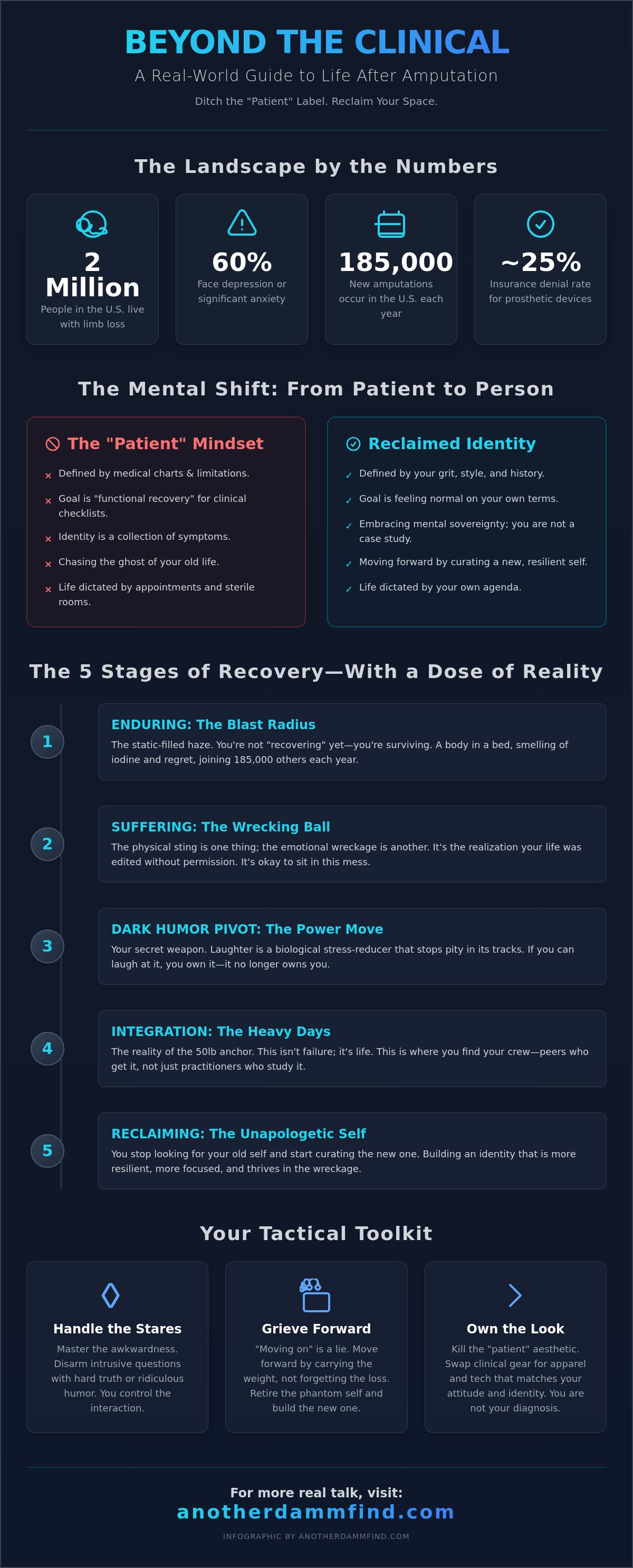
We're ditching the "patient" label to focus on the raw grit of actually living. You're one of 2 million people in the U.S. moving through this chaos. It's time to stop letting a missing limb be your only personality trait. This guide delivers REAL talk on crushing those awkward stares, finding your dark sense of humor, and building a new identity that feels authentic. We're breaking down mental frameworks to help you stay sharp while managing everything from social anxiety to the 25% insurance denial rate for the gear you actually need. Let's get it.
Key Takeaways
- Stop chasing the ghost of your old life. Learn why "normal" is a moving target you define, not a destination on a clinical map.
- Master the mental shift of how to feel normal after amputation by separating your human worth from your medical charts.
- Get the tactical lowdown on handling public stares and intrusive questions, from dropping the hard truth to using ridiculous humor to shut it down.
- Kill the "patient" aesthetic. Find out how to reclaim your visual identity by swapping clinical vibes for gear that actually matches your attitude.
- Validate the wreckage. Learn why it is okay to hate the situation and how to navigate the "suffering" phase without the toxic positivity.
The 'New Normal' Myth: Why Your Old Life Is Gone (And Why That’s Okay)
"Normal" is a lie sold in hospital gift shops. It implies there is a reset button you can hit to magically wake up in your pre-op body. There isn't. Your old life is officially dead; that's actually the best thing that could happen to you. Why? Because chasing a ghost is a recipe for permanent misery. Recovery isn't a circle. It's a straight line into unknown territory.
Medical professionals love the term "functional recovery." They want to see you hit your marks, use your prosthetic for specific hours, and check off the boxes. But walking on a carbon fiber blade doesn't automatically teach you how to feel normal after amputation when you're sitting at a bar or trying to date again. The clinical world often ignores the psychological trauma and emotional discomfort that sticks to you long after the stitches come out. You're not a success story just because you can climb stairs. You're a success when you stop apologizing for existing.
Breaking the 'Patient' Mindset
You're not a collection of symptoms. Stop letting your calendar be dictated by white coats and sterile waiting rooms. In 2026, the medical industry will give you plenty of data on your "limitations," but they don't know your grit. Breaking the patient mindset means reclaiming your mental sovereignty. Mental sovereignty is the absolute refusal to let a medical diagnosis define your worth; it's the first step to feeling normal on your own terms. You're a person with a history, a style, and a life. You aren't just a "case" for some resident to study.
Grieving the Limb Without Losing the Soul
Grief is messy. It's okay to absolutely hate your situation. You don't have to be the "inspiring" amputee 24/7. Validating your anger is more productive than faking a smile for your physical therapist.
- Moving on is a lie: It implies forgetting what you lost.
- Moving forward is tactical: It means carrying the weight without letting it crush your spirit.
- Retire the phantom self: That version of you is gone. Stop comparing your current wins to your old baseline.
The goal of learning how to feel normal after amputation is to stop looking for your old self and start curating the new one. It's about building an identity that doesn't just survive the trauma but actually thrives in the wreckage. You're building a version of yourself that is more resilient, more focused, and entirely unapologetic.
The 5 Stages of Recovery—With a Dose of Reality
Forget the five stages of grief you learned in a textbook. Recovery isn't a neat ladder; it's a mosh pit. First comes Enduring. This is the static-filled haze where you're just a body in a bed, smelling like iodine and regret. You're now part of the 185,000 people in the U.S. who join this club every year. It’s loud, it’s clinical, and it’s confusing as hell. You aren't "recovering" yet. You're just surviving the blast radius.
Then comes Suffering. This isn't just about the physical sting. It’s the realization that your life has been permanently edited without your permission. Doctors will talk about normal feelings after amputation, but they usually mean "sadness" in a way that sounds manageable. In reality, it’s an emotional wrecking ball. Statistics show that 60% of us deal with depression or anxiety. It’s okay to sit in that wreckage for a minute. You have to acknowledge the mess before you can start clearing it out.
Why Humor Is Your Secret Weapon
Somewhere between the tears and the grueling physical therapy, you hit the Dark Humor Pivot. This is where you make a joke about your "missing piece" and the room goes silent. Good. Lean into that silence. Using amputee humor is a high-level power move. It's a core part of how to feel normal after amputation because it stops people from pitying you and starts making them respect your grit. Laughter is a biological stress-reducer. If you can laugh at the situation, you own it. The situation no longer owns you.
Navigating the 'Suffering' Phase Without Drowning
There are days when the prosthesis feels like a 50lb anchor. That’s not failure; that’s the reality of Integration. To survive the heavy days, you need peers, not just practitioners. You need people who speak your language, not medical jargon. Find the crew that knows the struggle of a bad socket fit or the sting of a dumb question from a stranger. If you’re feeling stuck in the "patient" phase, maybe it’s time to swap the hospital-issued look for something with soul. Snagging some amputee awareness gear can be a small, tactical way to reclaim your visual space.
Finally, you reach a point where the limb loss is just a detail. It's a tool. It's part of the kit. Learning how to feel normal after amputation isn't about reaching a finish line where the limb grows back. It's about realizing you're still the one calling the shots, even if the equipment you're using has changed. You're building a new baseline that's tougher than the old one.
Reclaiming Your Identity: You Aren't Just a Medical Case
Amputation is identity theft. Plain and simple. One day you're a mechanic, a hiker, or a parent. The next, you're a "patient" in a gown that doesn't close in the back. The medical system is elite at fixing the plumbing, but it’s trash at fixing the person. They focus on your range of motion while you're staring at the ceiling wondering who the hell is looking back in the mirror. This identity crisis hits harder than the physical trauma because it attacks your "why."
You have to separate your worth from your physical completeness. You aren't a puzzle with a missing piece. You're a whole person with a streamlined design. Learning how to feel normal after amputation starts with realizing that "normal" is a mental state you seize, not a permission slip from a doctor. The emotional recovery after limb loss is about retiring the old version of yourself and launching the 2.0. It’s about finding hobbies that don't feel like consolation prizes. If you can’t run miles, maybe you crush adaptive rowing or master a new craft. It’s not "lesser." It’s just different.
Finding Your New 'Vibe'
Aesthetics aren't vanity. They're armor. When you look like a medical project, you feel like one. When you dress with intent, you reclaim the narrative. Redefining your style means incorporating your new reality into a look that says "I’m here" instead of "I’m recovering." Wear your personality on your sleeve. Check out the Another DAMM Find story to see how raw art and a rebellious spirit can build a brand out of wreckage. Style is the first step in showing the world you aren't just a case study.
The Veteran Perspective on Resilience
Resilience isn't about being "tough" in a fake, stoic way. It’s about a mission-first mindset. If you've ever looked into navy submarine service, you know about life in cramped, high-pressure environments where "embracing the suck" is the only way to survive. You apply that same grit to your recovery. You have a mission: to live a life that doesn't revolve around your limb loss. Some days you fail. Some days the gear breaks. You fix it, you reset, and you move. That is how to feel normal after amputation. You don't wait for the feeling. You build it through action.
Handling the Stares, the Questions, and the Awkwardness
People are naturally curious, which is a polite way of saying they're annoying. You're just trying to buy milk, but suddenly you're a walking educational exhibit. The public gaze is a reality you can't ignore, but you can definitely manage it. Most sites tell you to "educate" the public. That's a full-time job you didn't sign up for. Part of how to feel normal after amputation is realizing you don't owe a single person your medical history. Not the cashier. Not the guy at the gym. Nobody.
Setting boundaries is a survival skill. If someone asks "what happened?" and you aren't in the mood, a firm "I don't talk about it" is a complete sentence. You aren't being rude; you're being honest. You have the right to a normal day without reliving your trauma for a stranger's entertainment. It’s about social sovereignty. You define the interaction, not the person staring at your prosthetic.
The 'Stare-Down' Strategy
Don't look at the floor. When you catch someone burning a hole in your gear with their eyes, meet their gaze. Give a quick, sharp nod. Maybe a wink if you're feeling chaotic. This simple act reclaims the social space. It signals that you see them seeing you. Usually, they'll look away, embarrassed. You just won the interaction. If they keep staring, lean into it with a grin. You aren't a medical project; you're the most interesting person in the room. Own it.
Humor as a Social Shield
Humor is the ultimate equalizer. It puts other people at ease so you can actually have a regular conversation. If you’re tired of the "I’m so sorry" face, hit them with a ridiculous fake story. Tell them it was a shark attack in a freshwater lake or a botched teleportation accident. This is how to feel normal after amputation in the wild. It turns you from a victim into a storyteller. Try a list of go-to fakes:
- I traded it for a better parking spot.
- Shark attack in a swimming pool.
- It's actually in the shop for a laser upgrade.
- Saving a kitten from a very small, very angry dragon.
- I simply misplaced it and haven't found the time to look.
A witty comeback is your best friend. Try this: "I traded the limb for a lifetime supply of tacos, so unless you're buying the next round, we're done here." It's firm, it's funny, and it ends the interrogation. If you want to stop the questions before they even start, let your clothes do the talking. A loud, irreverent amputee awareness t-shirt acts as a pre-emptive strike against awkwardness. It signals your vibe before anyone has a chance to make it weird.
Owning the Look: From Hospital Gowns to Badass Apparel
The hospital gown is a cage. It’s thin, drafty, and screams "vulnerability" to anyone within eyeshot. Shedding that uniform is your first damn act of rebellion. Transitioning into gear that actually says something about you is where the real work begins. "Adaptive" clothing in 2026 doesn't have to look like it was approved by a clinical committee. Most of it is boring, beige, and soul-crushing. You need apparel that matches the raw attitude you've developed just to survive the last few months.
Bold gear provides a psychological boost that no sterile therapy session can replicate. It’s about signaling. You are signaling to the world, and more importantly to your own brain, that you are no longer a medical project. This is a massive part of how to feel normal after amputation. High-quality, high-impact pieces change the way you carry yourself. When your clothes have soul, you start feeling like you have yours back too. It’s about reclaiming the narrative through fabric and ink rather than just "getting by."
Fit and comfort are non-negotiable for prosthetic users. You’ve got enough friction in your life; you don't need it from your long sleeve graphic tees. You want pieces that accommodate the gear without looking like a damn tent. Choosing the right fit shows you’re in control of your presentation. It’s the difference between being a patient and being a person with impeccable, unconventional taste.
Wearing Your Personality
Your style is a tactical choice. Diving into a graphic tee guide isn't just about shopping; it’s a mental recovery exercise. You are choosing the version of yourself you want to project to the world. Bold designs start the right conversations. They filter out the pity and attract the people who actually get your vibe. It’s about being seen as a person with an edge rather than a person with a missing limb.
The Final Step: Becoming the Expert of Your Own Life
Your physical therapist is the expert on your gait. Your surgeon is the expert on your stump. But you? You are the only damn expert on your life. Learning how to feel normal after amputation isn't a medical goal you reach by checking boxes. It’s a personal standard you set every morning. You decide when you’re back. You decide what "normal" looks like in your world. Maintain your edge. Keep your dark humor. Refuse to be sterile. Own your story, limb or no limb. This is your life. Take it back.
Take Back Your Narrative
You aren't a patient anymore. You're the architect of a new, tougher reality. We've covered why the old "normal" is a ghost and how reclaiming your identity starts with the absolute refusal to be a clinical project. Whether you're dropping a dark joke to kill the awkwardness or staring back at the public gaze, you're the one calling the shots now. This is the core of how to feel normal after amputation; it’s about choosing your own vibe instead of letting a medical diagnosis choose it for you. You are more than a collection of appointments and symptoms.
Don't settle for generic, soul-crushing crap that makes you look like you're still in the recovery wing. We’re veteran-owned and operated, featuring original hand-lettered designs by Rich Damm that actually have some teeth. It's high-quality, bold gear for people who hate the sterile, corporate aesthetic. Check out our Amputee Awareness gear and wear your attitude on your sleeve. You already have the grit to survive the surgery. Now you just need to own the life that comes after it. Keep moving forward and don't look back.
Frequently Asked Questions
How long does it typically take to feel 'normal' after an amputation?
There is no universal stopwatch for this process. Most people take six months to a year just to handle the mechanical basics of their new gear. The mental shift usually takes longer because you are building a new baseline from scratch. It’s about finding a rhythm that works for your new reality rather than chasing a reset button that doesn't exist.
Can I still drive or do my old hobbies after losing a limb?
You absolutely can. Adaptive technology is more advanced than ever. Whether it’s hand controls for your car or specialized prosthetic attachments for the gym, your old hobbies are still on the table. You might have to learn a different set of mechanics, but the mission remains the same. Adaptation is the only way to keep your edge in a world that expects you to slow down.
How do I deal with the depression that comes after amputation surgery?
Acknowledge the weight of the situation immediately. Since 60% of people with limb loss report symptoms of depression, you are definitely not alone in this fight. Seek out a therapist who understands trauma and find a community that speaks your language. Dealing with the wreckage is a necessary step in learning how to feel normal after amputation without faking a smile for the public.
What is the best way to respond to people staring at my prosthetic?
Reclaim the social space on your own terms. You can ignore the gaze, give a sharp nod of acknowledgment, or hit them with a ridiculous fake story about a shark attack. You don't owe anyone a medical explanation or a polite lecture. Setting firm boundaries is a survival skill that keeps you from feeling like a walking exhibit in someone else's museum.
Is it okay to use dark humor to cope with my limb loss?
It is more than okay; it is a tactical advantage. Dark humor is a biological stress-reducer that helps you seize control of a chaotic situation. When you make the joke, you take the power back from the trauma. It signals to everyone around you that you aren't a fragile victim, but a person who still has their wit and their soul intact.
How can I find a community of amputees who aren't overly 'clinical'?
Skip the sterile hospital forums and look for niche groups or veteran organizations. You want to find people who are obsessed with art, gear, and living life on their own terms. Look for the subcultures that value authenticity over professional polish. These are the peers who will give you the raw truth instead of reciting a medical pamphlet at you.
What should I look for in apparel as a new amputee?
Focus on fit, durability, and a total lack of clinical vibes. You need gear that accommodates your prosthetic without looking like a shapeless tent. High-quality apparel that features bold, hand-lettered designs can give you a massive psychological boost. Wearing your attitude on your sleeve is a core part of how to feel normal after amputation because it lets you define your look.
What is phantom limb syndrome and does it ever go away?
It’s a biological glitch where your brain still tries to communicate with a limb that isn't there. It often manifests as itching, tingling, or sharp pain. While it feels bizarre, it is a documented part of the re-mapping process. For many, the intensity fades over time as the brain adjusts to the new hardware. It is a physical hurdle, not a mental breakdown.


