


Stop letting strangers call you an "inspiration" just because you showed up to the track. It's patronizing, it's exhausting, and it doesn't help you shave a second off your split. You don't need a pat on the back; you need a tactical edge. Developing a true amputee athlete mindset in 2026 isn't about smiling through the suck. It's about weaponizing your reality. That means owning everything from the $30,000 price tag on a high-end sports knee to the raw, gritty frustration of a socket that just won't seat right.
We know the vibe. You're sick of being the hero in someone else's feel-good story while you're navigating WPA licensing and the three-year lifespan of your gear. This guide skips the fluff and focuses on raw, tactical resilience. We'll show you how to build a high-performance mental framework that values dark humor and pure grit over polished platitudes. We're breaking down the 2026 eligibility standards and how to turn your physical limitations into a calculated advantage. Whether you're wearing one of our Amputee Awareness T-Shirts or grinding in a tank top, it's time to stop being a caricature and start being a machine.
Key Takeaways
- Stop being a hero caricature and start treating your physical reality as a tactical integration of mental dominance.
- Adopt the "Machine Mindset" to turn every training session into a military-grade mission where failure isn't an option.
- Master dark humor as a psychological superpower to control the room and keep your edge on the field.
- Build a high-performance amputee athlete mindset by auditing your social circle and surrounding yourself with people who value grit over pity.
- Learn how bold, irreverent gear uses enclothed cognition to shift your performance from average to elite.
What is the Amputee Athlete Mindset? (Beyond the Inspiration Porn)
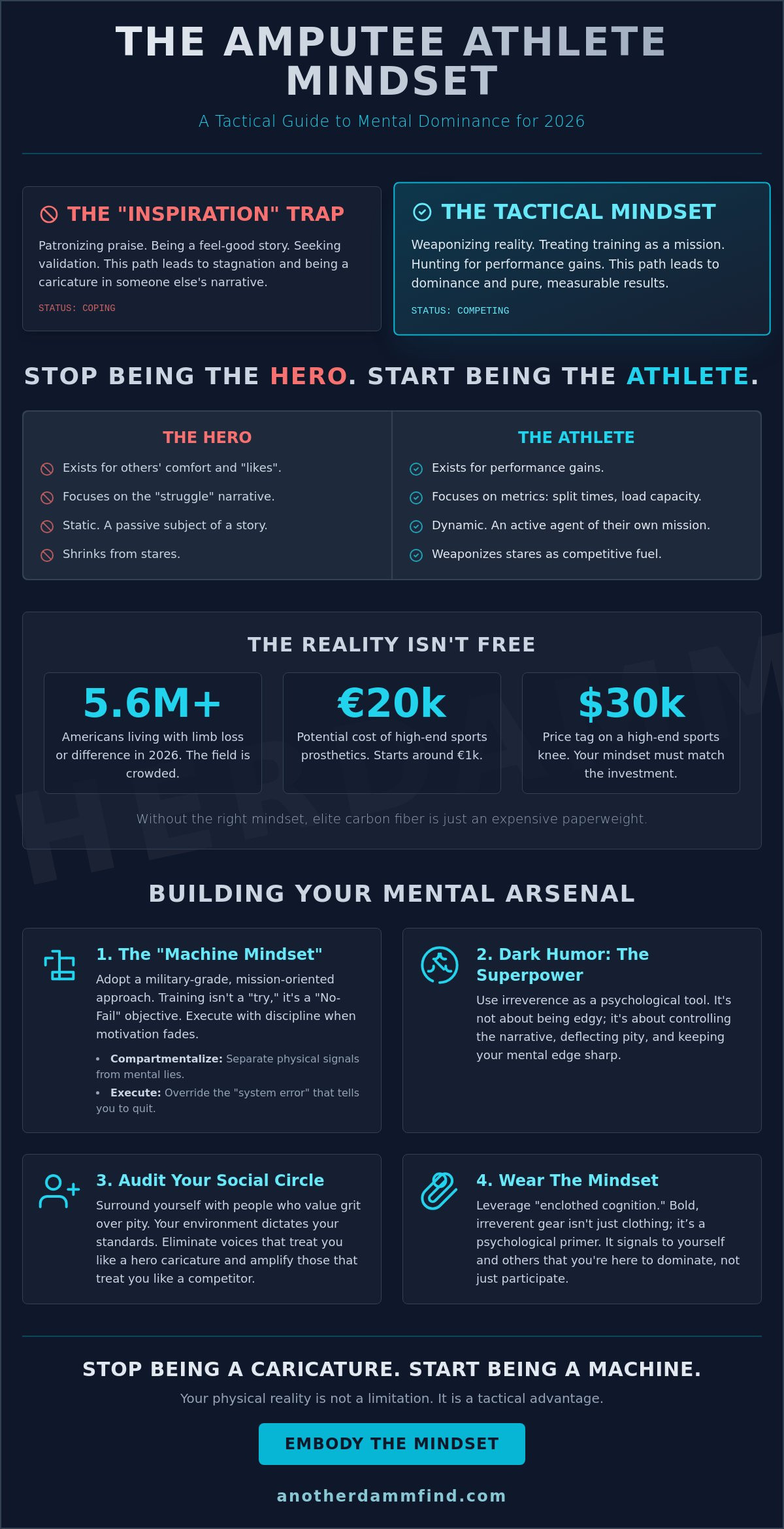
Let’s get one thing straight. The amputee athlete mindset isn’t a self-help slogan. It’s not about finding your "inner light" or some other soft-boiled nonsense. It’s a tactical integration of physical adaptation and cold, hard mental dominance. In 2026, with over 5.6 million Americans living with limb loss or difference, the space is getting crowded. You aren't just "getting back out there." You're building a system. This mindset is the prerequisite for any physical training program because, without it, you're just a person with expensive gear and no direction.
People love the "Inspiration Trap." They see you at the gym and act like you’ve conquered Everest just by putting on your shoes. It’s a backhanded compliment. It implies that your baseline is "pitiful" and anything above that is a miracle. That’s coping. Coping is just surviving the day. Competing is different. Competing is looking at the guy in the next lane and wanting to smoke him. It’s about metrics. It’s about the reality that while a basic sports prosthesis starts around €1,000, the high-end tech can hit €20,000. If your head isn't right, that carbon fiber is just an expensive paperweight. You have to move past the "happy to be here" phase and enter the "here to win" phase.
The "Hero" vs. The "Athlete"
The media wants a hero. They want a tear-jerker montage with swelling violin music. Screw that. Heroes are static; they exist to make able-bodied people feel better about their own lives. Athletes are dynamic. They care about split times, load capacity, and recovery cycles. Real progress happens when you stop seeking "likes" for your struggle and start hunting for performance gains. The amputee athlete mindset is the weaponization of personal adversity. It’s taking the "suck" and turning it into a fuel source that doesn't run out when the cameras stop clicking. Look at the history of the Paralympic Games. It didn't start as a feel-good festival. It started as a way to prove that elite performance is about results, not just participation trophies.
Weaponizing the Stares
People are going to stare. It’s human nature. You can shrink, or you can use it. When you walk into a weight room with a mechanical limb or a running blade, you own the room's energy. That curiosity is a source of competitive fuel. You aren't there to blend in. You're there to set the pace. Use your presence as psychological warfare. While they’re busy wondering how your socket stays on, you’re busy outworking them. It’s about signaling that you aren't just participating; you're dominating. Whether you're rocking one of our Amputee Awareness T-Shirts or a raw tank top, you're making a statement. You're the different one on the field. That’s not a weakness. It’s your edge.
The "Machine Mindset": Building Military-Grade Resilience
Forget the fluffy motivation. You need a system. The "Machine Mindset" isn't about being a cold, unfeeling robot; it's about being disciplined enough to execute when the motivation evaporates. This approach borrows heavily from the Green Beret ethos. It’s about viewing your training as a "No-Fail" mission. Whether you’re hitting your first 5k or a heavy lift, the objective is non-negotiable. This is the core of a high-performance amputee athlete mindset. You don't just "try" to finish. You execute the mission because that’s what the machine does.
Compartmentalization is your primary weapon. You have to learn the difference between physical pain and mental fatigue. One is a warning from your body; the other is a lie from your brain. When your socket is rubbing or your residual limb is barking, that’s a tactical problem to solve. When your brain tells you to quit because you're tired, that’s a system error to override. We see this in every inspiring journey of resilience, where the athlete treats their body like a piece of hardware that requires maintenance rather than a source of excuses.
The Veteran Advantage
The Another DAMM Find story is built on this foundation. It’s rooted in the transition from military service to civilian life with a limb difference. In the "Silent Service," you do the work without expecting a parade. You can apply that same mentality to your personal grind. Find the mission-critical objective in every workout. Is it building volume? Is it refining your gait? If you're out there in the cold at 0500, a Submarine Veteran Hoodie keeps the heat in while you focus on the mission. The goal is the only thing that matters.
Building Your SOP for Success
You need Standard Operating Procedures (SOPs). These are daily rituals that prevent the "dark hole" of depression from opening up. When you have a protocol, you don't have to think. You just do. Your amputee athlete mindset thrives on structure. It’s about creating a rhythm that the chaos can’t break.
- Hardware Check: Treat your prosthesis like tactical gear. Inspect the liners, the valves, and the bolts every single morning.
- Pre-Mission Brief: Visualize the workout before you start. Identify the points where it will suck and decide now how you will respond.
- Post-Mission Debrief: What worked? What felt like trash? Adjust the gear or the technique for the next run.
The machine is not emotionless. It's just too busy being disciplined to let those emotions dictate the outcome.
Dark Humor: The Tactical Advantage of Adaptive Athletes
Humor is a weapon. It’s not about being the class clown; it’s about psychological warfare. When you lean into amputee humor, you’re signaling that you’ve already processed the trauma and turned it into an asset. It’s a high-level defense mechanism that keeps the "dark hole" at bay while keeping your head in the game. During high-intensity competition, a well-timed crack about a loose bolt or a missing limb acts as a pressure valve. It resets your nervous system. It tells your opponents that you are completely unfazed by your reality. If you’re comfortable enough to joke about it, they’re the ones who are going to be uncomfortable. That’s an edge you can’t buy.
Research on Developing Mental Toughness in Athletes confirms that elite performers use specific psychological strategies to stay resilient. In the adaptive world, humor is that strategy. It bridges the gap between you and the people who are terrified of saying the wrong thing. You control the room. You set the vibe. This isn't about seeking approval; it's about establishing dominance through self-assurance. When you're rocking one of our Amputee Awareness T-Shirts with a biting punchline, you aren't just wearing clothes. You're deploying a tactical icebreaker.
Controlling the Narrative
If you’re laughing, you’re winning the psychological battle. It’s that simple. Humor bridges the gap with teammates and coaches who might otherwise walk on eggshells around you. The "One-Legged" joke isn't just a punchline; it’s a sign of total self-acceptance. It shows you aren't waiting for permission to be there. You’re already part of the crew. By owning the narrative, you stop being a "case study" and start being a teammate. It shifts the focus from what you've lost to how much you've gained in grit.
The Science of the Smirk
There's actual biology behind the bite. Laughter releases endorphins that aid in physical recovery and reduce cortisol levels. This irreverence is a pillar of the amputee athlete mindset because it kills performance anxiety before it can take root. A well-placed joke can be as tactical as a prosthetic adjustment, shifting your mental alignment back to center when the stakes are high. It keeps you loose. It keeps you dangerous. You aren't just out there grinding; you're enjoying the chaos. That’s how you stay in the game for the long haul without burning out.
How to Build Your Competitive Edge (A Tactical Guide)
Building an edge is a cold calculation. It starts with your "Why." If you're training to please others or to fit into a "brave" narrative, you'll fold the moment the socket starts chafing. Your "Why" needs to be selfish. It needs to be about personal dominance and seeing exactly what your modified system can do. Once that’s locked, audit your circle. Pity is a slow acting poison. If your squad treats you like a fragile antique, find a new squad. You need people who expect you to hit your numbers. This is where the amputee athlete mindset transitions from a concept into a daily practice.
Forget vague goals. "Getting fit" is a lie people tell themselves to feel productive. You need micro missions. Finish this set. Shave three seconds off this mile. Win the next thirty seconds. Stacking these small, violent wins creates a landslide of momentum that no amount of physical limitation can stop. It’s about the grind, not the glory.
The Gear Audit
Your gear is an extension of your intent. Know your prosthesis better than the technician who built it. In 2026, with prosthetic lifespans averaging three to five years, you can't afford to be ignorant about your hardware. Ritualize the check. Bolts, liners, valves; every piece must be mission ready. Aesthetic isn't vanity; it's a signal. When you look like an elite athlete, you start moving like one. Grab an Embroidered Snapback Hat and lock in. Your appearance should scream that you're here to work, not just to participate.
The "Refocus Trigger"
Frustration is inevitable. When the mechanics fail or the body lags, you need a refocus trigger. It’s a mental circuit breaker to snap out of a negative spiral. Use the principles from our graphic tee guide to choose your armor for the gym. What you wear changes how you perform. It’s enclothed cognition in action. When the spiral starts, look down at your gear, hit your mental cue, and focus on the next play. The last rep is dead. The next one is everything.
Wearing the Mindset: Why Your Gear Matters
What you wear is a tactical choice. It isn't just about covering your skin; it’s about "Enclothed Cognition." This is the psychological reality that the clothes you wear change how you think and perform. If you dress like a patient, you'll move like a patient. If you dress like an athlete with a dark sense of humor and a chip on your shoulder, you’ll train like one. Your gear is the interface between your internal amputee athlete mindset and the external world. It’s a signal to yourself and everyone in the gym that you aren't there for a participation trophy.
We’re moving past "Amputee Awareness." Awareness is passive. It’s for the people staring at you in the grocery store. We’re moving into "Amputee Pride." This is active. It’s about building an athlete brand that is loud, irreverent, and unapologetic. With over 500,000 new cases of limb loss or difference in the US every year, the community is massive. You have a choice. You can blend into the sterile, corporate aesthetic of "adaptive fitness," or you can wear gear that actually reflects the gritty, raw reality of the grind. Conversation-starter gear isn't just for show. It’s a tool to control the room's energy before you even touch a barbell.
Armor for the Grind
Your apparel should match your no-BS attitude. When you pull on a tank top or a long sleeve graphic tee that leans into the irony of your situation, you’re making a tactical power move. It disarms the "pity" crowd and signals total confidence. A funny shirt isn't just a joke; it’s a filter. It attracts the people who get the grit and repels the people who want to treat you like a hero caricature. Gear acts as a visual SOP for your mindset, a constant reminder that the machine is online and the mission is the only thing that matters. You don't need permission to be elite. You just need the right armor.
The Another DAMM Find Approach
We don't do polished. We don't do sterile. Our designs are built by a veteran who understands the transition from the "Silent Service" to the adaptive world. This is about rejecting generic, mass-produced corporate fluff in favor of something with real ink and real attitude. We make gear for the people who find the humor in the struggle and the strength in the scars. Whether it’s one of our Amputee Awareness T-Shirts or a Submarine Veteran Hoodie, every piece is designed to anchor your amputee athlete mindset in reality. It’s time to stop wearing what they expect and start wearing what you’ve earned. Check out the Amputee Humor collection to gear up for your next mission.
Lock in the Machine and Own the Field
You have the tactical framework. Now you need to execute. Building a high-performance amputee athlete mindset means rejecting the hero narrative and embracing the grit. It’s about using your dark humor as a shield and your gear as a psychological anchor. You’ve learned to treat your training like a mission and your prosthesis like the precision hardware it is. Don't let the able-bodied world define your limits with their low expectations. You are a machine designed for adaptation and dominance.
We don't do sterile or corporate here. We are veteran-owned and operated; we deliver original hand-lettered designs for the people who actually live this life. Our apparel is unapologetically bold and raw, just like your journey. It’s time to signal your intent to the rest of the world and find the gear that matches your frequency. Shop the Amputee Humor Collection and Wear Your Mindset. Grab your armor, hit your micro-missions, and keep pushing. The next play is yours. Go get it.
Frequently Asked Questions
How do I stay motivated when my prosthetic is causing pain?
Treat pain as a tactical data point rather than a reason to quit. If the pain is coming from a hardware failure like a poorly seated socket or a worn-out liner, you fix the equipment. If it is just the "suck" of the grind, you lean into your discipline. You don't need motivation when you have a mission-first approach to your training.
Is it okay to use dark humor about my amputation in a professional sports setting?
Using humor is a high-level psychological move to control the room's energy. It signals to coaches and competitors that you are completely comfortable with your reality. This breaks the tension and allows everyone to stop walking on eggshells and start focusing on your performance metrics. If you are laughing, you are winning the mental game.
What is the "Machine Mindset" and how can a beginner use it?
The Machine Mindset is the practice of choosing disciplined execution over fleeting motivation. Beginners can start by setting non-negotiable micro-missions for every workout. Don't worry about the 2026 season yet. Just focus on winning the next thirty seconds of your set without letting your emotions dictate the outcome.
How do I handle people who call me "inspiring" when I’m just trying to work out?
Acknowledge the comment and immediately get back to work. Don't let someone else's low bar for "heroism" lower your personal standards for excellence. Use their patronizing energy as fuel to smash your next PR. You are there to be an athlete, not a feel-good story for the able-bodied crowd.
Can I be a competitive athlete if I only recently became an amputee?
You can absolutely compete if you focus on your classification and metrics from day one. Start by checking the 2026 WPA licensing requirements and getting your medical diagnostic forms in order. Building a solid amputee athlete mindset during your initial recovery is what separates the casual participants from the elite competitors.
What kind of apparel is best for representing the amputee athlete mindset?
Wear gear that acts as a visual SOP for your attitude. Our Amputee Awareness T-Shirts and tank tops are designed to be tactical icebreakers that signal grit and self-assurance. This kind of apparel uses enclothed cognition to shift your mental state from "patient" to "powerhouse" the moment you pull it on.
How do I find a community of adaptive athletes that isn’t too "preachy"?
Look for veteran-led groups or adaptive action sports circles like WCMX. These communities usually prioritize raw grit and dark humor over polished inspiration porn. They value the work and the results rather than just "staying positive" through the struggle. Find the people who expect you to show up and grind.
What are the first steps to building a tactical resilience SOP?
Start with a daily hardware check of your prosthesis every single morning. Inspect your liners, valves, and bolts to ensure everything is mission-ready. Pair this with a pre-workout ritual that includes a physical or mental "refocus trigger" to snap you out of any negative spirals before you start your training.


