


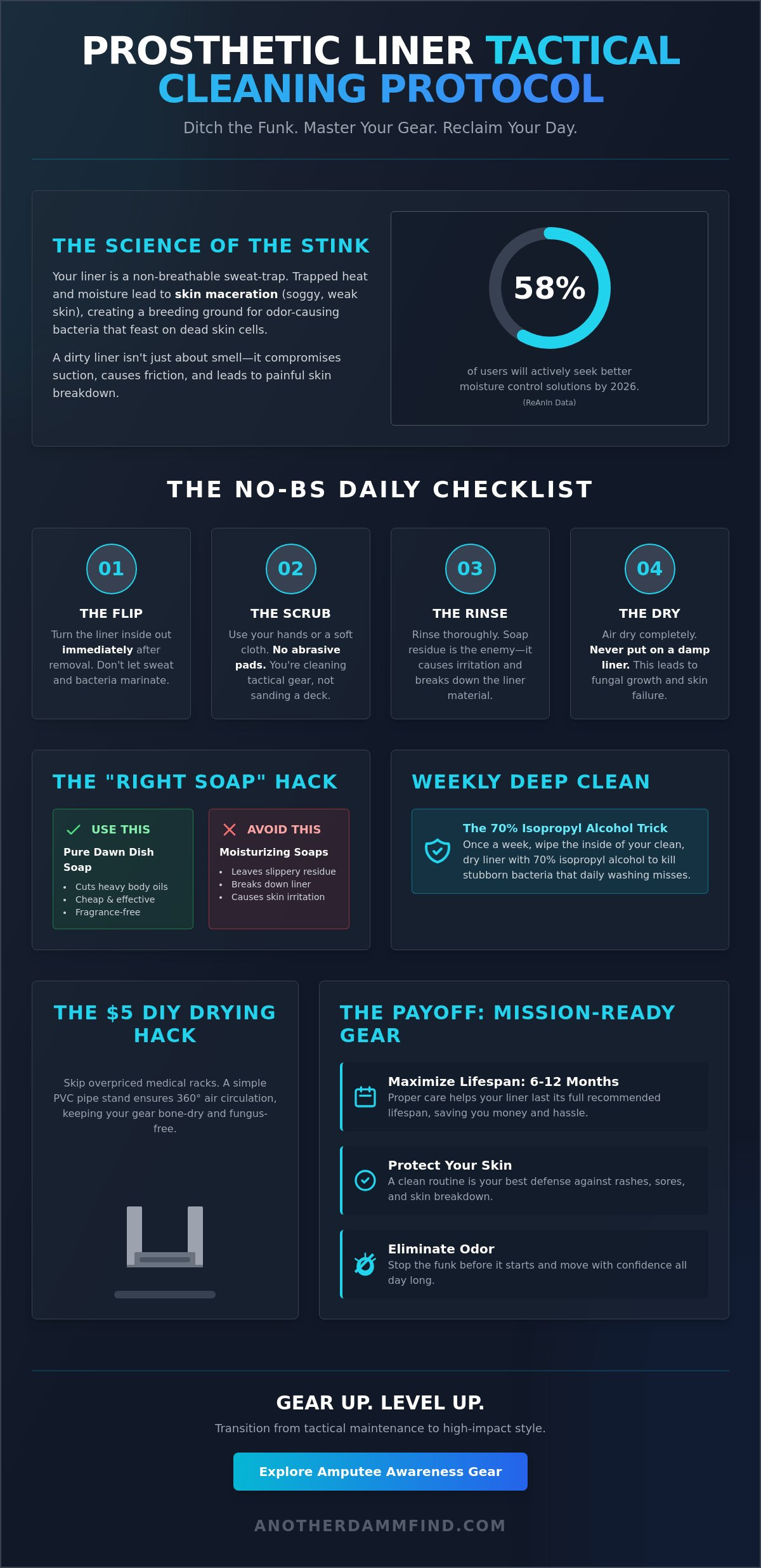
stop treating your prosthetic liner like a fragile medical antique and start treating it like the high performance tactical gear it actually is. you know the drill. you spend all day grinding, only to peel off your socket and get hit with that unmistakable locker room funk. it’s a damn nightmare. at Another DAMM Find, we know that with over 58% of users actively searching for better moisture control in 2026 according to ReAnIn data, the old school "soap and water" advice isn't doing enough to keep the bacteria at bay. we’re here to fix that with some high velocity prosthetic liner cleaning hacks that respect your time and your skin.
we agree that daily maintenance is a massive time suck that feels more like a medical chore than a lifestyle. that’s why we’re ditching the sterile hospital talk for a no-BS approach that actually works. you’re going to learn how to kill the odor, protect your limb from irritation, and make that $24.99 ALPS® cleanser go a hell of a lot further. this is your tactical checklist to a cleaner, faster routine that keeps your gear in the game for the full 6 to 12 month lifespan recommended by Horton's Orthotics & Prosthetics. let's get to work.
Key Takeaways
- flip your liner inside out immediately to stop sweat and dead skin from turning your socket into a damn petri dish.
- use the 70% isopropyl alcohol trick for a weekly deep clean that kills the bacteria daily washing misses.
- skip the overpriced medical drying racks and use our $5 PVC pipe hack to keep your gear bone dry.
- master these high-impact prosthetic liner cleaning hacks to stop the stink and keep your skin from breaking down.
- transition from tactical maintenance to high-impact style with gear that actually represents the grind.
Stop the Funk: Why Your Liner Cleaning Routine Matters
Let's be real. If you’re living the limb-loss life, you know that smell. It’s that sharp, swampy, "did something die in my socket?" scent that hits you the second the suction breaks. At Another DAMM Find, we call it what it is: liner funk. It’s a literal bacterial party happening in your socket; if you don't shut it down, your skin is going to pay the price. Relying on a quick splash of water is a recipe for disaster. Just rinsing is like trying to clean a grease fire with a damp paper towel. It doesn't work. Sweat and dead skin cells get trapped against your limb, creating a friction-heavy sludge that destroys your suction. When you understand the history and mechanics of what is a prosthesis, you realize that the liner is the most critical piece of tactical gear you own. These prosthetic liner cleaning hacks aren't just about hygiene; they're about maintaining your mobility and your self-respect.
Maintaining the vibe is just as important as the mechanics. You wouldn’t walk out the door in a shirt that smells like a dumpster, so don’t do it with your leg. A clean liner means better suction and less sliding, which gives you the tactical advantage when you're out on the hunt for unique finds. When your gear is dialed in, you move with more confidence. When it's swampy, you're just counting down the minutes until you can take it off. Don't let a lazy routine dictate your day.
The Science of the Stink
Silicone and gel are amazing for comfort, but they’re basically sweat-traps. They don't breathe. When your limb is sealed in that airtight environment, the heat has nowhere to go. This leads to skin maceration, which is just a fancy way of saying your skin gets soggy and weak like it’s been in a bathtub for ten hours. Once the skin is soft, the bacteria move in and start feasting on your dead skin cells. That's the source of the stink. Using smart prosthetic liner cleaning hacks keeps your skin tough enough to handle the daily grind without breaking out in a mess of sores.
Tactical Gear Mindset
Stop looking at your liner as medical equipment. It’s tactical gear. Think about the discipline of the Navy’s "silent service" on a submarine. On a sub, gear maintenance isn't optional; it’s survival. If a valve isn't cleaned, the mission fails. Your leg is your mission. Taking five minutes tonight to execute a proper cleaning routine saves you five days of sitting on the couch waiting for a rash to heal. It’s about the vibe, the discipline, and the respect you have for your own movement. Treat your gear like the high-performance equipment it is, and it will carry you through the day without the drama.
The No-BS Daily Cleaning Checklist
You’re tired. Your leg hurts. The last thing you want to do is spend twenty minutes hovering over a sink. We get it. But if you leave that liner sitting in a pool of its own filth, you’re asking for a skin disaster. This isn't about being "clean" for the sake of it; it’s about tactical readiness. A failed liner means a failed day. Follow these prosthetic liner cleaning hacks to get it done fast so you can get back to what matters.
- Step 1: The Flip. Turn that damn thing inside out immediately. The inside is the crime scene where the sweat and bacteria live. Don't let it marinate.
- Step 2: The Scrub. Use your hands or a soft cloth. No abrasive pads. You’re cleaning, not sanding a deck.
- Step 3: The Rinse. Soap residue is the enemy. If you don't get every bubble off, you'll develop "itchy leg syndrome" by noon.
- Step 4: The Dry. Never, ever put on a damp liner. Moisture trapped against your limb leads to fungal growth and skin breakdown.
Proper hygiene is the foundation of prosthetic limb skin care, and it starts with what you do the second you take the socket off. If you're feeling the vibe and want to level up your look while your liner dries, check out our latest amputee awareness gear at Another DAMM Find.
The "Right Soap" Hack
Forget the expensive, "specialty" medical soaps if you’re in a pinch. Pure Dawn dish soap is the secret weapon for cutting through the heavy body oils that gel liners love to soak up. It’s effective, cheap, and gets the job done. Avoid any soap with "moisturizers" or "skin softeners" like the plague. Those chemicals are designed to stay on your skin, which means they stay on the liner, breaking down the material and making it slippery. Stick to the fragrance-free rule. You want to smell like absolutely nothing. A fake meadow scent mixed with sweat is a vibe nobody wants.
The 60-Second Speed Clean
When you’re absolutely exhausted, use the "shower method." Take the liner into the shower with you. Wash it while you wash yourself. It’s high-velocity maintenance that fits into the routine you’re already doing. Just make sure you’re using that fragrance-free, non-moisturizing soap on the liner. This keeps your gear in top shape without adding extra chores to your night. Taking care of your equipment is a lifestyle, much like learning how to wash graphic tees to keep the art from cracking. Respect the gear, and the gear will respect you.
Tactical Sanitization: Killing Bacteria That Hate You
Daily washing is the baseline. It’s the absolute minimum. But even with a solid scrub, bacteria are tactical geniuses. They find the microscopic pores in your gel and set up camp. If you’ve ever wondered why it still reams of locker room even after a wash, that’s why. You need a weekly deep clean ritual to reset the clock. This is where prosthetic liner cleaning hacks move from basic hygiene to full-blown sanitization. We’re talking about 70% isopropyl alcohol. It’s the sweet spot for a reason. Anything higher evaporates too fast to kill the cell walls of the bastards living in your gear. Anything lower is just diluted water that won't get the job done.
Let’s bust the "soak" myth right now. Do not submerge your liner in a bucket of alcohol or bleach for hours. You’ll destroy the bonding agents and thin the gel until it’s damn near useless. You want a surgical strike, not a scorched-earth policy that ruins your expensive equipment. A quick, targeted application is all it takes to kill the funk without compromising the integrity of the material. Respect the gear, and it won't fall apart when you're mid-stride.
The Alcohol Mist Hack
Grab a cheap spray bottle from the dollar store. Don't waste your time with individual alcohol wipes; they’re annoying and don't get into the crevices. Mist the inside of the flipped liner until it’s damp but not dripping. This ensures even coverage across every square inch of the surface area. Now, follow the evaporation rule: let it air dry completely before you even think about flipping it back. This step is non-negotiable if you want to avoid folliculitis. Those red bumps aren't just "irritation." They're infected hair follicles caused by trapped bacteria. Kill the germs once a week, and you keep your skin in the game.
Dealing with Deep-Seated Odors
Sometimes, the funk has already won the war. If you’ve neglected the routine for months, the bacteria might be living too deep for a simple spray to reach. You can try a 15-minute soak in a very mild vinegar solution, one part vinegar to ten parts water, but if that doesn't kill the stink, it’s time to face reality. Liners have a finite shelf life. Data from Horton’s Orthotics & Prosthetics shows that most gear needs a replacement every 6 to 12 months. If yours is thinning, cracking, or permanently swampy, admit defeat and get a fresh one. If you need a lead on where to get fitted for a fresh one without the corporate BS, check out amputee support New York to find a tribe that can point you to a prosthetist who actually gets it.
DIY Drying Hacks: Because Wet Liners Suck
Washing your liner is only half the battle. If you put it on wet, you’re basically inviting a fungal colony to move into your socket. It’s a damn mess. Most people just flop the liner over a towel and hope for the best. That’s a rookie mistake. You need airflow. Without it, the moisture stays trapped in the gel, and you’re back to square one with the funk. These prosthetic liner cleaning hacks focus on the most ignored part of the routine: the dry. It’s the difference between a productive day and a day spent scratching a rash.
The gold standard for drying is the PVC pipe stand. You can build one for under $5 with a quick trip to the hardware store. It’s better than those clinical racks that cost five times as much. Just a vertical pipe on a base. It lets air circulate inside the liner so it dries from the inside out. If you’re in a massive rush, set it in front of a fan. A cold fan blast is fine. What you absolutely never do is use a hairdryer or stick it on a radiator. Heat is the enemy. It will melt your gel and turn your expensive silicone into a brittle, useless shell. With silicone holding a 48.7% share of the liner market in 2026 according to Coherent Market Insights, you can't afford to toast your gear. Avoid direct sunlight too; UV rays are just as bad for the material as a heater.
The "Wine Bottle" Stand Hack
If you don’t have a PVC stand yet, use an empty wine bottle. It’s functional and looks a hell of a lot better on your dresser than a sterile medical device. Just make sure the bottle is bone dry and clean. You don't want old Cabernet stains mixing with your liner funk. The weight of the bottle keeps it stable, and the narrow neck allows for that critical internal airflow. It’s a temporary fix that works perfectly until you build your permanent tactical rack. It’s about using what you have to keep the mission moving.
Travel Hacks for the Road
Being on the road is no excuse for a swampy leg. In a hotel room, use the microfiber towel roll technique. Lay the liner on a clean microfiber towel, roll it up like a burrito, and squeeze. Don't wring it; you'll tear the gel. Just squeeze. This wicks away about 80% of the moisture in seconds. For the rest, use the paper towel stuffing method. Stuff the inside with dry paper towels for ten minutes to soak up the remaining dampness. Pack a tactical cleaning kit with a small spray bottle of 70% alcohol and a microfiber cloth. It keeps the routine alive whether you’re in a hotel or a dive bar bathroom. Once your gear is dry and you're ready to hit the town, make sure you're wearing an amputee awareness shirt that actually looks good.
Beyond the Liner: Gear That Actually Represents You
You’ve mastered the prosthetic liner cleaning hacks. Your gear is sanitized, dry, and ready for the mission. But let’s be honest: having a clean leg is just the baseline for self-respect. It’s the foundation. If you’re putting in the work to keep your tactical gear in top shape, you shouldn’t be covering the rest of yourself in generic, mass-produced garbage. You wouldn’t spend an hour detailing a supercar just to drive it through a landfill. Treat your style with the same high-velocity discipline you bring to your gear maintenance. It’s about the total vibe, not just the technical parts.
There’s a massive gap in how most people talk about limb loss. It’s either tragic or "inspiring" in that sterile, hospital-brochure kind of way. We’re over it. At Another DAMM Find, we believe your gear should reflect the grit and the hunt. Maintaining your liner is about keeping your body ready for the grind. Wearing the right clothes is about keeping your mind in the game. It’s about identity. It’s about the vibe. When you take care of your equipment, you’re telling the world you respect the journey. When you wear our art, you’re telling the world you own it.
Wearing Your Personality
Let’s talk about that "inspirational" crap. You know the shirts. "My only limit is me" or some other watered-down nonsense. Boring. We prefer amputee humor because laughing at the situation is a legit superpower. It’s raw. It’s real. It’s the kind of talk you only hear from people who have actually been there. Our graphic tees are the perfect reward for sticking to your prosthetic liner cleaning hacks and keeping your skin healthy. When you wear our gear, you’re not just wearing a shirt; you’re joining a subculture of veterans and amputees who value authenticity over formal professionalism. You can read more about how we started in the Another DAMM Find story. We’re in this for the people, not the corporate approval.
The Final Checklist for a Badass Day
You’ve got the routine down. You’ve killed the bacteria. You’ve built the PVC rack. Now finish the job. A badass day requires a specific setup to keep the momentum moving:
- Clean, bone-dry liner? Check.
- Fresh, conversation-starting graphic tee? Check.
- Irreverent attitude that takes no BS? Double check.
Stop settling for the generic "amputee" look that feels like a medical prescription. You’ve done the work to stop the stink. Now do the work to stand out. Upgrade your wardrobe with pieces that actually speak your language and represent the grind. Check out the Amputee Awareness Collection and find something that hits as hard as you do. The hunt for the perfect find never stops. Don't just survive the day. Own the damn thing.
Stop Settling for a Swampy Socket
You’ve got the intel. You know that a clean leg is the difference between crushing your day and being sidelined by a nasty rash. Ditching the medical fluff for high-impact prosthetic liner cleaning hacks like the 70% alcohol mist and the $5 PVC drying stand is how you reclaim your time. It’s about discipline. It’s about respecting the gear that keeps you moving. Once you’ve killed the bacteria and fixed the funk, you’re ready to focus on the hunt for what’s next.
Don’t stop at the liner. Your whole vibe should reflect the same grit you bring to your maintenance routine. We’re veteran-owned and operated, delivering original lettering by Rich Damm that actually says something. We don't do boring. We do bold art for a community that’s seen it all and still keeps grinding. It’s time to trade in the generic hospital-grade look for something with a damn soul. Check out our Amputee Awareness Tees, gear that actually has a pulse.
Keep your gear tight and your style sharper. You’ve put in the work to stop the stink; now go out there and own the day. Stay dangerous.
Frequently Asked Questions
Can I wash my prosthetic liner in the washing machine?
No, keep that damn thing out of the washing machine. The mechanical agitation will shred the gel and the high heat will destroy the fabric bonding in minutes. Stick to hand washing in the sink with lukewarm water. It’s the only way to keep your gear from becoming a pile of useless, expensive scrap.
How often should I really be cleaning my liner?
You need to clean your liner every single day without fail. Sweat and dead skin cells start a bacterial party the moment you seal that socket. Daily maintenance is the only way to prevent the swampy buildup that leads to skin irritation and that unmistakable locker room funk.
What is the best soap for prosthetic liners?
The best soap is a mild, fragrance-free liquid like Dawn dish soap, which is a staple in many prosthetic liner cleaning hacks for cutting through body oils. Avoid any soap with "moisturizers" or "skin softeners" like the plague. Those chemicals leave a slippery residue that ruins your suction and irritates your limb.
How do I get the smell out of my prosthetic liner?
To kill the deep-seated funk, integrate a weekly alcohol mist into your prosthetic liner cleaning hacks. Use 70% isopropyl alcohol in a spray bottle to sanitize the entire inner surface. Let it evaporate completely to kill the stubborn bacteria that standard daily soaping leaves behind.
Can I use baby wipes to clean my liner on the go?
Baby wipes work for a quick emergency on the road, but they aren't a replacement for a real scrub. Many wipes have oils or scents that can leave a film on the silicone. Use them in a pinch when you’re out, but get back to your tactical cleaning routine as soon as you hit a sink.
What happens if I don’t clean my prosthetic liner every day?
If you skip daily cleaning, you’re inviting skin maceration and fungal infections. Your skin gets soggy, weak, and prone to painful rashes that can bench you for days. Horton’s Orthotics & Prosthetics notes that improper hygiene is a leading cause of skin breakdown in 2025. It’s a fast track to losing your mobility.
Is it safe to use bleach on a silicone liner?
Bleach is a hard no for silicone or gel liners. It’s a corrosive chemical that will turn your expensive gear brittle and yellow. Stick to the 70% alcohol method for sanitization. It’s effective at killing germs without eating through the material you rely on for comfort.
How long does a prosthetic liner usually last before needing replacement?
Expect your liner to last between 6 and 12 months under normal use. If you see thinning gel, cracks, or fabric separation, it’s time to retire the gear and get a fresh one. According to 2025 industry standards, wearing a worn-out liner is a recipe for skin damage and a poor socket fit.


