


You’d think the hardest part of the Silent Service is the six months of breathing recycled air and never seeing the sun, but the real soul-crusher is the first Thanksgiving back home. You’re standing there with a plate of turkey while your cousin asks if you saw any cool fish through the windows. Civilians don't get it. They think your life is a Hollywood movie or a claustrophobic fever dream, and honestly, trying to bridge that gap feels like trying to explain color to someone who’s lived in a basement their whole life. It's frustrating to realize that how to explain submarine service to civilians is a skill they never taught you in A-school.
We know the struggle. It is exhausting to answer the same three stupid questions while people look at you like you’re an alien who just landed. This is your no-BS roadmap on how to translate the underwater grind without losing your damn mind. We are going to give you the analogies that actually work, the confidence to tell your story on your own terms, and a look at the gear, like our Submarine Veteran Hoodies, that lets the world know you’re built different before you even open your mouth. No more "it’s classified" cop-outs. Just raw, unfiltered truth for the few who actually earned their dolphins.
Key Takeaways
- Trash the Hollywood "ping" myths. Learn to describe the 90% boredom and 10% terror that actually defines the steel pipe life.
- Master the basement quarantine analogy. It is the secret to how to explain submarine service to civilians without sounding like a technical manual.
- Grab the social survival guide for handling "stupid" questions. Stop saying "it's classified" and start telling stories that actually hit.
- Realize why earning your dolphins is the ultimate rite of passage. It is what makes submarine veterans a breed apart from the rest of the fleet.
Killing the Hollywood Myth: Submarine Life Isn’t a Movie
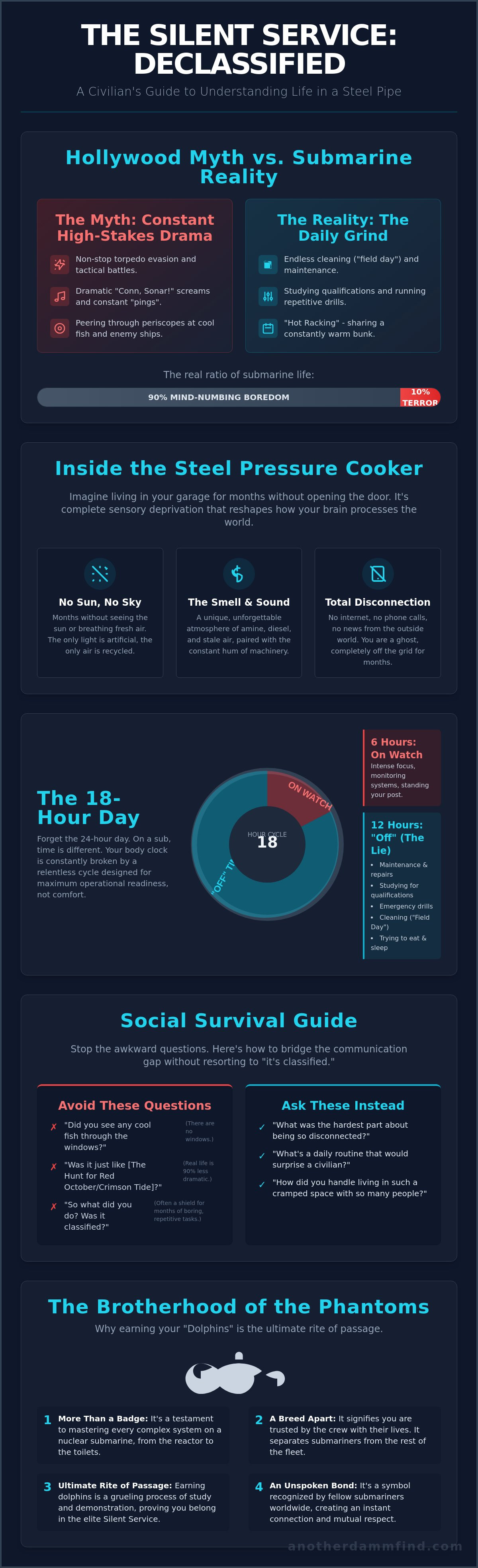
Hollywood is a liar. It sells you the high-octane drama of The Hunt for Red October or the sweaty, theatrical tension of Crimson Tide. It is all red lights, sonar pings, and dramatic "conn, sonar!" screams. In the real world, life in a steel pipe is 90% mind-numbing boredom and 10% pure, unadulterated terror. When you are trying to figure out how to explain submarine service to civilians, you have to start by burning their DVD collection. Most days aren't about dodging torpedoes. They are about fighting for a spot in the shower or wondering if the midrats are going to give you food poisoning. The movies skip the parts that actually define us.
The "Silent" in Silent Service
The "Silent Service" isn't just a cool nickname. It is a tactical requirement. We disappear. We drop off the face of the earth for months at a time. While the surface fleet is busy showing off their hulls and hitting ports, we are ghosts. This level of stealth is a global standard, seen in everything from the US fleet to the Royal Navy Submarine Service. For a civilian, "no news is good news" is a cliché. For a submariner’s family, it is a way of life that can be brutal. You don't get to call home because you had a bad day. You don't get to text your spouse about what's for dinner. You are just gone. When people ask what you did, the "it’s classified" excuse is often a shield for the fact that you spent three months doing things that would bore them to tears. You can tell them about the mission's purpose without giving away the coordinates. Focus on the isolation, not the intel.
Movies vs. The Mess Deck
Movies never show the "field day" where you scrub every square inch of the boat with a toothbrush for hours. They don't show "hot racking," where you crawl into a bunk that is still warm from the guy who just finished his watch. Tactical tension is real, but it is overshadowed by the daily grind of maintenance and cleaning the bilge. Real submarine life is cramped, smells like amine and diesel, and revolves around a mess deck that is the size of a walk-in closet. If you want to give someone the real story, check out this Navy Submarine Service Crash Course: Life in the Silent Service. It is the best way to start how to explain submarine service to civilians without sugarcoating the grit that actually makes a sailor.
The Psychological Architecture: Living in a Steel Pressure Cooker
Imagine living in your garage for three months without ever opening the door. No windows. No sun. No fresh air. Just you, some high-tech machinery, and 150 other people breathing the same recycled oxygen. When you are looking for how to explain submarine service to civilians, you have to start with the mental gymnastics. It isn't just about being underwater. It is about the complete sensory deprivation that comes with being disconnected from the planet. You are a ghost in the machine. This is the reality of life on a submarine. It is a psychological pressure cooker that reshapes how your brain processes the world.
The 18-Hour Submarine Clock
Forget the 24-hour day. That is a luxury for people with lawns. On a boat, we live on an 18-hour cycle. It is a relentless rotation of 6 hours on watch followed by 12 hours of "off" time. But "off" is a lie. Those 12 hours are packed with maintenance, studying for qualifications, and emergency drills. Your circadian rhythm doesn't just get confused; it completely snaps. This is where "hot racking" comes in. Hot racking is the ultimate test of personal space where you crawl into a bunk that is still warm from the body heat of the sailor who just stood up. It is efficient. It is necessary. It is also enough to make a civilian have a panic attack. Time becomes a suggestion, and sleep is a currency you are always short on.
The Smell and the Sound
The boat has a soul, and that soul smells like amine, diesel fuel, and feet. It is a thick, visceral scent that clings to your skin and saturates your uniform. You don't just smell it; you wear it. Even after you're out, a specific whiff of industrial cleaner or stale air can teleport you back to the mess deck in a heartbeat. Then there's the sound. It is never truly quiet. There is a constant mechanical hum, the clicking of valves, and the occasional groan of the hull under pressure. Veterans often find themselves waking up at the slightest change in a room's ambient noise because their brains are still wired to listen for a pipe bursting or a pump failing. If you still feel that hum in your bones, you might as well represent it. Throw on one of our Submarine Veteran Hoodies and let the world know you survived the pressure cooker.
Analogies for the Uninitiated: How to Describe the Service
Civilians live in a world of windows, Wi-Fi, and fresh air. You don't. When you are staring down the challenge of how to explain submarine service to civilians, you have to stop using Navy jargon and start using things they have actually felt. Don't talk about displacement or nuclear reactors. Tell them it is like a three-month lockdown in a windowless basement with 150 roommates who all share one bathroom. That hits harder. It is an office in a pipe. You work, eat, and sleep in the same 100 yards of steel for months. There is no destination. You aren't "going" to Italy; you are just "being" in the North Atlantic while the world moves on without you.
The Submarine vs. Civilian Life Framework
Sometimes a simple comparison is the only way to bridge the gap. Use this breakdown to show them the difference between their "rough day" and your average Tuesday on the boat.
| Life Event | Civilian Version | Submariner Version |
|---|---|---|
| The Commute | Sitting in traffic on the highway. | Walking 20 feet from your bunk to your watch station. |
| Grocery Run | The local store whenever you want. | Canned everything after week three. Fresh milk is a myth. |
| Staying Connected | Unlimited 5G and FaceTime. | Familygrams: 50 words, one-way, and delayed by weeks. |
The "Space Station Underwater" Comparison
Think of the boat as a space station, but the vacuum is trying to crush you instead of suck you out. We are closer to astronauts than surface sailors. We rely on complex life-support systems just to breathe. Every sailor lives by The Submariner's creed; it is a promise to keep the water out and the air in while being a professional phantom. It is a high-stakes identity that most people can't wrap their heads around. To really paint the picture for them, you need the right words. Check out this Submarine Slang: The Raw, No-BS Guide to Talking Like a Bubblehead to help translate the madness of how to explain submarine service to civilians without losing your edge.
The Social Survival Guide: Handling the "Stupid" Questions
"So, did you see any whales?" It is the question that makes every bubblehead want to roll their eyes into the back of their skull. You were 800 feet down in a windowless steel pipe. No, you didn't see a whale. You saw a sonar screen, a bunch of sweaty dudes, and the inside of a valve. Mastering how to explain submarine service to civilians is mostly about managing these repetitive, often ridiculous questions without being a total prick. They don't know any better. They grew up on Hollywood myths and claustrophobic nightmares. Your job is to set boundaries while giving them just enough flavor to satisfy their curiosity without compromising your sanity.
The Top 3 Questions (and How to Answer Them)
- The Food: Civilians think we eat grey sludge. Tell them the truth. The food is actually the best in the fleet for the first three weeks. After that, it becomes a desperate science experiment involving powdered eggs, canned peaches, and "bug juice."
- The Claustrophobia: They always ask if you felt trapped. The reality is that you were too damn busy to notice. Between 18-hour days and constant drills, you didn't have time for a panic attack. You were just focused on not breaking anything.
- The Depth: This is where you use the standard classified flex. Just tell them "deep enough to be a problem if we stop" and move on. It sounds cool, it’s accurate, and it ends the conversation.
When to Use Dark Humor
Submariners are fueled by caffeine and dark humor. It is a survival mechanism. We joke about things that would give a civilian nightmares because that is how we process the pressure of the Silent Service. The "I could tell you, but I’d have to kill you" line is a classic for a reason. It is a cliché, but it works every time you need to shut down a conversation. Just be careful when sharing sea stories at a backyard BBQ. If your story ends with everyone being afraid of the ocean, you might have gone too far. Keep it focused on the pranks and the mess deck madness. If you want to see how we channel that raw veteran energy into something tangible, check out The Another DAMM Find Story: Veterans, Amputees, and Raw Art.
Sometimes you just don't want to talk. We get it. If you're done being a tour guide for people who will never understand the grind, let your clothes handle the introduction. Grab some Submarine Veteran apparel and keep the conversation on your own terms. It saves you the breath and lets the world know you're part of a subculture they can't join.
The Brotherhood of the Phantoms: Why We Wear the Dolphins
The rest of the Navy likes to talk about the sea. Submariners live inside it. We are the phantoms. We operate in the dark, under crushing pressure, where a single mistake kills everyone on board. That shared mortality creates a brotherhood that civilians simply cannot fathom. It is why we wear the dolphins. It isn't just a shiny piece of metal. It is a certificate of sanity in an insane environment. When you are figuring out how to explain submarine service to civilians, you have to make them understand that the badge isn't a decoration. It is a blood oath. It means you are part of a lineage that dates back to the first hull that ever dove under the waves.
Earning the Fish
The path to the fish is a mental and physical gauntlet. It starts with the "Qual" book. You are a "non-qual" or a "numb-nut" until you prove you know every valve, pipe, and circuit on the boat. You don't sleep. You study while others eat. You stand before a board of salty veterans who want to see you break. The moment those dolphins are pinned to your chest, you stop being a passenger. You become a permanent part of the crew. You are finally trusted with the lives of the 150 other people in that steel tube. That pride lasts long after you hang up the uniform. It is a transformation that changes your DNA.
Transitioning to the "real world" is a trip. Suddenly, people care about things that don't matter. They complain about traffic or slow Wi-Fi. You’re just glad to have a window and air that doesn't smell like amine. But you don't lose that identity just because you're off the boat. You just change how you project it. You carry the Silent Service with you in how you handle stress and how you view the world. It makes how to explain submarine service to civilians a secondary concern to simply living by the standards you learned in the deep. You are a submariner for life. Period.
Conversation Starters That Do the Work for You
Sometimes, you don't want to give the full tour. You want a silent signal to the tribe. That’s where the gear comes in. Submarine Veteran Hoodies do the heavy lifting for you. They act as a filter. Other bubbleheads see them and give the nod. Civilians see them and either keep walking or ask the right questions. It is about authenticity. It is about wearing your service on your sleeve, literally. If you are looking for gear that actually represents the grind, check out our submarine veteran apparel. Find the pieces that signal you are a breed apart. You earned the fish. Now wear them.
Own Your Story and the Deep
You survived the pressure cooker. You earned the fish. Now it's time to stop apologizing for the silence. You've got the analogies to bridge the gap and the social armor to deflect the whale questions. Mastering how to explain submarine service to civilians isn't about giving them a technical manual; it's about reclaiming your narrative and making them respect the grind you endured. Whether you use the basement quarantine comparison or just hit them with a "classified" smile, you own the depth. You aren't just a veteran; you are a phantom who operated where the world couldn't see you.
We are veteran-owned and operated by a real US Navy Sub Vet who knows the smell of amine and the weight of the dolphins. Our gear features original hand-lettered designs that act as a silent signal to the tribe. It's conversation-starting apparel that cuts through the BS before you even say a word. Don't waste your breath on people who won't ever see the sun from a mess deck.
Check out our Submarine Veteran Apparel and stop explaining yourself.
Keep your head up and your air clear. You are part of the elite, and you don't owe the surface world a damn thing.
Frequently Asked Questions
How do you explain submarine service to someone who has never been on a boat?
You explain it by stripping away the high-tech sonar talk and focusing on the human pressure of living in a windowless steel pipe. Focus on the sensory deprivation. Tell them it is about disappearing from the planet for months while the world moves on without you. Learning how to explain submarine service to civilians requires you to translate the mental grind into something they can actually feel, like a long-term lockdown in a basement.
What is the hardest part about explaining life on a submarine?
The hardest part is the complete lack of common ground between your reality and their daily life. Most civilians can't imagine a world without a cell signal or the sun. Trying to describe the specific smell of amine or the bone-deep fatigue of an 18-hour day often falls flat. You're trying to explain a culture of silence to people who live in a world of constant noise and instant connection.
Do submariners get claustrophobic while on patrol?
Submariners rarely get claustrophobic because the Navy's psychological screening and the intense workload weed out those who can't handle it. You are too busy standing watch, studying for qualifications, and running drills to worry about the walls. The boat is your entire universe. Most guys find that the cramped spaces eventually feel like a secure, familiar environment rather than a cage. It becomes your normal.
How do you answer questions about classified submarine operations?
You answer by setting a hard boundary and pivoting to the atmosphere of the mission rather than the details. Use the "I could tell you, but I’d have to kill you" joke to lighten the mood if you have to. Otherwise, just tell them you were doing your job in the dark. You can talk about the isolation or the food without ever mentioning a single coordinate or tactical objective.
What are the best analogies for living on a submarine?
The best analogies are the windowless office or the space station under the sea. Tell them it is like being an astronaut, but if the life support fails, you sink instead of float. Comparing a patrol to a three-month quarantine in a garage with 150 roommates is another winner. These comparisons help bridge the gap when you are figuring out how to explain submarine service to civilians without using technical jargon.
Why do submarine veterans have such a dark sense of humor?
Dark humor is a survival mechanism for dealing with high-stakes environments and recycled air. When you live in a steel tube where a single valve mistake can be fatal, you learn to laugh at the absurdity of it all. It is a way to process stress and build a bond with the only other people on earth who understand the grind. If the jokes are cynical, it is because the reality is raw.
What does it mean to be a "Bubblehead" in the Navy?
Being a Bubblehead means you are part of the elite few who volunteered to go under the waves. It is a badge of honor that signifies you earned your dolphins and survived the Silent Service. It means you are a breed apart from the surface fleet. You value stealth, technical mastery, and the brotherhood of the phantoms. It is an identity that stays with you long after you leave the boat.
How can I support a submarine veteran in my family?
Support looks like patience and an appreciation for the silence they lived in for years. Understand that they might need time to adjust to crowds or loud noises after being in a controlled, mechanical environment. Listen when they want to share a sea story, but don't push for details they aren't ready to give. Sometimes, just acknowledging that their service was a unique mental gauntlet is the best support you can offer.


