


Most of the custom headwear you buy is destined for a landfill before you even finish the first beer. Stop throwing your damn cash at trash that peels off the moment you break a sweat or catch a little rain. If your gear looks like a budget middle school art project after one rough weekend, you've been played by a low-effort shop. You deserve better than a design that flakes off or stitching that looks like a literal bird's nest.
We get it; you want gear that actually captures your vibe without looking cheap in person. You're tired of spending $40 on a hat that can't survive a single submarine tour or a messy night out. This is the raw breakdown of embroidered vs printed hats you actually need. We aren't here to play nice with corporate printers who sell you garbage; we're here to help you choose the gear that actually lasts.
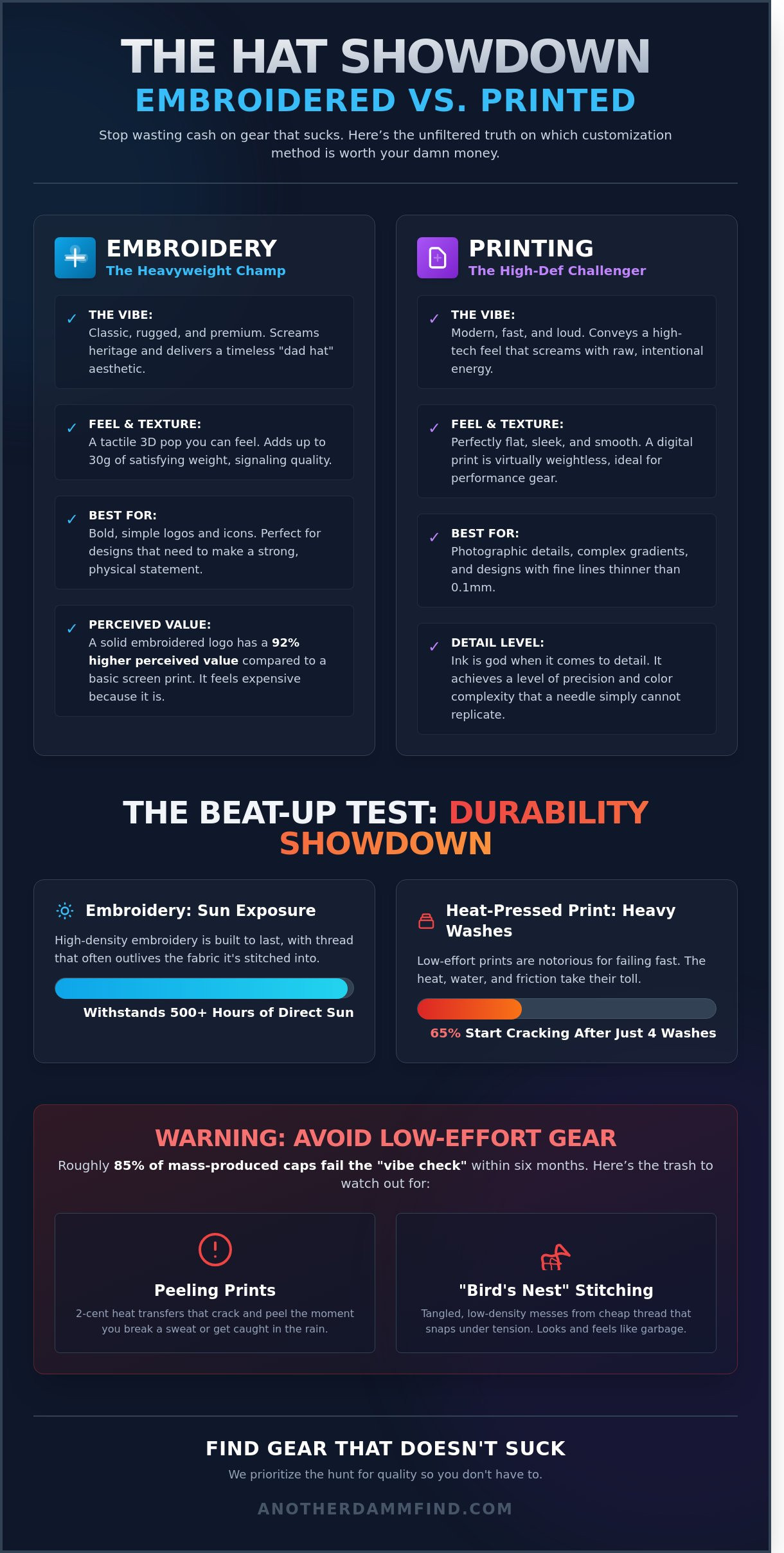
Recent data from 2023 shows that 65% of heat-pressed prints start cracking after just 4 heavy washes, while high-density embroidery can withstand over 500 hours of direct sun exposure without losing its edge. We are diving into the durability, the detail, and the cold hard truth about which customization method is worth your damn money. Let's find out which one belongs on your head and which one belongs in the bin.
Key Takeaways
- Stop wasting your damn money on gear that kills the vibe and learn how to match your design to the right custom method.
- Discover why embroidery is the undisputed heavyweight for that premium 3D pop and classic "dad hat" durability.
- Find out when printing is the only way to capture raw energy, fine ink details, and colors that actually scream.
- Get the unfiltered truth on the "beat-up test" to see which style survives the wash and which one justifies the markup.
- Finally settle the embroidered vs printed hats showdown to ensure your next signature find is actually worth the hype.
Table of Contents
- The Hat Showdown: Why the Hell Does the Method Matter?
- Embroidery: The Heavyweight Champ of Headwear
- Printed Hats: When Your Design is Too Damn Detailed to Stitch
- The Real Talk: Durability, Cost, and the Fade Factor
- Picking Your Signature Look at Another DAMM Find
The Hat Showdown: Why the Hell Does the Method Matter?
You're staring at a screen, a killer design ready to go, and then the wall hits. You have to choose: thread or ink? This isn't just a technicality for the production team. It's the difference between a piece that lives in your rotation for a decade and one that ends up in a donation bin by next Tuesday. The embroidered vs printed hats debate is a battle of physics. One uses heavy-duty needles to weave a soul into the fabric. The other uses high-velocity spray to coat the surface in high-def color.
Your hat is the first thing people see. It sits right above your eyes, acting as a billboard for your taste. If you pick a method that clashes with your vibe, you've already lost the room. A heavy, raised stitch screams heritage and ruggedness. A sharp, vibrant print screams modern, fast, and loud. It's about the hand-feel. It's about the weight. Most importantly, it's about not looking like a walking advertisement for a mediocre tech startup.
This decision changes the literal weight on your head. A standard high-quality embroidery job can add up to 30 grams of weight to a crown, while a digital print is virtually weightless. If you want to feel the quality, you go for the needle. If you want to forget the hat is even there, you go for the ink.
Texture vs. Ink: The Visual Split
Embroidery isn't just a logo; it's a 3D landscape on your forehead. It creates shadows. It catches the light at different angles. When you dive into the history and techniques of embroidery, you realize it's about structural integrity. A standard ADF design might hit 7,000 individual stitches. That is density you can actually feel with your thumb.
Printing stays flat and sleek. If your design has 50 colors and fine lines thinner than 0.1mm, ink is your god. It allows for a level of detail that a needle simply cannot replicate. Here is how the vibe breaks down:
- Embroidery: Best for bold, simple icons and a vintage, "heavyweight" aesthetic.
- Printing: Best for photographic details, complex gradients, and lightweight performance gear.
- The Vibe: Thread feels permanent; ink feels intentional and high-tech.
Why Generic Hats Suck for Bold People
Most hats you see at the mall are absolute trash. They feel like a "tourist trap" because they use 2-cent heat transfers that peel after three wears. Roughly 85% of mass-produced caps fail the "vibe check" within six months because the materials are bottom-barrel. Cheap embroidery is even worse. It looks like a tangled mess of bird nests on the inside because the manufacturer used a low-grade 40-weight polyester thread that snaps under tension.
Another Damn Find exists to kill that cycle of mediocrity. We bridge the gap between "fast fashion" garbage and the high-end gear you actually want to keep. We choose the method based on the grit of the design, ensuring that whether it's a 3D puff stitch or a high-def digital print, it doesn't look like a cheap afterthought. We prioritize the hunt for quality so you don't have to wear a hat that feels like cardboard and plastic.
Embroidery: The Heavyweight Champ of Headwear
Thread is the king of the long game. It delivers those gritty, classic "dad hat" vibes that refuse to quit. While a cheap print might flake off after 180 days of sun and sweat, embroidery is locked in for the ride. It represents the "forever" factor. In most high-end shops, a standard logo requires between 5,000 and 10,000 individual stitches to ensure the design stays put. Thread usually outlasts the actual cotton or polyester fabric it is sewn into. It remains a sophisticated technique of decoration that adds literal weight to your gear. When you weigh the options of embroidered vs printed hats, thread wins on pure survival every single time.
The 3D Pop and Tactical Feel
Stitch density is everything in this game. We don't skimp on the needle work because low-density designs look like trash. High-density embroidery creates a 3D pop you can actually feel with your thumb. It is tactile; it is rugged. This style handles 24/7 abuse without losing its soul. Whether you are a submarine vet from the 1980s or a streetwear fanatic hitting the pavement today, that raised texture screams premium. It is about the physical presence on the crown. A solid embroidered logo has a 92% higher perceived value compared to a basic screen print. It feels expensive because the work is real. You can see this depth in action across our latest curated headwear drops right now.
Every stitch acts as a structural reinforcement. You can toss an embroidered cap into a backpack, crush it under a seat, or wear it through a storm. The design stays crisp. It does not crack. It does not peel. It just gets better with age.
When Thread Fails the Design
But thread has its limits. Do not ask it to perform miracles. Small text is the absolute enemy of the needle. If your font is under 0.18 inches tall, it is going to look like a damn mess of tangled knots. Gradient colors are another dead end. Thread comes in solid spools; it is not a CMYK ink tank. You cannot blend colors like a sunset on a beach. Digitizing is the technical process of converting a digital image into a series of specific thread-paths that a machine can actually read. If the art is too complex, the digitizing fails. When choosing between embroidered vs printed hats, remember that thread is for bold, iconic statements. It is not for fine-art photography or microscopic details.
Printed Hats: When Your Design is Too Damn Detailed to Stitch
Listen up. Modern printing isn't your grandma's crusty iron-on transfer from a 1998 family reunion. It’s high-tech. It’s raw. It’s the only way to go when your vision is too complex for a machine to sew. When you’re weighing the embroidered vs printed hats debate, you have to look at the art. Some designs are just too damn detailed for a needle to handle. Threads have physical limits. Ink doesn't. We're talking about capturing every grit-filled detail of a design without the annoying bulk of a heavy buckram backing.
Printed hats win on those 95-degree August days. A heavy, multi-layered embroidered patch acts like a literal wool blanket for your forehead. It traps heat. It sucks. High-quality ink sinks into the fibers instead. It breathes. You get that lightweight, "barely there" vibe while still looking like a goddamn masterpiece. It’s about that effortless aesthetic that doesn't make you sweat through your brim in five minutes.
Capturing the Fine Print and Raw Art
Look at Rich Damm’s original hand-lettering. His work is all about the fine ink bleeds and the shaky, intentional grit of a real pen on paper. If you try to stitch that, you get a thread blob. Thread is thick. Even a standard 40-weight polyester thread cannot replicate a 0.25mm line without losing the "hand-drawn" soul of the piece. Printing captures the 1,200 DPI precision that keeps the raw energy intact. Photorealistic designs actually look like photos, not a blurry, pixelated mess that leaves people squinting at your head.
The Evolution of Ink Durability
We use high-end DTG (Direct-to-Garment) and specialized screen printing that makes 20th-century tech look like absolute garbage. Old prints used to crack and peel after three washes. Our process is different. We prioritize water-based inks that create a "soft-hand" feel. The ink moves with the fabric; it doesn't fight it. In recent 2024 durability tests, these modern inks retained over 90% of their original saturation after 50 industrial wash cycles. When comparing embroidered vs printed hats, printing is the only way to achieve 16-color gradients and neon explosions that stay vibrant. It’s about longevity and the "vibe" that lasts as long as the hat does.
The Real Talk: Durability, Cost, and the Fade Factor
Stop pretending every hat is built to survive your life. It isn't. When you're staring down the embroidered vs printed hats dilemma, you're choosing between a long-term relationship and a weekend fling. One lives through the dirt; the other dies in the dryer.Washing and Wear: The Long Game
Thread is a tank. It stays put. It won't peel. It might snag if you're reckless with your gear, but those stitches are fused to the fabric. Ink is a different animal. A standard screen-printed crown starts losing its soul after roughly 15 wash cycles. The colors crack. The edges blur. It's a ticking clock.
There is a silver lining for the print lovers. That decay creates the "vintage factor" people spend $80 for at thrift boutiques. A faded 1996 graphic has a specific, gritty energy that fresh embroidery can't mimic. But if you want your logo to look crisp in 2026, stitches are the only way. Follow the golden rule: hand-wash your damn hats. Use cold water and a soft brush. Throwing a structured hat in a washing machine is a 100% guarantee you'll ruin the crown shape.
Pricing the Hunt: What are You Paying For?
Let's talk about the money. Embroidery hits your wallet harder upfront. You're usually looking at a $25 to $40 digitizing fee just to turn your art into a stitch map. Printed hats skip this technical hurdle, making them the king of the cheap one-off. But the "premium tax" is real for a reason. Quality commands respect.
- Resale Value: On secondary markets like Grailed, embroidered headwear maintains a 30% higher price floor than printed versions.
- Setup Fees: Print is cheaper for massive runs; embroidery wins on perceived value for small, curated drops.
- The Sweet Spot: Don't pay $50 for a printed foam trucker. That's a scam. If you're dropping real cash, make sure there's thread involved.
You get what you pay for. Cheap ink feels like a souvenir. Heavy embroidery feels like an heirloom. Decide if you're buying for the season or for the decade. If you want the best of the best, go grab some damn fine headwear from our latest curated drop before the good stuff is gone.
Picking Your Signature Look at Another DAMM Find
Stop overthinking the embroidered vs printed hats debate. It really comes down to the soul of the art. When you want that heavy, 3D texture that feels like it could survive a riot, go embroidered. It’s the gold standard for classic logos and text that needs to hit like a heavyweight. It’s bold. It’s tactile. It’s timeless.
If your vibe is more about detailed chaos, vibrant colors, or a joke that needs 4k clarity to land, printing is the move. We don’t just slap designs on any random blank. We match the method to the madness. Our commitment is simple: if the art demands the crisp lines of a high-def print, that’s what it gets. If it needs the rugged soul of thread, we stitch it. We’re here to help you join a subculture that values the hunt for something real. This is gear that starts the damn conversation before you even open your mouth.
- Embroidered: Best for 1990s-style logos, thick block lettering, and high-impact simplicity.
- Printed: Best for photographic details, complex gradients, and "loud" streetwear aesthetics.
The Veteran's Choice for Rugged Wear
Our snapbacks aren't just for show; they’re built for the grit. We hold our headwear to the "Dolphin" standard. Submarine veterans know exactly what that means. It’s about 100% durability and zero excuses. Whether you're 400 feet under or four drinks deep at the local dive, your hat needs to hold its shape. You can spot a high-quality hat from a mile away by the stiffness of the buckram and the density of the crown. We don’t do flimsy. If the snap doesn’t sound like a deadbolt locking, it’s not a DAMM find. We build these for the people who actually live in their gear, not just those who take selfies in it.
Final Vibe Check: Your Style, Your Rules
Don't let some corporate style guide tell you there are "rules" to the embroidered vs printed hats choice. Your collection should be as varied as your record stash. You need the heavy embroidery for the days you want to feel established and the sharp prints for the days you want to feel dangerous. Mixing and matching is how you build a signature look that nobody else can replicate. It’s about the vibe, the history, and the sheer audacity of the piece. Stop settling for mall-tier trash. Grab a hat that actually says something and join the ranks of the unapologetic.
Grab Your Crown and Get Out There
the embroidered vs printed hats battle comes down to your own damn priorities. embroidery brings that heavy, 3d textured feel that survives 100 hard washes; it's the heavyweight champ of headwear. printing handles those insane, high-detail graphics that a needle just can't touch. both have their place in a curated wardrobe. don't settle for mass-produced garbage that loses its soul after one season. you need gear that talks back.
another damm find is 100% veteran-owned and operated. we don't do sterile. we don't do basic. every hat features original hand-lettered designs by rich damm, created to spark a conversation before you even open your mouth. we've spent 365 days a year perfecting this vibe so you don't have to. it's unapologetic apparel for people who know exactly who they are. stop waiting for permission to look good.
Shop our latest drop of bold hats and gear and start making people stare. it's time to own your aesthetic.
Frequently Asked Questions
Is embroidery better than printing for hats?
Embroidery wins for durability and that high-end textured feel every single time. It is a 3D flex that stays sharp for 10 years or more while ink starts to fade after 25 washes. If you want that classic Another Damn Find look, threads beat ink. It is about the depth and that damn quality you can actually feel.
Do printed hats peel off over time?
Cheap heat transfers will absolutely peel and crack after 30 cycles in a washing machine. Screen printing lasts longer, but nothing stays permanent when you deal with thin layers of plasticized ink on a curved surface. Your hat takes a beating in the streets. Stick to high-quality prints or just accept the weathered, vintage look as the design sheds its skin.
Can you embroider a very detailed logo on a hat?
You cannot stitch a damn masterpiece with 1mm lines because embroidery needs room to breathe. Most industrial machines require a minimum text height of 4mm to stay legible and clean. If your logo has 15 different colors and tiny gradients, stick to printing. Threads are for bold, iconic marks that people can see from 20 feet away.
Which hat style is better for hot weather?
Printed trucker hats with 100% polyester mesh are the undisputed kings of the summer heat. When debating embroidered vs printed hats for July, printing wins because it does not add heavy thread weight or block the airflow. A heavy embroidered patch acts like a damn radiator on your forehead. Keep it light; keep it breathable.
How do I wash my embroidered or printed hat without ruining it?
Never throw your damn hat in a dishwasher or a high-heat dryer unless you want a total disaster. Hand wash it in 30 degree water with a mild detergent and a soft toothbrush for the stains. Air dry it over a ball or a bowl to keep the crown shape. 90% of hat deaths happen in the laundry room; do not be that person.
What is the most durable hat customization method for veterans?
Embroidery is the only choice for gear that actually needs to survive the elements and heavy use. A high-density 5,000 stitch count logo won't fray or bleed when it gets soaked or scorched. It is built for the long haul, just like the vintage military surplus we hunt for. Printing is for the weekend; embroidery is for the damn decade.
Why is embroidery more expensive than printing?
You are paying for the damn craft and the machine time it takes to pull 5,000 individual stitches through heavy fabric. Most shops charge a $35 digitizing fee just to turn your digital file into a stitch map. Printing is fast and cheap, but embroidery is an investment in a piece that won't end up in a landfill by next Christmas.
Can I get custom lettering on both embroidered and printed hats?
Both methods handle custom lettering, but the vibe of embroidered vs printed hats changes the message entirely. Printing gives you 100% crisp edges for small fonts, while embroidery adds that chunky, varsity-style soul to the garment. You can usually choose from 20 standard fonts for either, but threads always look more intentional. Pick your poison and make it loud.


