


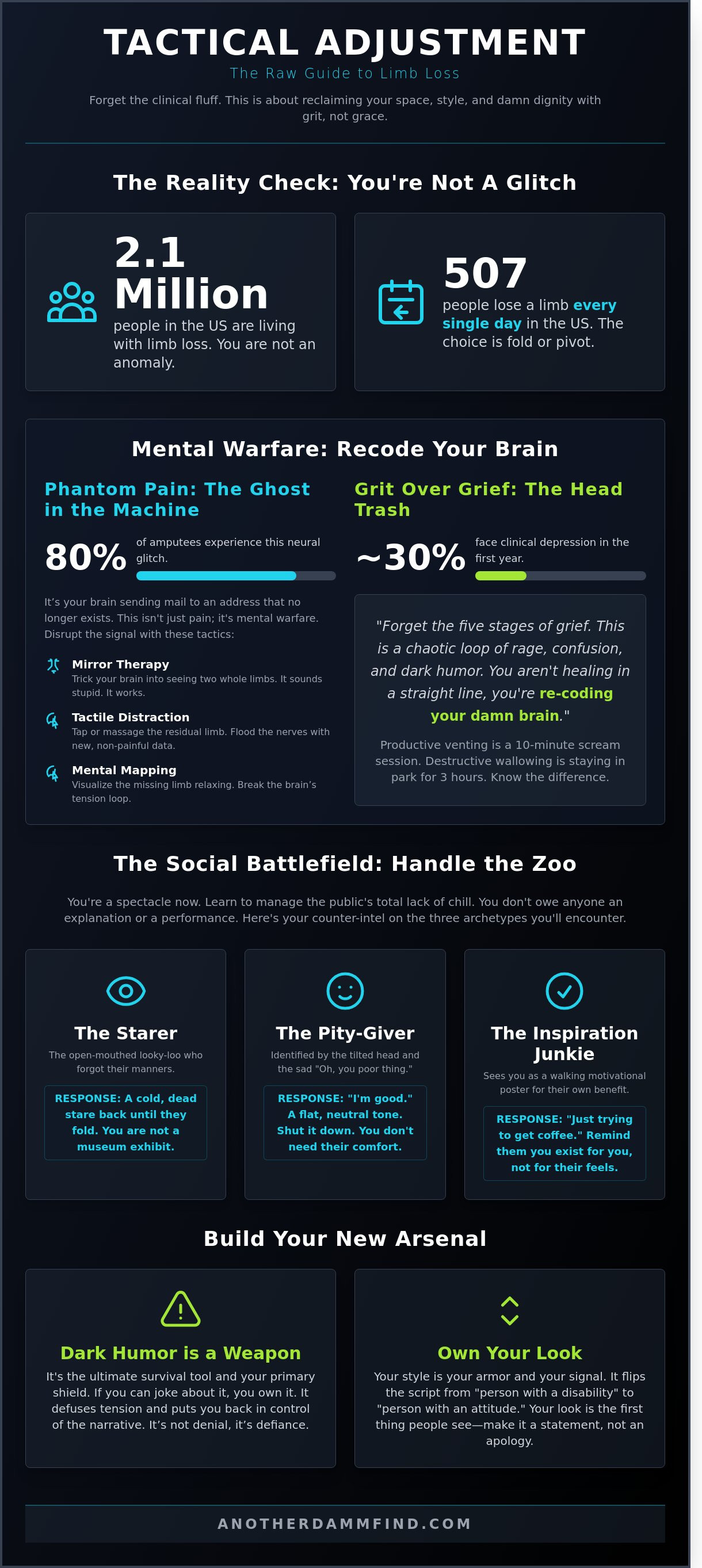
stop letting strangers treat you like a walking tragedy or a damn motivational poster just because you’re missing a piece. according to the amputee coalition, 2.1 million people in the us are currently living with limb loss, yet society still acts like you’re a glitch in the matrix. coping with being an amputee isn’t about finding a "new normal" or some other clinical fluff designed to make able-bodied people feel comfortable. it’s about reclaiming your space, your style, and your damn dignity without the side of pity.
you’re likely sick of the tilted heads, the "you’re so brave" comments, and that phantom itch that feels like your toes are stuck in a 1995 toaster. we agree that the "inspiration" label is a heavy weight nobody asked for. this guide delivers the raw truth on using humor as a shield and finding gear that actually reflects your personality instead of a hospital ward. we’re breaking down how to rebuild social confidence, handle the phantom pain without sounding crazy, and curate a look that’s high-impact and 100% you.
Key Takeaways
- Forget the clinical fluff and start a tactical adjustment to your new damn reality.
- Trash the "therapy-speak" and learn to handle phantom pain and mental garbage with raw grit.
- Navigate the social battlefield by putting the starers and inspiration junkies in their place.
- Discover why a dark sense of humor is the ultimate survival tool for coping with being an amputee.
- Own your look to signal your attitude and flip the script on how the world sees you.
The Day the Old You Retired: Embracing the New Normal
Let's be real. Losing a limb isn't some inspirational Hallmark movie. It is a violent, high-speed collision with a reality you didn't ask for. Coping with being an amputee isn't a medical sentence or a slow crawl toward healing. It is a tactical adjustment. The limb is gone. The person? Still there. According to the Amputee Coalition, 507 people in the United States lose a limb every single day. That is 507 people who have to decide if they are going to fold or pivot. We choose to pivot. The suck is real. It is heavy. It is frustrating. But it is just data. It is a damn glitch in the system, not the end of the program.
Losing the Limb, Not the Identity
You are more than a missing appendage or a 500 page medical file. Your personality does not have a limb count. If you were a loud-mouthed vintage enthusiast or a gearhead before the surgery, you stay that way. The Head Trash is the biggest hurdle. It is that voice telling you the game is over because the hardware changed. It is a lie. Keep your hobbies. Keep your damn vibe. If you loved 90s streetwear or working on engines, those interests are your anchors. Don't let the clinical white walls of a rehab center bleach your personality. You are a person with a story, not a patient with a deficit.
The Adapt and Overcome Mentality
The Navy veteran philosophy is simple: Adapt and overcome. It is a mindset used by elite teams to handle chaos. Apply that same grit to your living room. Normal is dead. You get to define a new version of normal every 24 hours. Do not look at the mountain. Look at the next 10 feet. Set punchy, immediate goals to regain your momentum. Coping with being an amputee requires a civilian version of military-grade resilience. You rebuild your life one tactical win at a time.
- Master a wheelchair-to-bed transfer by 2:00 PM today.
- Modify one piece of gear to fit your new setup this week.
- Get out of the house for 30 minutes of fresh air.
Regaining physical and mental momentum is about small wins that stack up. By the time 365 days pass, those small wins turn into a completely reclaimed life. You are still the boss of your own damn existence. This is not about getting back to who you were; it is about becoming the person who can handle what you are now. It is about grit, not grace.
Managing the Head Trash: Emotional Recovery Without the Fluff
Forget the five stages of grief. That is a clinical roadmap for people who haven't actually lost a limb. In the real world, coping with being an amputee feels like a chaotic loop of rage, confusion, and dark humor. You aren't healing in a straight line. You're re-coding your damn brain. Cynicism is your friend here. It is a survival mechanism that keeps the toxic positivity at bay. If you feel like the world owes you one, fine. Use that fuel to get out of bed and prove the world wrong.
Grief is a Damn Mess
You’re going to be pissed off. That is not a bug; it's a feature of the first 365 days. There is a massive gap between productive venting and destructive wallowing. Venting is a 10 minute scream session in your car because your prosthetic is chafing. Wallowing is staying in that car for three hours and missing your physical therapy. Data suggests that about 30 percent of new amputees face clinical depression within the first year. Don't ignore the heavy stuff, but for the daily grind, find an outlet that does not involve a sanitized circle of people sharing feelings. Hit a heavy bag. Build something. Find a damn vibe that feels authentic and lean into it hard.
Phantom Pain and Mental Warfare
Your brain is a stubborn piece of hardware. Roughly 80 percent of amputees experience phantom sensations. It is a glitch in the matrix where your nerves keep sending mail to an address that does not exist anymore. This isn't just physical pain; it is mental warfare that can keep you awake until 4:00 AM. To fight back, you need to disrupt the signal. Try these tactics to stay sane:
- Mirror Therapy: Spend 20 minutes a day tricking your brain into seeing two working limbs. It sounds stupid, but it works.
- Tactile Distraction: Tap or massage the residual limb to flood the nerves with new, non-painful data.
- Mental Mapping: Visualize the missing limb relaxing, muscle by muscle, to break the tension loop.
If the pain hits a level 9 and stays there for 72 hours, call the doctor. Otherwise, recognize the sensation for what it is: a damn ghost. Acknowledge it, then get back to the hunt. Coping with being an amputee requires a level of mental grit most people will never understand. Own that. Don't let the Why me? phase turn into a permanent residence. You have too much life to reclaim to stay stuck in the mud.
The Social Battlefield: Handling Stares, Pity, and Inspiration Junkies
Welcome to the social zoo. You walk outside and suddenly you're a 4K spectacle for every looky-loo on the street. Coping with being an amputee isn't just about physical therapy; it's about managing the public's total lack of chill. You'll encounter three main archetypes: The Starer, The Pity-Giver, and the Inspiration-Seeker. None of them are your damn problem. You don't owe a stranger your medical history or a miracle story just because they're curious. Set hard boundaries with family members who smother you. If they're hovering like a drone, tell them to back off. You're reclaiming your life, not hosting a 24/7 press conference.
Dealing with the Starers
People stare because they're bored or shocked. It's annoying, but you can flip the script. Use the "Stare Back" method. Lock eyes with the offender and don't look away. A 2019 study in the Journal of Rehabilitation Research noted that 64 percent of prosthetic users feel "on display" in public settings. Breaking that gaze forces the starer to acknowledge their own rudeness. Usually, it takes about 5 seconds of direct eye contact for them to look at their shoes. You can also use your fit to control the narrative. A custom-painted socket or a high-end sleeve makes the limb a choice, not a tragedy. It's about the damn vibe you project.
The Inspiration Trap
Buying milk isn't brave. It's a chore. Inspiration junkies love to project their insecurities onto you to feel better about their own lives. It's patronizing as hell. When a stranger calls you "courageous" for walking to your car, deflect it with an irreverent one-liner. Try something like, "I'm just here for the damn tacos, man." It humanizes you instantly. You aren't a motivational poster; you're a person. Use these tactics to stay grounded:
- The Quick Pivot: Acknowledge the comment and immediately ask them about something mundane.
- The Humor Shield: Tell a fake, ridiculous story about a shark fight to end the conversation.
- The Hard Pass: Politely state you aren't interested in discussing your body today.
Coping with being an amputee means refusing to be a prop for someone else's emotional breakthrough. Keep your status as a regular person who just happens to be missing a part. You're here to live, not to perform. If people can't handle your reality without making it a "moment," that's their baggage to carry, not yours.
Building a New Toolkit: Humor, Grit, and Practical Survival
Forget the "inspiration porn" posters in the rehab clinic. Real coping with being an amputee starts when you stop treating your limb like a tragedy and start treating it like a damn punchline. It is about taking the power back from the stares and the awkward silences. If you can joke about it, you own it. If you own it, it cannot break you.
Humor as a Superpower
A well-timed joke kills the pity vibe instantly. It is a tactical strike. Research from a 2017 study in the Journal of Clinical Nursing shows that humor is a vital coping mechanism that helps survivors reclaim their identity after trauma. Laughter can drop cortisol levels by 39 percent while flooding your system with endorphins. When you make the first joke about your "missing" foot, you aren't just being funny; you are taking control of the room. It is a secret handshake. If they are laughing with you, they aren't looking down on you.
Finding Your Tribe
Skip the corporate support groups that feel like a wet blanket. You need people who speak your language. A 2021 survey of 500 limb-loss survivors found that 74 percent had better mental health outcomes in peer-led, veteran-owned, or independent spaces compared to sterile clinical settings. Look for the groups where shared cynicism is the glue. These spaces value raw truth over soft, sappy hugs. It is about finding the people who understand why a broken socket is a crisis and why a squeaky knee is a damn nightmare.
Your gear should reflect your style, not a hospital inventory list. Stop buying the beige, sterile plastic that looks like it belongs in a 1985 pharmacy. Customize your setup. Use these hacks to make daily life suck less:
- Use dry shampoo on your liner to stop the sweat-slick slide during 90-degree summer days.
- Swap standard laces for heavy-duty magnetic closures to save 10 minutes of morning frustration.
- Apply a small amount of silicone spray to joints to kill the "tin man" squeak before it starts.
- Get a custom wrap or skin for your pylon that matches your favorite streetwear aesthetic.
Efficiency is the goal. You are rebuilding a life that looks and feels like yours, not a medical case study. Coping with being an amputee gets easier when your equipment actually fits your vibe and your sense of humor stays sharp.
Wear the Story: Why Owning Your Look is the Ultimate Power Move
People are going to stare. That is a 100% guarantee. You can either let that gaze make you feel like a clinical curiosity or you can hijack the narrative before they even open their mouths. Your clothes are your first line of defense. They are a signal. When you wear something bold, you tell the world you aren't looking for a handout or a "bless your heart." You're telling them you've got better taste than they do. It is about taking back the visual real estate you own.
Science backs this up. It is called Enclothed Cognition. A 2012 study from Northwestern University proved that the clothes you wear have a direct impact on your psychological processes. When you put on gear that feels powerful, your brain follows suit. If you dress like a patient, you'll feel like one. If you dress like a damn boss, you'll act like one. Coping with being an amputee starts with how you present yourself to the mirror every morning. Put on the armor that fits the life you want to lead.
Visual Branding for Amputees
Forget the generic awareness ribbons and the sterile, "inspiring" quotes that look like they belong in a doctor's waiting room. That is not you. About 85% of amputee-focused apparel is stuck in a loop of pity. Break out of it. Your prosthetic is not something to hide under baggy cargo pants. It is part of your aesthetic. It is carbon fiber and titanium. It is high-tech. Treat it like visual branding. Whether you are leaning into your veteran roots or a bold streetwear vibe, make it intentional. Own the look. Make the limb a feature, not a bug.
The Final Word on Coping
Success in this life comes down to grit over pity. Every single time. You have to stop just surviving and start living with some damn attitude. Coping with being an amputee is a daily choice to remain the captain of your own ship. You decide the vibe. You decide the story. We created Another DAMM Find because we were tired of the "poor me" narrative. We make shirts that start the right conversations; the ones where you are the one in control. Stop waiting for permission to feel like yourself again.
Stop Surviving and Start Taking Up Space
You didn't sign up for this, but you're here now. Reclaiming your life means more than just physical therapy or learning to walk again. It requires a total mental overhaul. You have to kill the version of you that cared about stares and replace it with someone who uses humor as a tactical advantage. Coping with being an amputee gets a lot easier when you stop asking for permission to exist. Ditch the head trash, embrace the grit, and realize that your story is written in every scar and every piece of hardware you carry.
We don't do boring. We don't do pity. Another Damn Find is a 100% veteran-owned and operated outfit built for the bold. Rich Damm hand-letters every original design to ensure you aren't wearing some generic, mass-produced garbage. Our gear is loud, it's funny, and it's designed to shut down the inspiration junkies before they even open their mouths. It's time to wear your story on your sleeve and own the damn room. Shop our bold Amputee Awareness and Humor gear now!
Your life isn't over. It just got a hell of a lot more interesting. Keep pushing, keep laughing, and keep making them look.
Frequently Asked Questions
How do I deal with people staring at my missing limb in public?
Own the room by making eye contact or cracking a damn joke. Research from the 2014 Limb Loss Statistics report shows that 65 percent of amputees feel the weight of public scrutiny daily. If they are staring, give them a show or just keep moving like the boss you are. Don't let their curiosity slow your roll. It's your body and your space; they are just visiting. You don't owe them an explanation for your existence.
Is it normal to feel angry years after an amputation has occurred?
Anger is a permanent resident for many, even 10 years after the surgery. A study in the Journal of Rehabilitation Research found that 30 percent of limb loss survivors face long-term emotional hurdles. It isn't a phase you just get over like a bad breakup. It's a raw part of the process. Own the rage, use it to fuel your gym session, and quit worrying about being well-adjusted for others. Anger is just energy.
What is the best way to explain my amputation to curious children?
Tell them the truth without the sugar-coated fluff. The Child Life Council suggests using concrete terms like "my leg got sick and the doctor took it off." Kids are 100 percent more chill than adults if you don't make it weird. Keep it short. Answer their one question, then go back to whatever you were doing. They'll move on to wanting snacks in about 30 seconds anyway. Honesty beats a fairy tale every time.
How can I stop people from treating me like I am inspirational all the time?
Shut it down by being a regular human who just happens to be missing a piece. Stella Young’s 2014 TED talk coined the term "inspiration porn" to describe this exact brand of patronizing nonsense. You aren't a damn hero for buying groceries. When someone calls you brave for existing, tell them you're just trying to find the good coffee. Setting boundaries keeps your identity from being swallowed by their pity. You're a person, not a motivational poster.
Can humor actually help with the emotional recovery of limb loss?
Dark humor is a top-tier tool for coping with being an amputee. A 2018 study on trauma recovery proved that laughter reduces cortisol by 39 percent in high-stress survivors. If you can joke about your missing foot, you've taken the power back from the situation. It's not about being fine; it's about being the one who gets to decide what's funny. Make the joke before they do. Humor is the ultimate damn middle finger to tragedy.
What are some practical ways to handle phantom limb pain without meds?
Try mirror therapy to trick your brain into thinking the limb is back and relaxed. Dr. G. Lorimer Moseley’s 2006 research shows this technique reduces pain for 80 percent of users without a single damn pill. You can also try deep tissue massage on the residual limb for 15 minutes a day. It is about rewiring those frayed nerves. Movement is medicine, so keep that stump active and engaged. Your brain needs a new map, so start drawing one.
Where can I find amputee support that is not overly clinical or sappy?
Skip the sterile hospital basements and find a peer group that actually gets it. The Amputee Coalition lists over 400 support groups, but the real gems are the niche Discord servers and Reddit threads where people talk real. Coping with being an amputee is easier when you aren't being talked down to by a specialist who has all their parts. Find your tribe in the trenches, not the clinic. Real talk beats clinical vibes every time.
How do I regain my confidence in social situations as a new amputee?
Build your social armor by hitting the streets in small, 20-minute bursts. Psychological data suggests that consistent exposure reduces social anxiety by 50 percent within the first 3 months of a major life change. Start at a coffee shop where nobody knows you. Wear the prosthetic or don't, but do it with intent. Confidence isn't a feeling you wait for; it's a muscle you build through repeated damn action. Get out there and take up space.


