


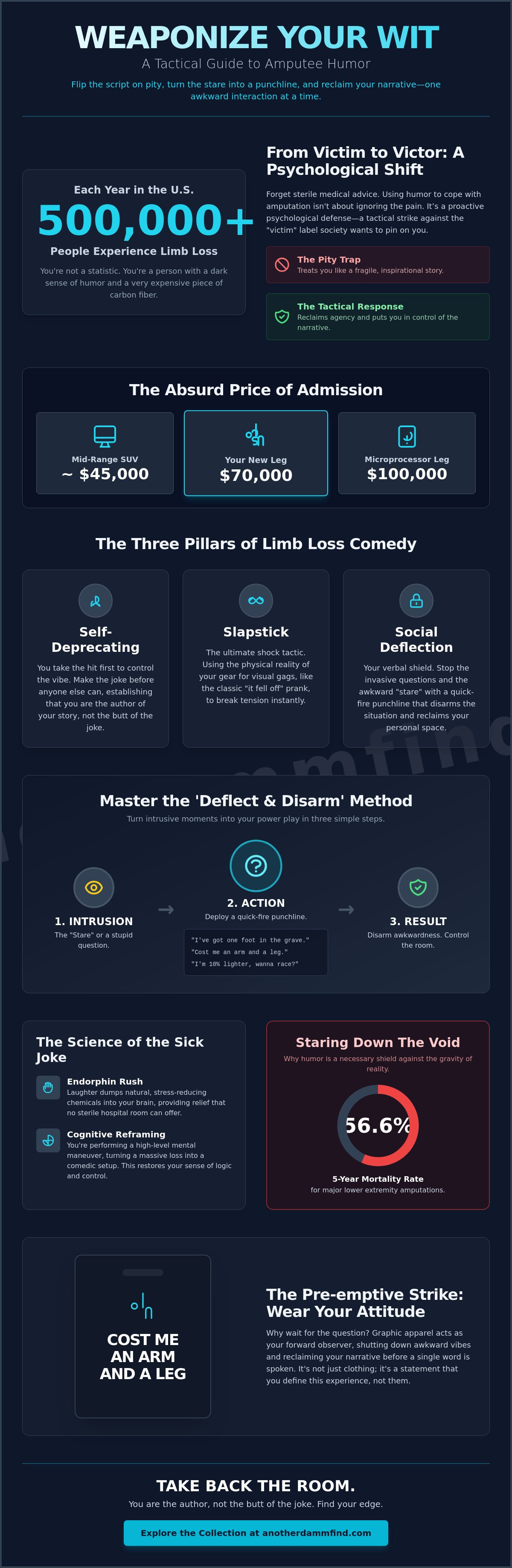
Your new leg costs $70,000; that’s more than a mid-range SUV; so why are you still letting strangers make things awkward with that "bless your heart" stare? It’s exhausting. You’re tired of the sterile, overly-sympathetic medical advice that treats you like a fragile glass figurine. You know the truth. Sometimes, the only way to stay sane in a world where over 500,000 Americans experience limb loss every year is to lean into the absolute absurdity of the situation. Using humor to cope with amputation isn't just a personality trait. It’s a tactical tool for reclaiming your life.
We get it. You’re done being "inspirational" all the damn time. You want control over your own story. This is about why a dark sense of humor is actually your most aggressive form of recovery. We’re going to show you how to weaponize your wit to deflect those pitying looks and give you total permission to be as irreverent as you want. Discover how to turn the stare into a punchline and take back the room; one awkward interaction at a time.
Key Takeaways
- Flip the script on medical-grade pity and learn why dark humor is your most aggressive psychological defense against the victim narrative.
- Weaponize the three pillars of limb loss comedy—Self-Deprecating, Slapstick, and Social Deflection—to control any room you walk into.
- Master the "Deflect and Disarm" method for using humor to cope with amputation when facing intrusive questions or the public "stare."
- Navigate the rules of "Cripple Consent" to keep your irreverence sharp while managing the boundaries of those around you.
- Discover how graphic tees act as a pre-emptive strike; shutting down awkward vibes and reclaiming your narrative before a word is even spoken.
The Psychology of the Dark: Why Amputee Humor is a Tactical Advantage
Forget the soft piano music and the slow-motion montages. Losing a limb is a violent, chaotic disruption of your reality. using humor to cope with amputation isn't about ignoring the pain. It’s about staring at the void and laughing because the alternative is predictable and boring. This isn't a "coping skill" from a dusty, sterile textbook. It’s a proactive psychological defense mechanism. It’s a tactical strike against the "victim" label society wants to pin on your chest. When you laugh at the absolute absurdity of a missing foot, you stop being a patient. You reclaim your agency. You decide how the story ends.
Reclaiming the Narrative
Making the joke first is the ultimate power move. It takes the weapon out of the injury's hands and puts it in yours. You aren't the butt of the joke; you are the author. Most "inspirational" content feels like a patronizing slap in the face. It’s polished. It’s fake. It’s designed to make able-bodied people feel better about your situation. A sick joke about your stump is different. It creates a boundary that says, "I am the one who defines this experience." You aren't a "teachable moment" for a stranger. You’re a person with a dark sense of humor and a very expensive piece of carbon fiber.
The Science of the Sick Joke
Your brain is essentially a high-performance chemistry set. Laughter dumps endorphins into your system, providing a natural hit of stress reduction that no hospital room can provide. This aligns with various psychological humor styles, particularly self-enhancing humor. You are performing high-level cognitive reframing. You are turning a massive physical loss into a perfect comedic setup. amputee humor acts as a superpower for mental health because it forces the brain to find logic in the illogical while restoring your sense of control.
The Three Pillars of Limb Loss Comedy
Comedy isn't a one-size-fits-all prosthetic. It's a customized rig built for your specific brand of chaos. When you're using humor to cope with amputation, you're usually pulling from one of three tactical pillars: Self-Deprecating, Slapstick, or Social Deflection. Clinical reviews from the NIH back this up; identifying humor as one of the most effective coping styles for amputees. It’s about more than just a laugh. It’s about survival. It’s about refusing to let the situation be heavier than your hardware.
The "Amputee Card" is your secret weapon. You’ve got a pass. Use it. Whether it's scoring the front-row seat or getting out of a boring conversation, the card is a high-utility asset. It turns a medical reality into a social advantage. If you’re newly initiated, start with entry-level quips. "I'm 10% lighter" or "I've got one foot in the grave" works wonders for breaking the tension without making people call for a priest. It signals that you're okay, which actually gives everyone else permission to stop being so weird.
- Self-Deprecating: You take the hit first to control the vibe.
- Slapstick: Using the physical gear for visual gags.
- Social Deflection: Stopping the "stare" with a quick-fire punchline.
Self-Deprecating vs. Self-Destructive
There’s a razor-thin line here. Laughing at the situation is empowering. Hating the person in the mirror is a trap. Empowering humor looks like mocking the $100,000 price tag of a microprocessor leg while knowing you're still the one in charge. It’s about curated chaos. Sometimes that means surrounding yourself with Rich Damm original lettering prints that celebrate the grind rather than the grief. Keep the jokes focused on the absurdity of the limb loss; not the value of your life.
Slapstick and the "Phantom" Prank
Physical comedy is the ultimate shock tactic. The "it fell off" gag in a crowded mall is pure gold. Using your prosthetic as a bottle opener or a doorstop isn't just practical; it’s a performance. The shock factor is a valid part of the healing process. It reminds you, and everyone watching, that your body is a tool, not a tragedy. When you can laugh at a prosthetic leg flying off during a workout, you’ve officially won. You aren't hiding. You're owning the space.
Humor as a Shield: Handling the Stares and the Stupid Questions
You’re at the grocery store. You’re just trying to find the right brand of hot sauce. Then you feel it. The "stare." It’s that heavy, awkward mix of pity and morbid curiosity from a stranger who thinks they’re being subtle. They aren't. Society loves to turn you into a public "teachable moment," but you didn't sign up for the job. using humor to cope with amputation is how you stop being an exhibit and start being the person in control of the room. Anger is exhausting. It burns through your energy and leaves you bitter. Humor? Humor is a tactical strike that ends the interaction on your terms.
Research shows that the capacity for wit is one of the primary strengths in the adjustment process. It’s a way to process the social friction of limb loss without losing your mind. When you use the "Deflect and Disarm" method, you aren't being "nice." You’re being effective. You’re giving the other person a way out of their own awkwardness while signaling that you aren't interested in their sympathy. It’s about speed. It’s about the quick-fire response that shuts down the "bless your heart" vibe before it can take root.
Here is your go-to script for the five most annoying questions you’ll hear this week:
- "What happened?" – "I forgot to tip my surgeon."
- "Does it hurt?" – "Only when I try to use my psychic powers."
- "Can I touch it?" – "Sure, but it’s got a hair-trigger self-defense mode."
- "How do you drive?" – "With a heavy foot and a lot of prayer."
- "You’re so inspirational." – "I’m just trying to buy milk, Karen. Let’s keep it moving."
The "Shark Attack" Script
Sometimes, the "truth" is boring. If someone is being particularly intrusive, use the Shark Attack. Tell an outrageous, high-stakes lie with a completely straight face. You lost it in a high-speed chase. You were a secret agent in a botched extraction. The goal is to make the person staring feel like the one who is out of place. A bold response is always better than a polite retreat. It forces the stranger to realize they’ve overstepped. It turns the awkwardness back on the source.
Finding Your Tribe
You can’t be the only one making the jokes. You need a circle where the punchlines don't need a disclaimer. Finding amputee support is about more than just medical advice; it’s about finding a community of limb-different badasses and "bubbleheads" who speak your language. You’ll know a "real" one in the wild by the way they look at your prosthetic. They won't stare with pity. They’ll check out your hardware, give you a nod, and maybe drop a joke about how your leg costs more than their car. That’s the energy you need.
When the Joke Doesn’t Land: Navigating Boundaries
Sometimes the joke lands like a lead weight. You’re using humor to cope with amputation, but your brother looks like he’s ready to call a crisis hotline. It’s the "civilian" freeze. People who haven't lost a piece of themselves don't know the rules. They’re trapped in a cycle of performative sympathy. They think laughing makes them a bad person. It’s your job to lead the way; but it’s also your right to shut it down when they overstep. You aren't a stand-up comic for their entertainment. You’re a person reclaiming their narrative.
Enter the concept of "Cripple Consent." It’s a simple hierarchy. You own the trauma; so you own the copyright on the jokes. You can call your stump whatever you want. You can joke about the phantom itch in a foot that’s currently in a medical waste bin. But that doesn't mean your able-bodied friends have a lifetime pass to join in. You set the tempo. If someone tries to "humor police" you; telling you that your jokes are "too much" or "inappropriate"; remind them who’s actually wearing the prosthetic. You aren't here to make them comfortable. You’re here to survive.
Managing "Civilian" Discomfort
Your inner circle needs an onboarding process. They’re scared to laugh because they don't want to hurt you. Give them the green light. A simple "It’s okay to laugh; I’m the one who said it" goes a long way. It breaks the tension and restores a sense of normalcy. But watch out for the office dynamic. Being the "funny amputee" can break the ice in a meeting; but don't let it turn you into a caricature for HR. Keep your best material for the people who actually earned the right to hear it. Not everyone gets a backstage pass to your recovery.
The Veteran’s Perspective on Irreverence
There’s a reason veterans and amputees often share the same dark, gritty outlook. It’s gallows humor. It’s the realization that when things are this messed up; you either laugh or you fold. the Another DAMM Find story is all about this bridge between service and survival. It’s about raw art that doesn't apologize for existing. Living unapologetically bold isn't a choice. It’s a necessity for anyone who’s been through the meat grinder and came out the other side with a story to tell.
Ready to wear the attitude that shuts down the "humor police" before they even start? Grab the gear that says it all for you.
Wear Your Attitude: Why Amputee Humor Apparel Matters
You’ve mastered the one-liners. You’ve set the boundaries. Now; you need to wear the manifesto. using humor to cope with amputation isn't just a mental game. It’s a visual one. A graphic tee is the ultimate pre-emptive strike in any social setting. It’s the visual equivalent of shutting down the pity party before it even starts. Most medical awareness gear is absolute garbage. It’s all soft pastel ribbons and "warrior" fonts that feel like they were designed in a corporate basement by people who still have all their toes. You deserve something that actually matches the grit of your reality. Something that feels as raw as the journey itself.
Positioning your apparel as a wearable manifesto of resilience changes the dynamic of every room you enter. You aren't just a person with a prosthetic; you’re a person with a perspective. Bold; raw art beats generic logos every single time because it refuses to play by the rules of "polite" society. It shows that you’ve processed the trauma and came out the other side with your edge intact. It’s about taking that $70,000 microprocessor leg and pairing it with a shirt that costs twenty bucks but carries ten times the attitude. That is how you reclaim the narrative.
The Conversation Starter
A funny shirt does the heavy lifting of social interaction for you. It breaks the ice. It answers the "what happened" before the first intrusive question is even asked. When you walk into a room wearing a design that leans into the absurdity; you change the atmosphere instantly. You aren't a patient waiting for a diagnosis. You’re a person with impeccable taste and a dark wit. The tactile quality of Rich Damm Original Lettering Prints matters here. It’s not mass-produced clip-art. It’s authentic. It’s hand-crafted. It signals that you belong to a subculture that values truth over comfort. Our Amputee Awareness T-Shirts and Long Sleeve Graphic Tees are designed to be the first and last word in any conversation.
Joining the DAMM Subculture
Choosing "irreverent" over "inspirational" is a political act. It’s a middle finger to a world that wants you to be "brave" in a way that makes them feel safe. Supporting veteran-owned businesses that actually get the gallows humor is how you maintain your edge. You aren't just buying a Custom Printed Coffee Mug or a Vinyl Decal; you’re joining a community of people who refuse to be sanitized. Whether you’re rocking Submarine Veteran Hoodies or Embroidered Snapback Hats; the gear is about identity. It’s about the search for unique items that reflect your specific brand of curated chaos. Stop being a patient. Start being a badass. Reclaim your story and look DAMM good doing it.
Take Back Your Narrative
You've got the scripts. You've seen the tactical advantage of a well-timed joke. Now; it's time to live it. using humor to cope with amputation isn't just about getting through the day; it’s about owning the room. It's about turning every awkward stare into a setup and every intrusive question into a punchline. You are the author of this story; not a patient in a medical journal. You've learned how to set boundaries and why your dark wit is actually a superpower for your mental health.
We don't do "inspirational" fluff. We do raw; authentic gear that matches your grind. We are veteran-owned and operated by a Navy Submarine Vet who understands the gallows humor required for survival. Every design features original hand-lettered art by Rich Damm; and we provide national shipping on every order. Stop settling for sterile awareness logos that have zero edge. Check out the Amputee Awareness Tees that actually have a damn personality. Stay loud. Stay irreverent. Keep making them laugh until they forget they were ever supposed to feel sorry for you.
Frequently Asked Questions
Is it normal to have a dark sense of humor after amputation?
It is completely normal and actually a standard psychological defense mechanism. Laughing at the absurdity of your situation is a tactical survival skill that keeps the trauma from crushing your spirit. Most people in the limb-loss community find that a dark wit is the only thing that makes sense when the world feels this chaotic. It is not a sign that you are broken; it is a sign that you are fighting back.
How do I tell my family it is okay to laugh at my jokes?
Be direct and give them the explicit green light. Your family is likely terrified of being insensitive or causing you more pain; so they freeze up when you drop a punchline. Tell them that your humor is a vital part of your recovery. Explain that when you make a joke; you actually want the laugh because it restores a sense of normalcy to the room. It breaks the "pity cycle" for everyone involved.
Can humor actually help with phantom limb pain?
While it is not a medical cure; laughter triggers a heavy hit of endorphins that can lower your perceived stress levels. Since stress is a notorious intensifier for neurological misfires; using humor to cope with amputation acts as a powerful cognitive distraction. It shifts your brain's focus from the phantom sensations to the social interaction. This mental reset can provide a temporary but necessary break from the physical grind of recovery.
What do I do if someone gets offended by my amputee jokes?
Ignore them or double down on the irony. You own the trauma; which means you own the copyright on the jokes. If a "civilian" gets offended on your behalf; that is their emotional baggage to carry; not yours. You are not responsible for managing the discomfort of strangers. Remind them that your humor is a tool for your survival and you do not need their permission to use it.
Is it okay for non-amputees to joke about my limb loss?
Only if they have earned "Cripple Consent" through your inner circle. Your best friends who have been in the trenches with you might get a pass; but random acquaintances do not. You set the tempo for every interaction. If someone who hasn't earned the right tries to make a joke; shut it down immediately. There is a massive difference between shared humor and someone punching down at your expense.
Why do I feel the need to make jokes when people stare at my prosthetic?
It is a pre-emptive strike designed to reclaim power in a social setting. Staring turns you into an exhibit; but a quick-fire joke reminds the observer that you are a person with a perspective. You are using wit to control the narrative instead of just being a "teachable moment" for a stranger. It turns the awkwardness back on the source and puts you back in the driver's seat.
How can I find other amputees who share my sense of humor?
Look for niche communities that prioritize peer support over sterile clinical advice. Online forums; social media groups for limb-different badasses; and veteran-owned spaces are usually where the real talk happens. You will know you have found your tribe when the jokes get darker and the "inspirational" disclaimers disappear. Seek out the people who value authenticity and raw art over corporate-style medical brochures.
Does using humor mean I am in denial about my amputation?
Absolutely not; it actually signals a high level of psychological acceptance. using humor to cope with amputation requires you to fully acknowledge the reality of your situation before you can even find the irony in it. Denial is hiding your limb and refusing to mention the loss. Humor is putting the reality on a graphic tee and laughing at the void. It is the most aggressive form of acceptance there is.


