


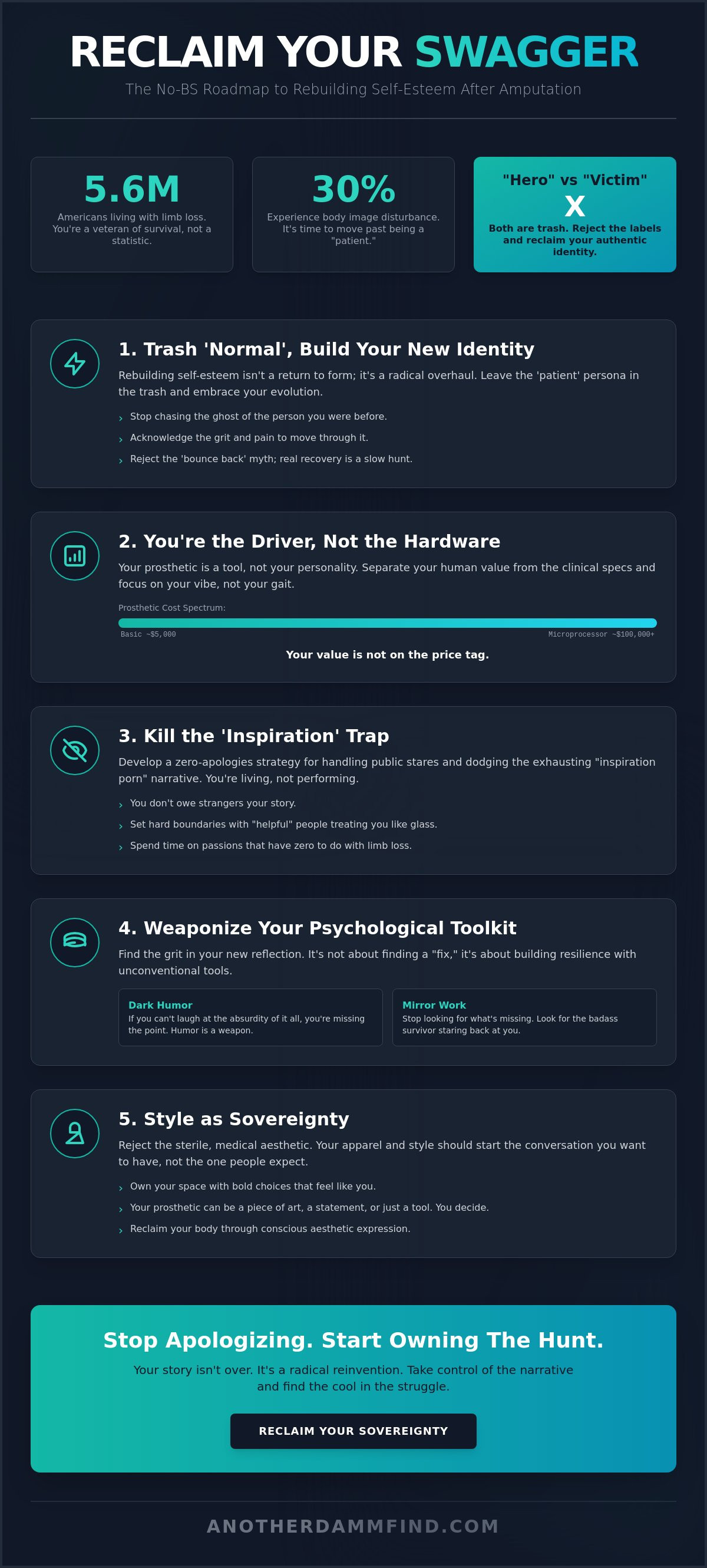
The world wants you to be a "hero" or a "victim," but both of those roles are absolute trash. You didn't ask to join the 5.6 million Americans living with limb loss, and you definitely didn't sign up to be someone's daily dose of inspiration porn. Rebuilding self-esteem after amputation isn't about finding some magical, clinical "inner peace" while staring at a $100,000 microprocessor leg; it's about getting your damn swagger back in a world that can't stop staring.
You're likely exhausted from the pity and the "broken" labels. We get it. This guide is the raw, no-BS roadmap to reclaiming your vibe through radical authenticity and dark humor. You'll learn how to develop a thick skin for social friction and integrate your limb loss into a badass new identity that feels like you, not a patient. We're moving past the 30% of individuals who experience body image disturbance and heading straight for the "coolest person in the room" status. It's time to stop apologizing for your space and start owning the hunt for your new self.
Key Takeaways
- Stop chasing "normal" and embrace the radical identity overhaul required for rebuilding self-esteem after amputation.
- Learn to separate your human value from your hardware by focusing on the "driver" rather than just the clinical functionality of your prosthetic.
- Develop a zero-apologies strategy for handling public stares and dodging the exhausting "inspiration porn" trap.
- Weaponize dark humor and unconventional mirror work to find the grit in your new reflection rather than looking for a "fix."
- Reclaim your sovereignty through bold style choices that reject the sterile, medical aesthetic of the traditional amputee world.
The Post-Amputation Reality Check: Why 'Normal' is a Damn Myth
Forget the word "normal." That ship sailed the second you woke up in the recovery room. If you're looking for a way to get back to the person you were before, stop. Rebuilding self-esteem after amputation isn't about a return to form; it's a radical identity overhaul. It is a ground-up reconstruction of how you move, how you think, and how you see yourself in the mirror. Most clinical guides want to sugar-coat this with "five stages of grief" and polite encouragement. We aren't doing that here. We're acknowledging the raw, jagged reality of the situation.
The "Enduring" and "Suffering" stages are real, and they usually feel like total trash. You don't have to like your new body today. You don't even have to like it next month. Acceptance doesn't mean you're thrilled about the change; it just means you've stopped lying to yourself about the facts. Part of that factual reality involves understanding phantom limb sensations, which can make your brain feel like it's trapped in a glitchy simulation. Acknowledging the grit and the pain is the only way to move through it. There is a jagged identity gap between the high-functioning person you remember being and the "patient" the world insists on seeing in your place.
Breaking the 'Patient' Cycle
Hospitals are built on pity and bleach. They treat you like a set of vitals and a wound. If you stay in that headspace, your confidence will stay in the basement. You've got to leave the "patient" persona in the trash with the paper gown. Stop waiting for the "old you" to return. He's gone, and honestly, that’s a damn opportunity. Physical healing is the doctor's job, but psychological sovereignty is yours. You aren't a project to be fixed; you're a person who is currently evolving into something much more interesting.
The Myth of the 'Bounce Back'
Social media loves a good "bounce back" story. It’s usually some curated clip of an amputee running a marathon three weeks after surgery. For the 500,000 Americans who experience limb loss every year, that is a total lie. Real recovery is slow. It’s frustrating. It’s full of small, grit-based goals that nobody else sees. Rebuilding self-esteem after amputation requires you to embrace the suck as a prerequisite for the hunt. You have to find the "cool" in the struggle. Don't aim for inspirational; aim for authentic. When you stop trying to perform "recovery" for other people, you can finally start building a vibe that actually belongs to you.
Reclaiming the Narrative: Identity Beyond the Prosthetic Clinic
Your prosthetic is a tool. It is not your personality. Whether you are rocking a basic $5,000 limb or a $100,000 microprocessor-controlled beast, the hardware is just equipment. Rebuilding self-esteem after amputation starts when you stop identifying as a "patient" and start identifying as the driver. The clinic wants to talk about your K-level and your gait. We want to talk about your vibe. If you let the medical industry define your worth, you'll always feel like a broken machine waiting for a repair. You aren't broken; you are just operating with a different set of specs now.
The "Phantom Identity" is a real mental hurdle. It is that ghost of the person you were before the surgery, constantly whispering that you are a lesser version of yourself. It is a lie. You are a veteran of a survival situation that most people can't even fathom. Understanding the emotional recovery process for amputees means recognizing that your ego needs a new foundation. It is about psychological sovereignty. You don't need a "bounce back." You need a takeover of your own story.
You Are Not a Medical Case Study
Doctors and therapists are there to help you move, but they don't get to tell you who you are. Stop letting them dictate your potential based on a chart. You also need to set hard boundaries with the "helpful" people in your life who treat you like you are made of glass. Reclaiming your ego means taking back control of your schedule and your interests. Consider these moves to kill the medical vibe:
- Ignore the "inspiration" labels and just be a person with a life.
- Tell family members when you don't need their help with basic tasks.
- Spend time on passions like music, art, or tech that have zero to do with limb loss.
Integrating the Limb Loss
Acceptance is a heavy word. It doesn't mean you have to like the fact that you lost a limb. It just means acknowledging it as a raw part of your history. You own this story now. When people ask what happened, you don't owe them a clinical explanation or a sob story. You talk about it on your own terms or not at all. Find your new baseline without comparing it to your pre-op stats. Your value isn't measured by how much you can lift or how fast you walk compared to five years ago. It is measured by how you show up today. Sometimes showing up means putting on a graphic tee that says exactly what you're thinking and walking out the door with your head high.
Social Friction: Killing the 'Inspiration' Trap and Handling the Stares
People are going to stare. It is a damn certainty. You can have the slickest prosthetic on the market or a perfectly tailored sleeve, but someone in the grocery store will still look at you like you just landed from Mars. This is usually the part where the clinical advice fails. They tell you to "be patient" or "ignore it." That is trash advice. Rebuilding self-esteem after amputation means learning to handle that friction without losing your cool or your identity. You need a real world strategy for Dealing With Stares: A No-BS Guide for Amputees that doesn't involve hiding in your house or apologizing for your existence.
Then there is the "brave" trap. You're just trying to buy a coffee, and someone calls you an inspiration. It feels like a compliment, but it’s often a backhanded way of saying they find your existence tragic. Being called inspirational for just living your life erodes your ego because it keeps you in the "medical case" category. Real confidence comes from being unremarkably human. It comes from regaining confidence after limb loss by refusing to be anyone's feel-good story of the day. You don't owe the public a heroic narrative or a polite smile.
The 'Inspiration Porn' Antidote
You are not a prop for someone else's gratitude journal. When people hit you with the "What happened?" question, they are overstepping. You have total sovereignty over that story. You can give them the clinical truth, a fake shark attack story, or a simple "I don't talk about it." Reclaiming your power means realizing you don't have to perform recovery for anyone. You aren't a miracle; you're a person with things to do. Setting these social boundaries is a massive part of rebuilding self-esteem after amputation. It proves to yourself that you are the one in control of the interaction.
Owning the Room (and the Stares)
If you look like you're hiding, people will pounce with pity. If you own your space, they back off. Use the "Stare Back" technique. It isn't about being aggressive; it is about making brief eye contact to acknowledge they are looking, then going back to your business. This simple move flips the power dynamic. Your body language dictates how the world perceives your limb loss. Stand tall. Keep your head up. When you focus on your damn attitude instead of your hardware, the stares stop being a threat and start being just another part of the background noise. You aren't a patient in the wild; you're the most interesting person in the room. Own it.
The Psychological Toolkit: Mirror Work, Movement, and Dark Humor
You've already ditched the "patient" label and learned to handle the stares. Now it's time to build the internal armor. Rebuilding self-esteem after amputation isn't a one-time event; it is a daily practice of recalibrating your brain to match your new physical reality. Approximately 30% of individuals experience body image disturbance and depression following an amputation. You stay out of that statistic by aggressively reclaiming your headspace. This isn't about "healing" in a clinical sense. It is about equipping yourself with the mental gear to own your new vibe without apology.
Movement is the first heavy hitter in your toolkit. Getting your heart rate up isn't just about physical health; it is about rebuilding the brain-body connection that gets severed during trauma. Whether you are hitting the gym or just moving around your living room, every bit of exertion tells your nervous system that you are still the one in charge. It bridges the identity gap by proving what your body can still do. When you sweat, you aren't a medical case. You're just a person putting in the damn work. Dark humor functions as a high-impact psychological shield because it forces you to confront the reality of your loss while simultaneously stripping it of its power to hurt you. If you can laugh at it, you own it. Check out our take on Amputee Humor: Why Laughing at Limb Loss is a Superpower to see how to weaponize your wit.
Mirror Work for the Bold
Forget those soft-focus self-help exercises. Real mirror work for an amputee is about grit. Don't just "look" at yourself; examine your scars and your new silhouette as battle-tested art. This is exposure therapy at home. You need to get comfortable in your own skin when nobody is watching so that you don't feel exposed when they are. Spend time in front of the glass. Practice your "vibe"-the way you stand, the way you move, the way you own the space. Do it until the person in the reflection doesn't look like a stranger anymore. You're looking for the strength in the jagged edges, not a way to "fix" what isn't broken.
The Power of the Dark Side
Humor is the ultimate self-esteem flex. When you crack a joke about your "missing part," you immediately disarm the pity-seekers. It shows the world that you aren't fragile and that you aren't seeking their validation. This is how you find your tribe-the people who get the joke and don't pity the punchline. Rebuilding self-esteem after amputation requires a sense of irreverence toward the situation. You've been through a war; you've earned the right to be a little cynical. If you're ready to stop blending in and start standing out, grab some gear that matches your new attitude and let the world know you're not here for their sympathy.
Style as Sovereignty: Why Your Apparel Should Start the Conversation
The medical supply world is a sea of beige and clinical gray. It’s designed to be "discreet," which is just a polite way of saying they want you to disappear. Screw that. Style is sovereignty. Rebuilding self-esteem after amputation means rejecting the sterile aesthetic of the hospital gift shop. When you choose what to wear, you are deciding how the world sees you before you open your mouth. It’s the difference between being a "patient" and being a tastemaker. This is the core of The Another DAMM Find Story: Veterans, Amputees, and Raw Art. We don't do "blending in" here. We do impact.
There is a psychological concept called "Enclothed Cognition." It is the science of how your threads mess with your head. Your clothes don't just change how others see you; they change how you think about yourself. If you dress like you're hiding, you'll feel like you're hiding. If you dress with a high-impact attitude, you'll carry that damn confidence into every room. It is a physiological shift. You aren't just putting on a shirt; you're armor-plating your ego. Rebuilding self-esteem after amputation requires you to dress for the takeover, not the recovery.
From Hiding to Highlighting
Most clinical guides tell you to wear loose clothing if you're self-conscious. That is a trap. Covering up makes you feel invisible and less confident. It reinforces the lie that your body is something to be ashamed of. We say highlight it. Use graphic tees and custom gear to signal your identity. Think of your look like "drop" culture. You are unique. You are one-of-a-kind. You are a damn find that can't be replicated. Your silhouette is a battle-tested piece of art. Own it.
The Conversation Starter
A funny shirt is a tactical move in the wild. It turns a pitying stare into a genuine laugh or a real conversation. It takes the power away from the observer and gives it back to you. When you wear apparel that reflects veteran-owned, no-BS values, you aren't asking for permission to exist. You're stating your terms. Self-esteem isn't a destination you reach; it’s a hunt. It’s raw. It’s jagged. And it’s damn well yours to find. Ready to reclaim your vibe? Shop the Amputee Awareness collection and wear your damn personality.
Own Your New Narrative
Rebuilding self-esteem after amputation isn't about fitting back into an old mold. It is about breaking the damn mold entirely. You've already seen that "normal" is a total myth and that your human value isn't tied to prosthetic hardware or clinical benchmarks. You are the driver of your story, not a medical case study. By weaponizing dark humor and choosing a style that highlights your grit rather than hiding it, you aggressively reclaim the social space you deserve.
Another DAMM Find is veteran-owned and operated by Navy Submarine Vet Rich Damm. We prioritize original hand-lettered art designed for the amputee community because we know the power of irreverent, bold gear. Our pieces are built to start the right conversations on your terms. Reclaim your vibe with gear that actually says something. Shop Another DAMM Find now.
Stop waiting for the world to give you permission to feel cool again. Your new identity is raw, battle-tested, and waiting to be claimed. Go get it.
Frequently Asked Questions
How long does it take to feel 'normal' again after an amputation?
"Normal" is a myth you need to bury immediately. It isn't about a timeline; it's about a total identity shift. With over 5.6 million Americans living with limb loss or difference, you're part of a massive, diverse crew. Stop looking at the calendar for a return to your old self. Start looking at your new capabilities and building a fresh baseline that doesn't rely on the past.
Why do I feel like everyone is staring at my prosthetic?
People stare because humans are naturally wired to notice anything outside the expected silhouette. It isn't personal; it's biology. You feel it more right now because you're hyper-aware of the change. Flip the script by making brief eye contact and owning the space. When you own the hardware, the stare loses its power to rattle your confidence or dictate your mood.
Is it okay to use humor to cope with my limb loss?
Humor is the ultimate weapon for rebuilding self-esteem after amputation. It disarms the pity-seekers and proves you aren't fragile. If you can laugh at the situation, you control the narrative. It’s not a deflection; it’s a psychological shield that keeps you from becoming a victim in other people's eyes. Dark humor is a sign of psychological sovereignty and grit.
What should I do when people call me 'brave' or 'inspirational'?
Being called "brave" for just existing is often patronizing. You don't have to accept the "hero" label if it makes you feel like a medical case study. A simple "I'm just living my life" is a powerful boundary. It reminds people that you are a person with a pulse and things to do, not their daily dose of feel-good inspiration porn.
How can I improve my body image if I hate how my residual limb looks?
Approximately 30% of amputees deal with body image disturbance, so your feelings are backed by data. Improving it starts with exposure. Look at the limb in the mirror until the "shock" wears off. It’s a part of your raw history now. Treat it like a battle scar that proves you survived something most people couldn't handle, rather than something to be hidden.
Can changing my style or what I wear actually help my self-esteem?
What you wear changes how your brain functions through a process called enclothed cognition. Ditching the medical "beige" for bold graphic tees or veteran-owned gear shifts your mindset from "patient" to "tastemaker." When you look like you have a vibe, you start to believe it. Style is just another form of sovereignty that helps in rebuilding self-esteem after amputation.
What if my family and friends are the ones making me feel like a patient?
Family members often over-help because they're scared, not because you're incapable. You have to be the one to break that cycle by setting hard boundaries. Tell them exactly where the line is and what you can do yourself. Refusing unnecessary help proves your autonomy to them and, more importantly, reinforces your own sense of physical and mental independence.
Are there support groups that aren't just 'sad circles'?
Look for groups focused on movement or advocacy rather than just sitting in a room. Organizations involved in "So Every BODY Can Move" campaigns, which are active nationally as of February 2026, often focus on athleticism and legislative action. Find the people who are too busy living and hunting for new vibes to spend all day being "sad."


