


Buttons and zippers aren't just hardware. They're the tiny, metallic gods currently deciding whether you'll leave the house on time or spend twenty minutes swearing at a sleeve. Facing these arm amputee daily challenges means cutting a steak feels like a damn tactical mission, a reality shared by 2 million people in the U.S. living with limb loss. You're likely tired of the clinical "how-to" guides that treat your life like a lab experiment. You're definitely over the pity stares from strangers who think you need a hug when you really just need a better grip on a coffee mug.
We're stripping away the medical fluff to give you the raw, unfiltered survival guide for 2026. You deserve shortcuts that actually work, not just textbook theory. We'll dive into how to navigate social awkwardness with humor, the reality of those $50,000 myoelectric arms, and why the April 13, 2026 CMS "L code" updates actually matter to your wallet. It's time to stop just getting by and start owning the damn vibe.
Key Takeaways
- Turn your kitchen from a battlefield into a damn workspace using silicone mats and the "knee technique" for food prep.
- Master arm amputee daily challenges by choosing gear that kills the button-and-zipper struggle while keeping your style loud.
- Get the raw truth on whether a $100,000 bionic arm or low-tech grit is the better move for your specific daily grind.
- Develop a tactical "shut-up stare" to handle inspiration junkies and unwanted pity without wasting your breath.
- Flip the script on social awkwardness by using bold graphic tees and snapbacks to control the conversation from the jump.
The One-Armed Siege: Why Daily Tasks Are a Damn Battle
The brochure lied to you. It didn't mention that your duvet would become a 50-pound weight or that your favorite button-down would turn into a tactical nightmare. Dealing with arm amputee daily challenges isn't about finding some zen-like peace. It's about surviving the first 15 minutes of the day without throwing your toothbrush through the damn mirror. You aren't just "managing" a medical condition; you're relearning how to exist in a world built for two-handed people. It's okay to be pissed off. Validation is rare in clinical settings, but here it's the baseline. If a zipper makes you want to scream, scream. Then figure out a way to beat it.
Living with limb loss means your "new normal" is a loud, messy adjustment period. Approximately 2 million people in the United States are currently in this fight, proving you aren't alone in the frustration. The difference between just "managing" and actually living your life is the attitude you bring to the struggle. We're stripping away the clinical sugar-coating to talk about the raw reality of the daily grind. This is a siege, and you need a better strategy than just "trying harder."
The Mechanical Reality of Upper Limb Loss
Losing a hand is fundamentally a physics problem. You've lost your primary source of leverage, not just a grip. While a comprehensive overview of amputation covers the surgical side and the statistics of the 185,000 amputations that occur annually in the U.S., it rarely mentions "sound side" overuse. Your remaining arm is now doing 200% of the work. That's a recipe for carpal tunnel and burnout if you aren't careful. The learning curve is steep and jagged. You'll move from "I can't do this" to "I found a weird way to do this using my chin and a doorframe." It isn't pretty, but it works, and that's the only metric that matters.
Why Humor is Your Secret Weapon
Dark humor is the only therapy that doesn't cost $150 an hour. It's a psychological shield. When you can joke about being a "one-armed bandit," you take the power back from the people staring at you in the grocery store. We believe amputee humor beats therapy any day because it turns a tragedy into a punchline you control. You're joining a community of people who get the joke and don't want your pity. We value the history of our struggle while styling it for a modern, edgy audience. Embracing the absurdity of the situation is the fastest way to stop being a victim and start being the person who owns the damn room.
Kitchen Combat and Wardrobe Wars: Real Task Survival
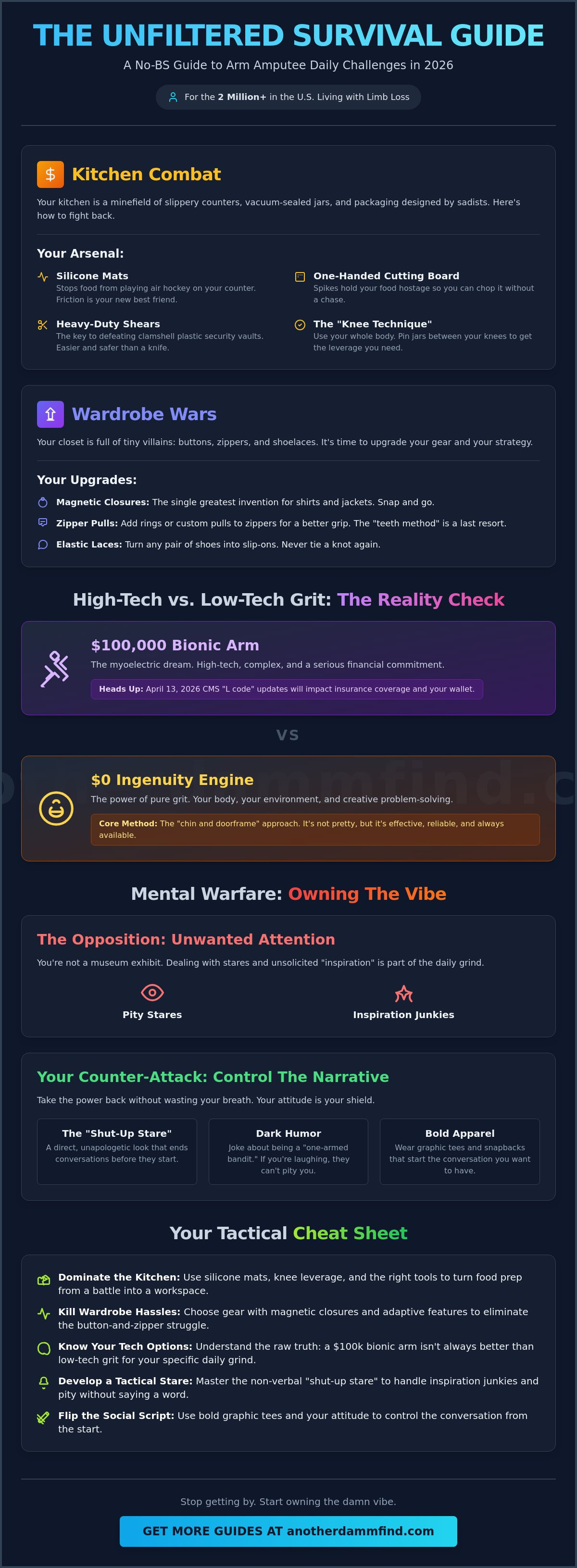
The kitchen is a damn minefield. You're trying to chop an onion and it's sliding like an air hockey puck across the counter. Mastering arm amputee daily challenges in the kitchen requires gear that actually bites back. Forget the delicate approach. You need silicone mats for friction and a "knee technique" for stabilizing jars that were clearly sealed by a spiteful giant. It's messy. It's loud. It works. Leverage is your new best friend; use the counter, your hip, or even the corner of a drawer to get the job done.
Scrubbing your only hand is a literal circus act. You're basically rubbing it against your own chest or using suction-cup brushes that inevitably fly off the tiles. For the real-deal mechanics of staying clean, these tips for bathroom activities help you handle the slippery reality of one-handed hygiene. Then there's the digital grind. Typing a text with one thumb while holding a coffee mug is a high-stakes sport. The digital struggle is real. You're fighting autocorrect with one thumb while trying to balance your phone on your leg. It’s a constant dance of drops and typos. Some people swear by specialized one-handed keyboards, but most of us just get really damn fast at the swiping method.
Cooking One-Handed Without Burning the House Down
Get a one-handed cutting board with stainless steel spikes. It pins your steak or potato in place so you can actually use a knife without chasing your dinner around the room. Packaging is the hidden enemy. Clamshell plastic is basically a security vault. Keep a pair of heavy-duty kitchen shears within reach at all times. They’re easier to control than a knife when you’re hacking through stubborn plastic. If you can't open it, buy the pre-chopped version. It's not lazy. It's a 100% valid survival strategy in a world that thinks everyone has ten fingers.
Buttons, Zippers, and Other Wardrobe Villains
Buttons are the ultimate gatekeepers. Magnetic closures are the greatest invention since sliced bread, letting you snap into a shirt without a 20-minute struggle. Zippers often require the "teeth method." It's effective, but your dentist will definitely have opinions about your enamel. For footwear, the "no-tie" lace revolution is your best friend. Slip-ons are the gold standard for getting out the door in under five minutes. If you're tired of the battle, just throw on a heavyweight graphic tee and skip the hardware entirely. Style shouldn't be a chore; it should be a vibe you control.
Life Hacks vs. Reality: What Actually Works?
The medical industry loves to sell you the dream of a $100,000 bionic hand that can play the piano. The reality is that many arm amputee daily challenges are better solved with a roll of velcro and some sheer stubbornness. While high-end tech is impressive, it often fails the "real life" test. Your residual limb, or even your chin, is frequently more reliable than a microprocessor that requires a charging cable. We're talking about the grit it takes to navigate a world that doesn't care if your battery is at 5%. High-tech solutions have their place, but they don't replace the raw instinct of a survivor.
Most prosthetic devices have an average lifespan of just 3 to 5 years. That is a short window when you consider the hoops you have to jump through with Medicare Part B to cover its 80% share of the approved amount. Sometimes, the best hack is knowing when to leave the damn arm on the shelf. You aren't "failing" at being an amputee if you prefer going lifestyle-only or using a basic $3,000 body-powered hook over a $50,000 myoelectric arm that weighs as much as a bowling ball. It is about what makes you feel most like yourself, not what looks best in a brochure.
The Prosthetic Pitfall
Physical fatigue is the secret nobody talks about in the clinic. Doctors focus on the "cool" factor, but they forget that carrying a prosthetic all day is a damn workout for your shoulder and back. Then there's the phantom limb pain. Trying to focus on a task while your non-existent hand feels like it's in a meat grinder is a mental siege. A survey on daily living activities for amputees highlights that tasks like using scissors or tying shoes remain massive hurdles regardless of the tech you're wearing. Success isn't about the price of your gear; it's about the efficiency of your movement and the mental stamina to keep going.
DIY Hacks from the Amputee Community
The best tools usually aren't found in a medical catalog. They're found in the hardware aisle. Duct tape, industrial velcro, and non-slip silicone mats are the true heroes of the one-armed life. Most "assistive devices" sold by big-box medical companies end up in a junk drawer because they're too damn slow to set up. Real survival means developing a "third hand." You use your knees to hold a bottle, your chin to steady a phone, or your feet to grab a dropped sock. It's not about being graceful. It's about getting the job done so you can move on with your day. Keep your residual limb in fighting shape with proper skin care, because at the end of the day, your own body is still your most unique find.
The Mental Load: Stares, 'Inspiration,' and Unwanted Help
Physical hurdles are loud. They involve clattering pans and ripped shirts. But the quietest arm amputee daily challenges are often the heaviest. It's the mental weight of being a public spectacle every time you step outside. You're just trying to buy a gallon of milk, but to the lady in aisle four, you're a walking miracle. These "Inspiration Junkies" don't see a person; they see a motivational poster. It is exhausting to be "brave" for strangers when you're actually just trying to finish your grocery list before the store closes.
Then there are the "Helpful" people. They swoop in to grab your bag or open a door you already had under control, usually nearly knocking you over in the process. Their pity help is a distraction. It breaks your rhythm. It reminds you that they see a deficit where you see a lifestyle. Mental burnout is real. It's okay to admit that being the "strong amputee" 24/7 is a damn lie. Some days, you just want to be the person who gets to be grumpy in peace without someone telling you how "inspiring" your frown is.
Coping with the Public
The "What happened?" question is the soundtrack to your life. You've heard it from curious kids, intrusive seniors, and random guys at the bar. You have options. You can give the clinical truth, or you can tell them you lost it in a high-stakes underground thumb-wrestling match. Humor disarms the awkwardness, but the "Shut-Up Stare" is your best defense when someone crosses the line. Inspiration porn is the toxic social habit where your survival is used as a "no excuses" prop to motivate people who don't have a clue about your reality. You aren't a prop for their self-improvement. You're a person with a life to live.
Finding Your Tribe
Isolation is the enemy. You need a circle that doesn't look at you with tilted heads and sad eyes. You need the "one-armed bandits" who will laugh with you when you drop your phone for the fifth time today. We built this brand on that exact energy. The Another DAMM Find story is about veterans and amputees turning a mess into a message that actually says something. Online forums are fine, but real-world connections with people who live the same raw reality are what stick. Stop playing nice for the "normies" and start surrounding yourself with people who value the vibe. If you're ready to stop being "inspiring" and start being yourself, grab some gear that speaks for you and let the clothes do the talking.
Own the Struggle: Wear Your Attitude on Your Sleeve
Your clothes are the first thing people notice before you even open your mouth. In a world that often looks at limb loss with a tilted head and a sad sigh, your outfit is the first line of defense. Navigating arm amputee daily challenges is exhausting enough without having to manage everyone else's feelings about your body. When you walk into a room, people's eyes do that weird, darting dance where they try not to look but can't help themselves. Give them something better to look at than an empty sleeve or a medical-grade prosthetic. Control the narrative from the jump.
Style is a tactical choice. It is about shifting the gaze from "what happened to you?" to "where did you get that shirt?" You aren't just a patient or a statistic in a 2026 medical report. You're a person with a vibe that hasn't changed just because your limb count did. Using apparel to start a conversation on your own terms is a power move. It turns a potential moment of pity into a moment of connection. It's about being unapologetically you, even when the world expects you to be quiet and "courageous."
Apparel with Attitude
A bold graphic tee stops the "pity stare" in its tracks. It acts as a filter for the people you actually want to talk to. If someone can't handle a joke about your missing arm, they probably aren't your kind of person anyway. Choosing gear that represents your history, like our submarine veteran hoodies or awareness tees, signals that you're part of a specific, self-assured subculture. This is the veteran-owned difference. We don't do corporate BS or sterile designs. We do raw, real art that feels like an unfiltered conversation with a friend who has impeccable taste.
Next Steps for the New Amputee
Stop trying to be "normal." Normal is a trap designed by people who have two hands and zero imagination. Start being efficient instead. If that means using your feet to hold a door or wearing a tank top in the dead of winter to show off your ink, do it. Life is too short for boring clothes and polite explanations. You can check out our latest amputee awareness products to find a look that matches your energy. Whether it's a snapback hat or a long sleeve tee, make sure it says what you're thinking so you don't have to. You're still the same badass you were before, just with 50% fewer fingernails to clip. Own the struggle. Wear the vibe. Keep hunting for those unique finds that make you feel like the legend you are.
Ditch the Pity and Own Your Damn Story
The world isn't going to get easier, but you're getting faster. You've learned that silicone mats beat clinical theory and that a well-placed joke kills a pity stare faster than a prosthetic ever could. Facing arm amputee daily challenges isn't about waiting for a cure or a cheaper bionic hand. It's about hacking your environment until it works for you. You've got the tools now. You know how to handle the "Inspiration Junkies" and when to leave the heavy hardware on the shelf.
We don't do "inspiring" posters here. We do gear that speaks the truth. As a veteran-owned and operated shop, we build designs for amputees, by people who actually get the grind. It's high-quality, no-BS apparel that tells the world you're not a victim; you're a find. Stop letting strangers dictate your narrative with their sad eyes. Stop the pity stares; grab a shirt with some damn attitude. You're still the same badass. Now go out there and act like it.
Frequently Asked Questions
How do arm amputees tie their shoes?
Most of us don't bother with traditional laces because they're a massive time sink. We use elastic "no-tie" laces or lock laces that turn any sneaker into a slip-on. If you're determined to use standard strings, there's a one-handed loop-and-pull technique, but it's slow. Efficiency is the goal here. Life is too damn short to spend five minutes fighting a knot every time you want to go for a walk.
Can you drive a car with only one arm?
Yes, you can drive safely with a few simple vehicle modifications. A spinner knob attached to the steering wheel allows for full 360-degree control with a single hand. Most people also move the blinker stalk or secondary controls to the side of their remaining arm. You'll need a quick driving evaluation to get the proper restriction on your license, but after that, the road is yours.
What are the biggest challenges for a new arm amputee?
The biggest arm amputee daily challenges usually involve bilateral tasks like holding a container while opening the lid. New amputees often struggle with the loss of leverage and the mental exhaustion of constant problem-solving. The first 185,000 people who lose a limb each year in the U.S. quickly realize that muscle memory is a stubborn beast. Relearning how to balance your body weight without a limb takes serious time and grit.
How do you wash your hand when you only have one?
Friction is the only way to get the job done. You stick a suction-cup scrub brush to the side of the sink or the shower wall and rub your hand against it. Some people use their own chest or thighs to create enough resistance for a good lather. It feels a bit ridiculous at first, but it's the most effective way to stay clean without needing a second set of fingers.
Is it better to use a prosthetic arm or go without?
There is no "better" way, only what works for your specific grind. While a high-end bionic arm can cost over $70,000, many people find them too heavy for 16 hours of daily wear. Going "lifestyle" or using no prosthetic at all allows for better tactile feedback from your residual limb. You have to decide if the functional gains of a hook or hand outweigh the physical weight and the damn battery charging schedule.
How do arm amputees handle kitchen tasks like cutting food?
We use spiked cutting boards and rocker knives to keep the kitchen from becoming a disaster zone. A spiked board pins your meat or vegetables in place so they don't slide around while you're slicing. Rocker knives allow you to cut using a downward pressing motion rather than a sawing action. It turns a tactical mission into a standard Tuesday night dinner without the need for extra hands.
What should I say to someone who just lost an arm?
Keep it real and avoid the "inspiration" trap. Say something like, "I'm sorry, this sucks, and I'm here if you need a hand with the heavy stuff." Don't tell them they're a hero for just existing. Treat them like the same person they were before the surgery. If you want to be actually helpful, offer to open a stubborn jar or help with a zipper without making a big damn production out of it.
How do you deal with phantom limb pain during daily tasks?
Mirror therapy and sensory grounding are the most common ways to shut up a screaming brain. Approximately 80% of amputees deal with phantom sensations that feel like cramping or burning in a hand that isn't there. Tapping on your residual limb or using a TENS unit can help distract the nerves. It’s a mental battle that requires you to stay focused on the task at hand while your brain tries to glitch out.


