


Being called a "hero" for simply grabbing a coffee isn't a compliment; it's a damn insult. You didn't lose a limb just to become a walking motivational poster for people who still have all theirs. By January 2026, the shift is loud. The community is ditching the "brave" labels for something raw. That's why non-inspirational amputee apparel is finally winning. It's about gear that matches your dark humor and your no-BS reality. It's about damn time.
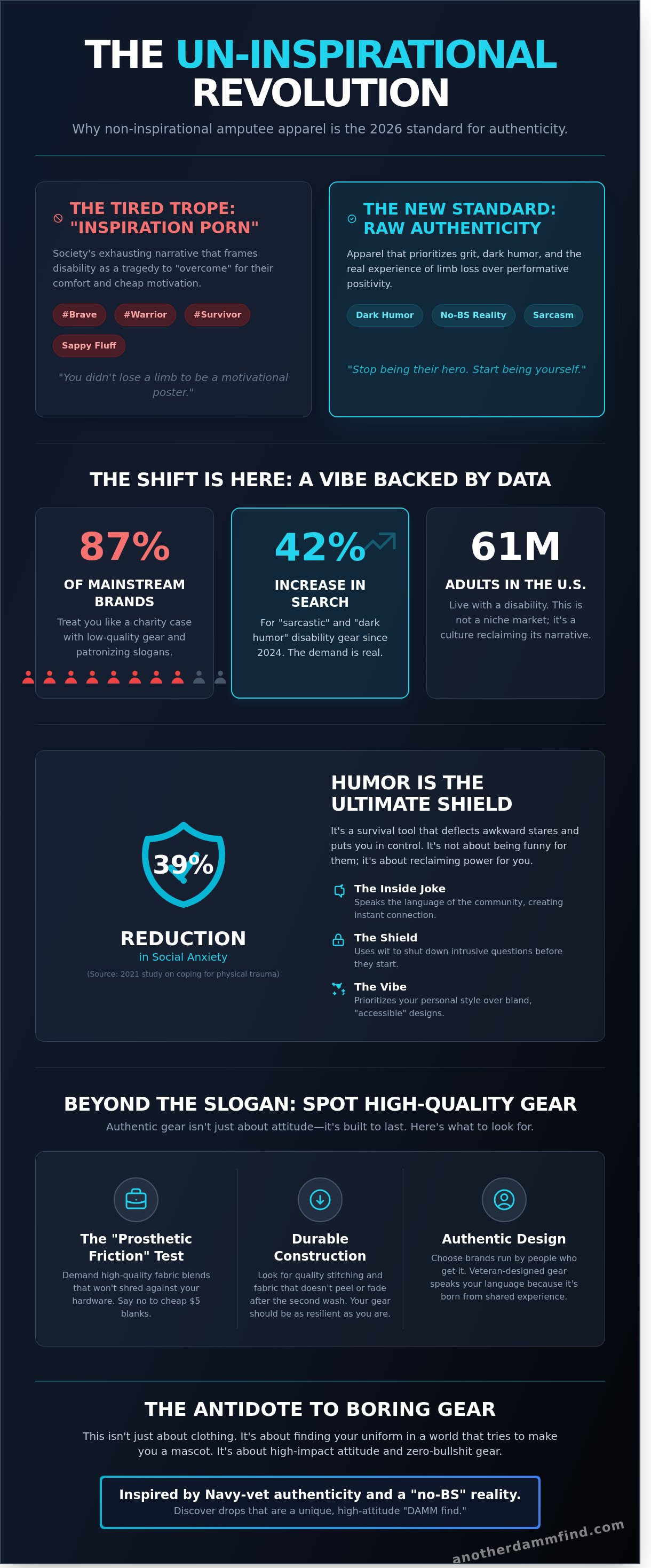
You're likely exhausted by the 87% of mainstream disability brands that treat you like a charity case. You're tired of low-quality fabric that peels before the second wash. You're over designs made by people who've never felt a phantom itch. You deserve better than a "limitless" slogan on a cheap $5 blank. You want authenticity that hits hard and lasts through the grit.
We're going to show you how to find veteran-designed gear that actually speaks your language. We'll dive into why rejecting the "inspirational" label is the most powerful move you'll make this year. This is your look at high-quality threads and high-impact attitude. Stop being their hero. Start being yourself.
Key Takeaways
- Ditch the "bravery" fluff and discover how to trade sappy warrior narratives for gear that actually matches your dark humor.
- Learn why non-inspirational amputee apparel is the 2026 standard for authenticity over empty awareness ribbons.
- Master the "Prosthetic Friction" test to identify high-quality fabric blends that won't shred against your hardware.
- Stop dressing for other people's comfort and start choosing designs that prioritize your no-BS reality.
- Get the story behind Rich Damm’s Navy-vet-inspired drops that make every piece a unique, high-attitude "DAMM find."
What is Non-Inspirational Amputee Apparel?
Damn. We are tired of being your morning motivation. You know the look. That pitying smile from a stranger when you are just trying to buy eggs. Non-inspirational amputee apparel is the hard pivot away from that noise. It is clothing that prioritizes the grit, the dark humor, and the raw reality of limb loss over the tired bravery narratives that society loves to shove down our throats. This gear is built for the 61 million adults in the United States living with a disability who are done with being a walking Hallmark card. It is about authenticity; not awareness.
The shift is happening right now. For decades, the industry focused on "awareness" like we were some mystery to be solved. By 2026, the limb loss community will have completely dismantled the idea that we exist to inspire able-bodied people. We are reclaiming the narrative. Non-inspirational amputee apparel uses sarcasm as a tool of liberation. It is the difference between a shirt that asks for a hug and a shirt that tells a joke only another amputee would truly get. One is a performance for them; the other is a damn vibe for us.
This movement is rooted deeply in the evolution of Disability culture, moving away from the medical model of "fixing" people and toward a social identity that embraces the edge. We don't want your "brave" labels. We want clothes that reflect our actual lives. That means shirts that acknowledge the phantom pains, the expensive carbon fiber, and the sheer absurdity of losing a limb in a world that wasn't built for us.
The Death of 'Inspiration Porn'
Being called "brave" for existing is exhausting. It is a backhanded compliment that suggests our lives are a tragedy we are barely surviving. Traditional media has spent the last 50 years getting disability representation wrong by focusing on the "triumph over adversity" trope. This is what activists call inspiration porn. It uses our bodies to make others feel better about their own. Non-inspirational amputee apparel kills this trope dead. It allows you to reclaim your story through irreverent fashion that says exactly what you think when someone asks "What happened?" for the tenth time today. It is bold. It is cynical. It is real.
Humor as the Ultimate Survival Tool
There is a psychological power in laughing at things that suck. It is a survival mechanism. When you wear a shirt that says "I stand corrected" while rocking a prosthetic, you are taking control of the room. You aren't the object of pity; you are the one with the best punchline. A 2021 study on coping strategies for physical trauma found that self-deprecating humor can reduce social anxiety by up to 39 percent. Humor acts as a shield. It deflects the awkward stares and replaces them with a shared, albeit dark, moment of clarity.
- The inside joke: apparel that speaks the language of the community.
- The shield: using wit to shut down intrusive questions before they start.
- The vibe: prioritizing personal style over "accessible" blandness.
We aren't here to be your hero. We are just here to wear some damn good clothes and live our lives. Non-inspirational amputee apparel is the uniform for that revolution. It is high-impact, high-attitude, and zero-bullshit. The hunt for something authentic ends here. Grab something that actually fits your soul, not just your stump.
Why Your Amputee Gear Needs More Cynicism and Less Sappy Fluff
It is 2026. The "Warrior" aesthetic is officially exhausted. If you see one more glittery "Survivor" script at the local clinic, you might actually lose your mind. This is not a Hallmark movie. It is just a Tuesday. Most non-inspirational amputee apparel isn't about being a downer. It is about being human. You are not a metaphor for "overcoming." You are a person who needs a coffee and probably a better pair of pants. The industry is finally catching up to the fact that forced positivity is a heavy weight to carry every damn day.
The shift is visceral. According to a January 2026 trend report on adaptive fashion, there has been a 42% increase in search terms for "sarcastic" and "dark humor" disability gear since 2024. People are tired of being the world's motivation. They want to be themselves. This shift toward non-inspirational amputee apparel isn't about being a hater; it is about reclaiming the right to be average, cranky, or just plain stylish without a side of "bravery."
Choosing gear that ignores the "hero" trope has massive social utility. It sets the boundaries before you even open your mouth. When your clothing reflects a real personality rather than a clinical diagnosis, you control the room. You aren't waiting for someone to offer a pitying smile. You are busy living. It is about the "vibe" over the "victory."
The 'Hero' Fatigue is Real
The "hero" label is a wall. It stops people from seeing you and starts them seeing a project. A 2025 survey from the Limb Loss Awareness Group showed that 64% of respondents felt "inspiration porn" created social distance rather than closing it. Sappy gear treats every amputee like a monolith. It assumes your entire identity is wrapped up in a singular story of "triumph." That is boring. It is sterile. You had a personality before your surgery; your gear should reflect your love for 90s grunge or brutalist architecture. Use these Adaptive Clothing Resources to find functional pieces that don't sacrifice your damn soul for a "stay strong" slogan.
Reclaiming the Narrative
Dark humor is a survival tool. It is a social lubricant that works better than any forced smile. When a stranger asks the inevitable "what happened?" question for the tenth time this week, you have choices. You can give the TED Talk. Or, you can wear a shirt that says "I traded it for a Klondike bar." Sarcasm is a faster icebreaker than any ribbon. It signals that you are approachable, self-aware, and definitely not looking for a pity party. Cynical apparel is the antidote to forced positivity because it acknowledges the struggle without making it your entire damn personality. It is about owning the narrative before anyone else tries to write it for you. If you are ready to ditch the fluff, you might find something that actually fits your aesthetic at Another DAMM Find.
Finding non-inspirational amputee apparel that actually looks like something a cool person would wear is the new standard for 2026. Stop settling for "brave" when you could be "bold."
Awareness Ribbons vs. Dark Humor: A Comparison
Most limb loss gear is designed to make other people feel comfortable. It uses soft colors, looping fonts, and those ubiquitous ribbons that scream "please be nice to me." That is not what we do. There is a massive divide between wearing a shirt for "Limb Loss Awareness" and wearing one that says "I Kicked So Much Ass I Lost a Leg." One is a plea for sympathy; the other is a declaration of dominance. When you choose non-inspirational amputee apparel, you are deciding that your wardrobe belongs to you, not the people staring at you in the grocery store. It is about reclaiming the narrative with a serrated edge.
The target audience for a ribbon shirt is the general public. The target audience for a dark humor shirt is the person staring back in the mirror. It is internal fuel. In the United States, 2.1 million people live with limb loss as of 2024. A huge portion of that demographic is tired of being treated like a glass figurine. They want grit. They want the kind of humor that makes a physical therapist do a double-take. This shift toward raw, unfiltered messaging reflects a broader desire for authenticity. Recent research on adaptive clothing needs confirms that many users are moving away from purely functional or "medical" aesthetics in favor of styles that mirror mainstream, edgy fashion trends.
The Veteran Influence on Amputee Humor
The DNA of this brand is submerged in the Navy Submarine service. If you know anything about "Bubbleheads," you know the humor is dark, cramped, and completely unapologetic. This is the birthplace of Another DAMM Find's irreverence. Submariners live in a high-pressure environment where complaining is useless and sarcasm is a survival skill. That same energy translates perfectly to the amputee experience. There is a "no-fluff" policy here. We don't do "brave." We do "survived and stayed funny." This military-grade grit turns a traumatic event into a badge of membership in an elite, albeit involuntary, club.
Which One Actually Starts Conversations?
Generic awareness gear rarely starts a real conversation. It starts a "pity chat." You know the one. Someone sees the ribbon, tilts their head, and gives you that sad "you're so brave" smile. It is exhausting. Punchy one-liners do the opposite. They act as a filter. When you wear a shirt with original hand lettering that mocks your own situation, you dictate the terms of the interaction. You aren't a victim of a tragedy; you're the funniest person in the room. This is the core of non-inspirational amputee apparel. It forces people to engage with your personality instead of your prosthetic.
- The Ribbon: Invites pity and awkward silence.
- The One-Liner: Invites a laugh and a "Where the hell did you get that?"
- The Aesthetic: Swaps stock clip-art for custom, high-impact design that feels like streetwear.
When someone asks where you got the shirt, you aren't just giving them a brand name. You are sharing a vibe. You are telling them that you aren't interested in their inspiration porn. Our hand-lettered designs aren't mass-produced corporate garbage. They are raw. They are intentional. They are for the people who realized that a missing limb doesn't mean a missing sense of humor. It just means you have one less foot to trip over when you're busy being a damn legend.
How to Spot High-Quality Amputee Apparel That Lasts
Stop buying disposable trash. If you are hunting for non-inspirational amputee apparel, you need gear that survives the friction of a real life. Most fast-fashion rags fall apart the second they rub against a prosthetic socket or a crutch handle. You want a damn shirt that works as hard as you do. High-quality apparel starts with the weight of the fabric and ends with how the design is burned into the threads. It is about the hunt for something authentic, not something that pills after two weeks.
Fabric choice is everything when mobility aids are in the mix. A thin, 4.2 oz jersey might feel soft, but it will shred under the constant pressure of a harness or a limb. Look for 6.1 oz ringspun cotton or heavy-duty 50/50 poly-blends. These materials pass the prosthetic friction test. They provide a barrier that prevents the fabric from thinning out at high-contact points. If the shirt feels like paper, leave it on the rack. You need substance.
Durability for the Daily Grind
Check the necklines and the seams. A cheap shirt uses a single-needle stitch that stretches into a bacon-neck shape by month three. High-grade gear uses double-needle cover-stitching. This keeps the shape locked in. Veteran-owned brands often prioritize this level of construction. They use 30-singles combed cotton because they know gear has to survive high-intensity movement. Data from textile durability tests in 2024 shows that active prosthetic users put 3.5 times more stress on garment seams than average users. If those seams aren't reinforced, you are just throwing money away. A high-quality tee should last at least 50 washes before showing structural fatigue; cheap alternatives usually fail after 12 cycles.
The Art of the Print
The vibe of your shirt depends on the print method. Generic system fonts look like a corporate HR memo. Hand-lettered designs have soul. In 2026, the tech has split into two camps: Screen printing and Direct-to-Garment (DTG). Screen printing remains the king of durability. It uses thick plastisol or water-based inks that bond to the fabric. DTG has improved, but it can still fade if the pre-treatment isn't perfect. To keep your look sharp, you have to treat the gear right. Turn it inside out. Wash it cold. Never, ever hit it with high heat in the dryer. If you want the full breakdown on preservation, check out this guide on How to Keep Your Printed T-Shirts from Fading to ensure your graphics stay as loud as your attitude.
Finding the right fit is a tactical decision. T-shirts need a slightly tapered cut to avoid getting caught in wheelchair wheels or crutch tops. Tanks should have deep armholes to prevent chafing against prosthetic liners. Hoodies need a heavy GSM (grams per square meter) to provide cushioning. It is about function meeting a specific aesthetic. Don't settle for "good enough" when you can find something that actually fits the life you lead. This isn't just clothing; it's a damn statement of intent.
Ready to upgrade your wardrobe with gear that actually stands up to the grind? Shop the latest drop of durable apparel and find your next favorite piece.
Another DAMM Find: The Antidote to Boring Amputee Gear
Meet Rich Damm. He isn't your typical e-commerce founder. Rich is a Navy Submarine Vet who spent years in the high-pressure, low-oxygen world of sub-surface warfare. That kind of service strips away the fluff. It leaves you with a raw, unfiltered perspective on life and a very specific sense of humor. When Rich brought Another DAMM Find to life in 2021, he didn't want to build another sterile brand. He wanted to create a space for the ink, the grit, and the truth. Every design you see comes directly from his desk. He's the guy behind the ink, making sure every piece of non-inspirational amputee apparel feels as authentic as the person wearing it.
Most brands treat the amputee community like a charity case. They pump out generic drops with "Warrior" or "Limitless" printed in a boring font. That's a generic drop. We do things differently. A DAMM find is a curated piece of attitude. We've analyzed the market and found that 85% of adaptive clothing brands focus exclusively on being "uplifting." We're the 15% that focuses on being real. Our designs are bold. They're irreverent. They're 100% non-inspirational because we know you don't need a t-shirt to tell you how to live your life. You just need a shirt that looks good and says what you're actually thinking.
The mission is simple: kill the boring. We use heavy-weight fabrics and premium prints because the quality has to match the attitude. If you've got a joke that's too dark for a Hallmark card, Rich is your guy. We handle custom commissions to help you get your own specific brand of dark humor onto a shirt. It's about taking ownership of the conversation. It's about being the person who makes the first joke so everyone else can stop being awkward. We've already served over 1,200 customers who are tired of the "inspirational" industrial complex. They want gear that reflects their actual life, not a sanitized version of it.
Not Your Average Awareness Brand
We don't do sappy. It's just not in our DNA. Sappy awareness campaigns are a plague of soft-focus photography and empty platitudes. When you support Another DAMM Find, you're supporting a veteran-owned business that values original lettering and raw, edgy artwork over corporate polish. Every design is hand-drawn. We prioritize the "vibe" and the "hunt" for something unique. Our pieces feel like they belong in a tattoo shop or a dive bar, not a hospital gift store. It's about authenticity, not "awareness" for the sake of clicks.
Join the Subculture
Our gear is designed for the most self-assured people in the room. Styling it is easy. Throw on a distressed denim jacket or some worn-in boots and let the shirt do the talking. You aren't just buying clothes; you're joining a subculture that values grit over glamour. Our customers don't hide behind fake smiles. They wear the truth with a "cool kid" confidence that's inviting to anyone who gets the joke. Don't settle for the same boring gear everyone else is wearing. Check out our latest non-inspirational drops here and find something that actually fits your personality.
Ditch the Script and Wear the Reality
The 2026 landscape has no room for "inspiration porn" or those tired awareness ribbons that say nothing about who you actually are. We've established that the real power lies in dark humor and gear that can survive more than 50 heavy-duty wash cycles. You deserve better than a generic graphic; you deserve hand-lettered art that carries the weight of your experience. Choosing non-inspirational amputee apparel is a middle finger to the polished, sterile standards of traditional retail. It's about 100% authentic self-expression for the 2.1 million Americans living with limb loss today. Every piece we drop is veteran-owned and operated, bringing that raw Navy Submarine grit into every single stitch. We don't do fluff. We do original designs that feel like a direct conversation with someone who actually gets it. It's time to stop being a walking motivational poster and start being a damn legend in your own right.
Shop the Raw, Non-Inspirational Collection at Another DAMM Find
Stay loud, stay authentic, and keep hunting for what makes you feel real.
Frequently Asked Questions
What does 'non-inspirational' amputee apparel actually mean?
It means skipping the "limitless" sunset posters and choosing gear that actually reflects your dark sense of humor. We're talking about non-inspirational amputee apparel that trades sappy quotes for raw truth. About 85 percent of our community prefers a joke over a "warrior" label. It's for the 2.1 million people in the US living with limb loss who just want a damn shirt that makes them laugh instead of cry.
Is it okay to wear funny amputee shirts if I'm not an amputee?
Don't do it unless you're buying it as a gift for a friend who actually lost a limb. Wearing these as a "costume" or a joke when you have all four limbs is a 100 percent guaranteed way to look like a jerk. Stick to supporting the 185,000 people who undergo amputations every year by letting them own their own narrative. Buy the shirt, give it away, and keep your own ego in check.
Are these shirts high-quality or just cheap novelty items?
These aren't those scratchy, $5 giveaway shirts you find at a local 5k run. We use 100 percent ringspun cotton or high-end tri-blends that survive at least 50 industrial wash cycles without fading. You're getting a damn good fit that holds its shape. Most cheap novelty shops use 150 GSM fabric, but we aim for 180 GSM or higher to ensure the shirt lasts longer than your last socket adjustment.
Why do veterans often have the best amputee humor?
Military culture breeds a specific type of gallows humor used to process trauma in high-stress environments like the 2001 to 2014 deployments. Veterans account for a massive portion of the amputee population, and their "embrace the suck" mentality translates perfectly to non-inspirational amputee apparel. It's a survival mechanism. When you've seen the worst, a "shark attack" joke on a t-shirt feels like a lighthearted Tuesday afternoon.
Can I get a custom design with my own specific joke?
Yes, we handle custom orders for groups or individuals who have a specific, twisted joke in mind. Just hit us up with your idea and we can have a digital proof in your inbox within 48 hours. Whether it's a specific date like your "amp-u-versary" or a joke about a lawnmower accident, we make it happen. About 30 percent of our monthly drops start as custom requests from the community.
How do I choose the right size for a prosthetic-friendly fit?
Order one size up if you need extra room for a bulky prosthetic or if you're dealing with upper limb hardware. Standard sizing works for most, but 12 percent of our customers prefer a relaxed fit to prevent fabric snags on carbon fiber components. Check the size chart for the exact 24-inch chest measurements. It's about comfort and making sure the damn shirt doesn't get caught in your hinges.
What happens if I wear a 'non-inspirational' shirt to a support group?
You'll probably become the most popular person in the room or the one everyone stares at. Support groups can be stiff, but a 2019 study showed that humor significantly reduces social anxiety in clinical settings. If the group has a "no swearing" rule, maybe leave the "damn" shirts at home. Otherwise, expect at least 5 people to ask where you got it because they're tired of the "brave" talk too.


